

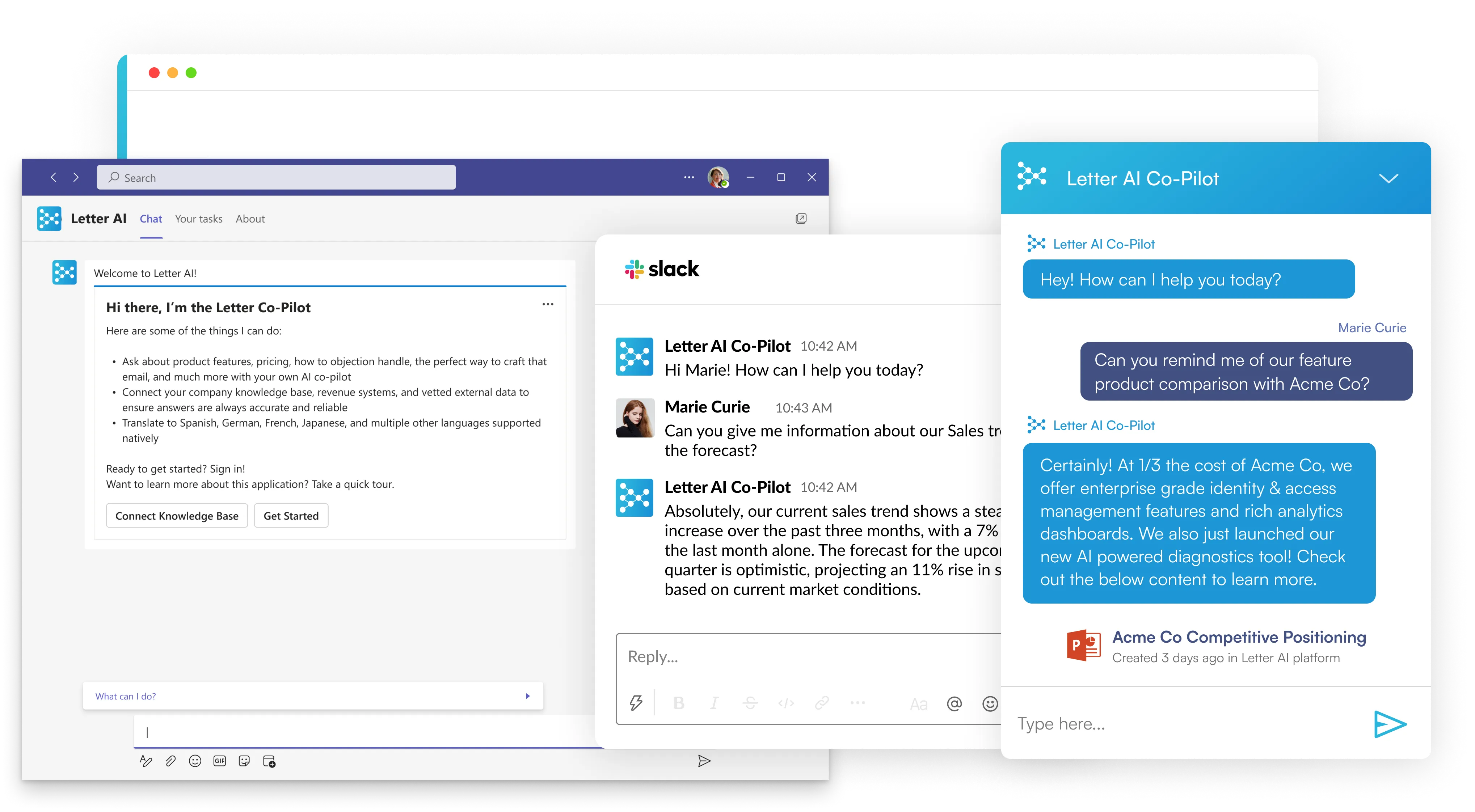
Image source: Letter AI official product page. The image shows AI Co-Pilot in Teams, Slack, and an embedded chat surface inside a multi-channel sales workflow.
Sales AI should not stop at writing emails. The more valuable move is entering the deal room.
Letter AI is worth studying because the sales AI category is already packed. Some tools write emails. Others make calls, summarize meetings, generate follow-ups, or analyze conversations. All of that sounds like sales efficiency, but much of it can be absorbed by CRM, Gong, Salesforce, HubSpot, Seismic, Highspot, or other large platforms.
Letter AI reframes the problem. The seller does not only need another AI that can write. The seller needs accurate, company-approved answers during customer conversations, internal Q&A, RFP work, training, and buyer collaboration.
That is the commercial entry point.
Three Signals First
The first signal is funding. Business Insider reported that Letter AI raised a $40 million Series B in February 2026, only four months after a $10.6 million Series A.
The second signal is customer reach. The same report said Letter AI had customers in 30 countries, including Lenovo, Adobe, Novo Nordisk, and Plaid.
The third signal is customer impact. Letter AI’s Lenovo case study says its AI Sales Rooms supported more than $400 million in TCV and reduced time spent finding accurate answers by more than 90 percent. Those figures come from an official customer case study, not an independent audit.
Together, the signals show why this is not just another sales assistant story. It is a case about turning sales knowledge, enablement, RFPs, and buyer collaboration into a purchasable operating layer.
It Is Not a Sales Assistant. It Is a Revenue Enablement Control Layer.
Letter AI describes itself as revenue enablement powered natively by AI. That phrase is easy to read as marketing language, but the product shape is specific.
Traditional sales enablement sits across several budget categories:
- content management: sales decks, product sheets, competitive notes, pricing explanations
- training and coaching: onboarding, role play, pitch practice, certifications
- buyer interaction: sales rooms, demos, next-step pages, shared materials
- RFP and proposal work: reading requirements, finding approved answers, drafting responses
- internal Q&A: product, pricing, compliance, delivery, and competitor questions
Letter AI’s move is to pull those scattered workflows into an AI-native platform. Its public product navigation includes Letter Compass, AI-Powered Training & Coaching, Content Management, Letter AI Agent, and Deal Pursuit.
That means it is not simply placing a chat box next to the sales process. It is embedding AI into workflows that revenue organizations already buy.
For builders, the distinction matters. “Help a seller write an email” is an action. “Help a global sales organization answer correctly in every customer moment” is a budget item.
The Lenovo Case Shows What It Is Selling
Letter AI’s Lenovo case study is useful because it shows the product in an enterprise context.
Lenovo’s Digital Workplace Solutions team needed to bring a complex solution to a global sales team. The problem was not just writing a few sales materials. The larger question was whether global sellers could understand the solution, practice it, answer customer questions, and give buyers a professional experience.
Letter AI describes several product motions in that case.
Training Becomes Interactive Practice
The official case study says Lenovo’s enablement team could create multilingual training in hours, where the process previously took weeks or months. It also describes AI roleplay for pitch practice.
That is an official claim and should be treated carefully. But as a product signal, it shows what Letter AI is compressing.
The product is not merely reducing the time required to write training copy. It is shortening the distance between product knowledge and a seller who can use that knowledge in front of a buyer.
Many AI products optimize the production of materials without improving whether those materials are actually used. Letter AI packages content, Q&A, and roleplay together to increase absorption inside the sales organization.
RFP Work Becomes Knowledge Retrieval
The Lenovo case also says users can upload multiple RFP files, let Letter AI generate question responses, customize a cover letter and executive summary, and send the output to a bid manager.
That sounds like document automation, but the more important phrase is “Golden Responses repository.”
RFP questions repeat. Enterprises do not want AI to rewrite every answer from scratch in inconsistent, unreviewable ways. They want approved answers that can be reused, updated, and traced.
That is a critical B2B AI lesson: one-off generation is cheap. Reusable, governable, accountable generation is where the value begins.
The Buyer Room Becomes an AI Interface
Letter AI’s Deal Pursuit page emphasizes RFP automation and AI Sales Room. In the Lenovo case, the company says AI Sales Rooms supported more than $400 million in TCV and provided personalized buyer experiences for large deals.
Again, those are official case-study figures. They should not be treated as independently verified ROI.
The direction, however, is important. Traditional sales rooms are shared spaces where sellers place decks, videos, pricing notes, and follow-up materials. An AI Sales Room tries to become a buyer-side question-answering surface. Buyers can explore their own questions instead of waiting for another seller response.
If this works, sales software value no longer lives only inside the seller’s internal workflow. It moves into the buyer’s decision environment.
Why This Can Raise Money in a Crowded Category
Business Insider reported that Letter AI raised $40 million in Series B funding four months after a $10.6 million Series A, and that the company was roughly 25 people at the time with customers in 30 countries.
That signal suggests two things.
First, the sales AI category may be crowded, but enterprises still pay for products that enter core revenue workflows.
Second, investors and customers are not only looking for faster writing. They are looking for products that can replace or merge older budget pools.
Letter AI sits near several existing budgets: sales enablement, training, content management, sales knowledge bases, customer rooms, RFP tooling, and internal Q&A systems. If it can combine even a few of those, it does not have to fight large platforms on one small feature alone.
The broader commercialization lesson is familiar but often ignored. Do not only ask whether a user will pay for an AI feature. Ask whether the AI product can repackage a budget that already exists.
Where the Moat Might Be
Letter AI does not publish standard self-serve pricing. The product motion appears demo-led and enterprise-oriented.
That is not surprising. The product is not selling individual productivity. It is selling organizational consistency.
Once an enterprise stores product materials, competitive messaging, training content, RFP approved answers, buyer room templates, and sales Q&A in the system, the switching cost becomes deeper. The lock-in is not only accounts or raw data. It is the way the sales organization expresses itself.
This is a useful test for AI builders.
If your product helps a customer generate content every day but that content does not become an organizational asset, the product is easier to replace.
If every use enriches the customer’s knowledge base, standard processes, review system, and business context, the product has a better chance of moving from tool to system.
What Builders Can Copy
Move From Action Automation to Workflow Ownership
Writing a sales email is an action. Managing sales knowledge, training, buyer rooms, and RFP work is workflow ownership.
When choosing a product direction, ask less often whether an action can be automated. Ask whether the upstream and downstream work around that action is fragmented enough to become a new workspace.
Explain the New Product Through Old Budgets
Letter AI is not creating budget from nothing. It stands on old budgets: sales enablement, training, content management, customer collaboration, and bid support.
That matters for commercialization. A product with no budget home has to educate the buyer from scratch. A product that combines several old tools into a higher-level workflow can enter procurement with a clearer story.
Separate Evidence Layers
The Lenovo case is instructive, but its 2,000-plus sessions, $400 million-plus TCV, and 90 percent-plus reduction in answer-finding time are official case-study metrics. The Business Insider funding and customer reporting is a stronger third-party signal. The official metrics are better used as product-use clues, not as certain ROI proof.
This distinction matters when writing case studies, fundraising narratives, and sales material. Strong AI product analysis separates third-party facts, company claims, and interpretation.
Recut a Crowded Market by Changing the Entry Point
Sales AI is crowded. Letter AI’s angle is not “let the AI speak for the seller.” It is “help the seller say the right thing in any sales moment.”
That is the value of a new entry point. In the same large category, feature layers may be crowded while workflow and organization layers still have room.
Many AI products do not need to become more magical. They need to move closer to budget, permissions, and accountability.
The Bottom Line
Letter AI’s lesson is not simply that sales AI still has room.
The sharper lesson is that enterprise AI products cannot live on single-point efficiency alone. They have to answer three questions:
- Who is responsible for the result?
- Which old budget will this replace or combine?
- Does every use create an organizational asset?
Letter AI’s answer is to turn sales content, training, customer Q&A, RFP work, and buyer rooms into a revenue enablement control layer.
That is the part many AI builders should study. Do not only build an AI that can do work. Build a system that helps the organization do the work correctly, repeatedly, and with memory.