

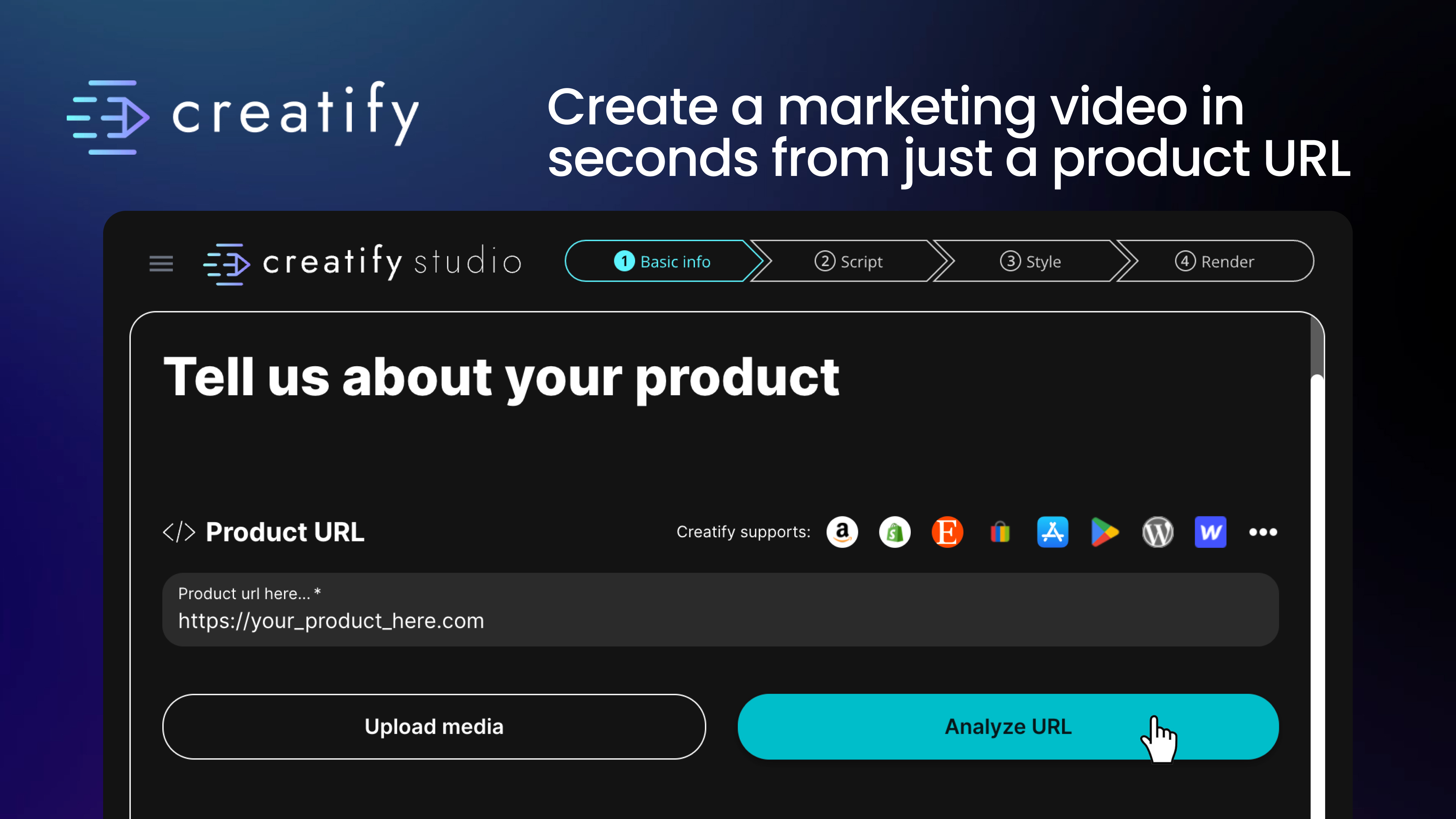
Image source: public TikTok App Center product screenshot. The image explains the Creatify Studio workflow from product URL to script, style, and render.
AI ad tools are not really selling videos. They are selling a variable factory.
Creatify is worth studying because the AI video ad market is already crowded. Many products can generate avatars, scripts, product shots, and short videos. If the only question is whether a tool can produce a video, Creatify is not the rarest product in the category.
The useful lesson is that Creatify does not position itself as a more impressive AI video editor. It pulls out the real pain in paid growth: teams do not need one beautiful video. They need many fast, cheap, testable creative variants.
That is the line between a generic AI video tool and a commercial advertising workflow.
Three Signals First
The first signal is funding. Public sources describe Creatify as founded in 2023 and as having raised a $15.5 million Series A in 2025, with roughly $23 million in total funding.
The second signal is positioning. The company calls itself an AI ad generator, and the central starting point is not “write a prompt.” It is “enter a product URL.”
The third signal is operating scale. The company’s own site says it supports more than 18,000 brands and agencies, has analyzed more than 30 million ads, created more than 15 million ads, and touched more than $1 billion in ad spend. Those are official claims, not independently audited facts.
Together, the signals make the case clear. Creatify is not selling the magic of a single generated clip. It is selling the ability to create, compare, and refresh ad creative at the speed paid acquisition demands.
The First Product Move: Give Me a Product URL
The TikTok App Center screenshot for Creatify Studio shows a simple workflow: Basic info, Script, Style, Render. The user’s first action is not opening an editing timeline or writing a complex prompt. It is entering a product URL and letting the system analyze it.
That entry point matters.
For ecommerce brands, apps, games, and DTC companies, the product page already contains the raw material: benefits, images, pricing, user scenarios, and calls to action. Creatify reorganizes those existing assets into ad material instead of asking the user to start from a blank canvas.
This reduces two kinds of friction.
First, non-specialists can begin. The user does not need to understand camera language, script structure, or editing rhythm. They only need to know what they are selling.
Second, growth teams can put the tool into their existing testing routine. One day the input is a different product page. The next day it is a new benefit. Later it may be a new audience angle, voice, avatar, or platform format.
Many AI tools fail because the first action is too heavy. Asking the user to “think of a good prompt” quietly returns the hard work to the user. Creatify’s first action feels closer to what growth teams already do: paste a link, choose a format, and inspect the result.
Productization Is Not Generation. It Is Batch Testing.
Creatify’s public product surface includes URL to Video, AI Avatar, Batch Mode, AI Script Writer, Ad Intelligence, and Ad Launcher. Individually, none of those modules is mysterious. Together, they point to a sharper product idea: break advertising creative into variables.
An ad can vary by:
- the first three-second hook
- narrative angle
- product benefit
- avatar or spokesperson
- language and accent
- aspect ratio
- platform style
- call to action
Traditional teams need writers, actors, editors, media buyers, and analysts to test these variables. The process is slow, expensive, and hard to systematize.
Creatify’s commercial opportunity sits here. It is not promising to generate the single best ad. It is making it cheaper to generate many versions and then letting performance data decide.
That is much closer to how advertising budgets are actually spent. Advertisers do not pay only for creative as an artifact. They pay for lower CPA, faster experimentation, and a steadier supply of usable assets. When an AI product enters that chain, the budget ceiling is no longer a small creator-tool subscription. It can move closer to the production and media-testing budget.
The Pricing Reinforces the Same Logic
Creatify’s pricing page presents Free, Pro, and Enterprise tiers. The free plan includes 10 monthly credits, described as enough for roughly two video ads or 20 image ads. The Pro tier shows 300 credits per month. Enterprise emphasizes more credits, AI ad performance guidance, and enterprise security and privacy.
This is not simply feature gating. It prices around usage intensity and team maturity.
New users can try the free credits and see whether URL-to-ad output is useful. Growth teams that test frequently move toward more credits, templates, ad intelligence, and launch workflows. Agencies and larger brands care about security, batch production, APIs, white labeling, team management, and performance guidance.
Creatify is therefore leaning toward three budget types.
Small-Team Experiment Budgets
Free and entry-level usage let independent sellers, startup teams, app developers, and small brands test quickly. The goal at this stage is not to maximize revenue per user. It is to prove the immediate value of turning a product page into an ad.
Growth-Team Creative Budgets
Once a team is running paid acquisition regularly, creative supply becomes a repeated need. Old ads fatigue. Winning ads need variants. New channels need new cuts. The purchasing logic becomes: save time, reduce production cost, and increase testing density.
Enterprise and Agency Workflow Budgets
Larger customers do not buy only generation. They buy security, collaboration, brand asset control, review flows, platform connections, and performance learning. At this level, the model is the underlying capability. The product being sold is production order.
Why This Matters for AI Builders
AI video generation will keep getting cheaper, faster, and better. If a product only says “we can generate video,” it will be difficult to defend.
Creatify’s stronger move is placing model capability inside the full context of ad production. It is not just claiming that its videos look more real. It is saying:
Start From the Product Page
The user’s existing product information becomes the input. The user does not have to invent the entire campaign from scratch.
Output Toward Real Platforms
TikTok, Meta, YouTube, Snap, and AppLovin are not decorative channel names. They are where the ad material will eventually go.
Use Batch Variants to Match Media Buying Reality
Paid advertising does not trust isolated inspiration. It trusts continuous testing. AI is especially useful when it pushes the cost of that testing down.
Add Intelligence Before the Creative Decision
If a product only generates assets, the user still has to decide what to generate. Competitor ad tracking, ad insights, and performance guidance move the product from a production tool toward a growth decision system.
That pattern is useful beyond advertising. The better question is not “what can AI generate?” It is “which repeated experiment inside a budgeted workflow can AI compress?”
The Risks Are Also Clear
The first risk is platform absorption. Meta, TikTok, Google, and other ad platforms have strong incentives to build generation, launch, and optimization into their own systems. Creatify has to prove the value of being cross-platform, cross-asset, and team-oriented.
The second risk is model commoditization. Avatars, voiceovers, product shots, and editing will all become cheaper. The moat cannot rest only on output quality.
The third risk is evidence quality. Creatify’s site presents large numbers around analyzed ads, generated ads, customer savings, and ROI. Those are useful product and traction signals, but they are official claims. Builders can learn from the product packaging and commercialization path without treating every number as a directly transferable fact.
What Is Reusable
The lesson is not “build an AI video ad tool.” The reusable structure is:
Find a High-Frequency, Measurable, Budgeted Workflow
Advertising has budget and performance measurement built in. If an AI product improves speed or reduces cost, the purchasing case is easier to explain.
Turn User Input Into a Lightweight Action
A product URL is better than a blank prompt because it converts existing customer assets into AI input.
Make Outputs Variables, Not Masterpieces
Masterpieces are judged aesthetically. Variables are judged experimentally. For commercialization, the second framing connects more naturally to ROI.
Move From Tool to System
Scripts, assets, avatars, batch generation, ad intelligence, platform launch, and enterprise controls create a stronger reason for higher account value when they are packaged together.
Creatify’s reminder to builders is direct: if the product stops at “generate one result,” cheaper models and platform features will catch up.
The stronger question is whether you can compress a repeated industry trial-and-error process into a paid machine.
In advertising, that machine is a creative variable factory. In another market, it might be a sales-script factory, compliance-evidence factory, support-process factory, document-extraction factory, or any other production system that turns AI output into business results.