

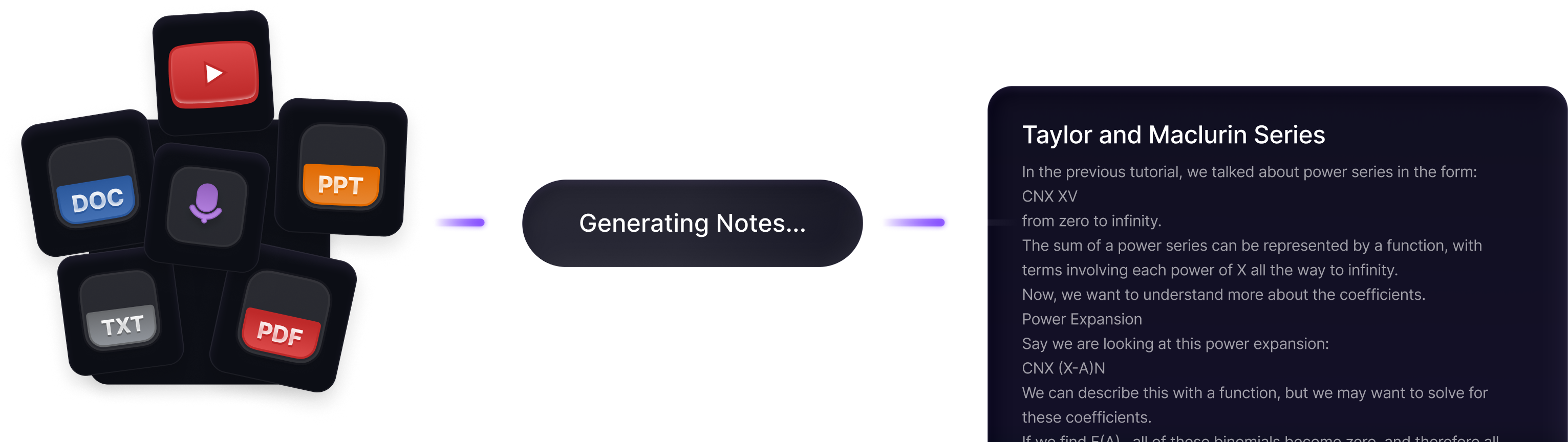
Image source: Turbo AI official product media. The image explains the product workflow and is not third-party growth evidence.
AI study tools do not really sell notes. They sell the review loop.
Turbo AI is useful as a case study because it does not stop at “summarize my class.” It turns learning into a repeatable sequence: input material, organize notes, create flashcards, test recall, collaborate, and return to the material again.
That loop is more important than the 5 million user headline. It shows how a consumer AI product can avoid competing directly with a general assistant by owning a high-frequency behavior with a clear outcome.
Three Signals First
The first signal is growth. Business Insider reported that Turbo AI grew from 1 million to 5.7 million users in six months and was adding about 20,000 users per day.
The second signal is monetization. The same report said the subscription cost $20 per month or $120 per year, that the company was profitable, and that expected annualized revenue had reached eight figures.
The third signal is product shape. Turbo AI’s homepage does not only promise AI notes. It shows PDFs, videos, audio, and class recordings turning into notes, flashcards, quizzes, podcasts, and collaborative study materials.
The case is not “students like AI.” The case is that students repeatedly need to convert messy course materials into something they can actually study.
It Is Not Selling Smarter Notes
Turbo AI’s entry point is simple. A student can record a lecture, upload a PDF, paste a YouTube video, or add an audio file.
The homepage describes the product as turning anything into notes, flashcards, quizzes, and more. Its student page shows a fuller chain: upload material, generate editable notes, create flashcards and quizzes, make podcasts, and share or collaborate with classmates.
That differs from a generic AI summary tool. A summary gives the user something to read. A study loop gives the user something to do next.
Students do not ultimately need a beautiful summary. They need to remember material, find gaps, practice retrieval, and prepare for exams. Turbo AI packages those next steps into the product.
That is the core productization move.
Why Consumer Growth Can Work Here
Business Insider reported that Turbo AI grew from 1 million to 5.7 million users over six months, added about 20,000 users per day, had a 15-person team, was profitable, and had raised only slightly more than $750,000.
Those details matter because they suggest a capital-efficient growth path. The story is not only that users arrived. It is that the product found a distribution channel that matched the behavior.
The article describes early campus tactics such as handing out cookies and putting up posters, followed by TikTok amplification, including one video with about 20 million views. That makes sense for a study tool. A product that helps a student prepare faster is easy to demonstrate, easy to copy from a friend, and easy to share before an exam.
Student markets are often dismissed as low willingness to pay. But they also have high social density. If one student finds a tool that makes ugly PDFs readable, transforms a recording into notes, or creates a quiz the night before an exam, the product can spread through dorms, classes, group chats, and short-form video.
The distribution message is practical: consumer AI growth is easier when the first value moment is visible in seconds and tied to an urgent task.
Why $20 Per Month Can Still Work
Turbo AI’s reported pricing is interesting: $20 per month or $120 per year.
The monthly plan sits near the ChatGPT Plus reference price. The annual plan lowers the effective cost to about $10 per month, which is more plausible for a student who wants a recurring study tool.
The product also has a free tier. Users can try the core workflow before upgrading for more capacity or advanced capabilities. That is familiar freemium design, but the important point is what the upgrade is selling. It is not simply “more tokens.” It is less study friction.
There are three pieces of value.
First, Turbo AI makes material readable. Students do not start with clean data. They start with lecture slides, rough recordings, videos, scanned PDFs, handouts, and last-minute files. Turning that mess into organized notes is already valuable.
Second, it makes review measurable. Flashcards and quizzes tell the student whether they actually remember the content. That turns AI output from passive reading into a feedback system.
Third, it makes study material shareable. The product emphasizes real-time collaboration, shared notes, comments, and cross-device access. Learning is social, especially in school. A single user’s study asset can become a class or group resource.
That is why the product can be more than a one-time conversion tool. It can become a place where students keep coming back before tests, assignments, and study sessions.
How to Read the Official Numbers
Turbo AI’s official blog announced 5 million users in October 2025 and cited company-published metrics such as more than 15 million notes, 350 million flashcards, and 20 million quiz answers. The homepage also shows official numbers such as 5M+ active students, 15M notes, and 30-second processing time.
These should be treated as official claims, not independent audits.
They still help explain the product. The flashcard and quiz numbers indicate that usage does not stop at a generated note. Users appear to move into follow-on study actions. That is the difference between a content generator and a habit-forming loop.
The strongest interpretation combines official usage metrics with third-party reporting on growth, pricing, profitability, team size, and funding efficiency. Turbo AI looks less like a demo and more like a consumer AI product with repeat behavior and a visible paid path.
Five Builder Lessons
The first lesson is to begin with a repeated pain point, not an AI capability. Turbo AI does not lead with model sophistication. It starts from a clear moment: a student has class material and needs to study from it soon.
The second lesson is to make the first value happen quickly. The product emphasizes fast processing and free starting points. For consumer AI, the first upload has to make the user feel immediate relief. Long-term vision does not matter if the first study asset is not useful.
The third lesson is that output format can be closer to a moat than model choice. A general chat assistant produces an answer. Turbo AI produces notes, flashcards, quizzes, podcasts, and collaborative documents. Each format maps to a different study action and tells the user what to do next.
The fourth lesson is that presentation is not decoration. Business Insider’s article notes the founder’s belief that presentation matters because students spend time making iPad notes look good. That is a sharp product insight. A study tool has to become part of a user’s real learning library. If the output is ugly, the student may not want to edit, save, share, or return to it.
The fifth lesson is that low fundraising can be a positive signal. Turbo AI reportedly raised only slightly more than $750,000 while reaching profitability and an eight-figure annualized revenue run rate. For builders, the lesson is not to avoid funding. The lesson is that a product with strong repeated usage and organic distribution can create business evidence before it raises a large round.
The Risks Are Clear Too
Student AI tools face obvious risks.
Academic integrity is the first. A product has to keep proving that it helps students learn rather than helping them cheat.
Recording permission and copyright are second. Uploading class recordings, textbooks, slides, or video material can create policy and rights issues. The product’s long-term trust depends on how it handles those boundaries.
Platform competition is third. General assistants, operating systems, learning management systems, and education platforms can absorb pieces of note generation. Turbo AI needs to keep its advantage in the full loop: review data, learning formats, collaboration, design quality, and campus network effects.
Seasonality is fourth. Student usage can spike around exams and fall during breaks. The company needs to turn a test-prep tool into a durable knowledge and review habit.
The Reusable Pattern
The point is not that every founder should build a student note product.
The reusable pattern is the sequence. Find a task the user repeats every week. Break it into input, organization, practice, feedback, and sharing. Put AI into each step, instead of stopping at the first generated output.
Many AI products are weak because they only answer the first request. Turbo AI is stronger because it gives the user a reason to return after the first answer.
Notes are the entry point. The review loop is the business.