

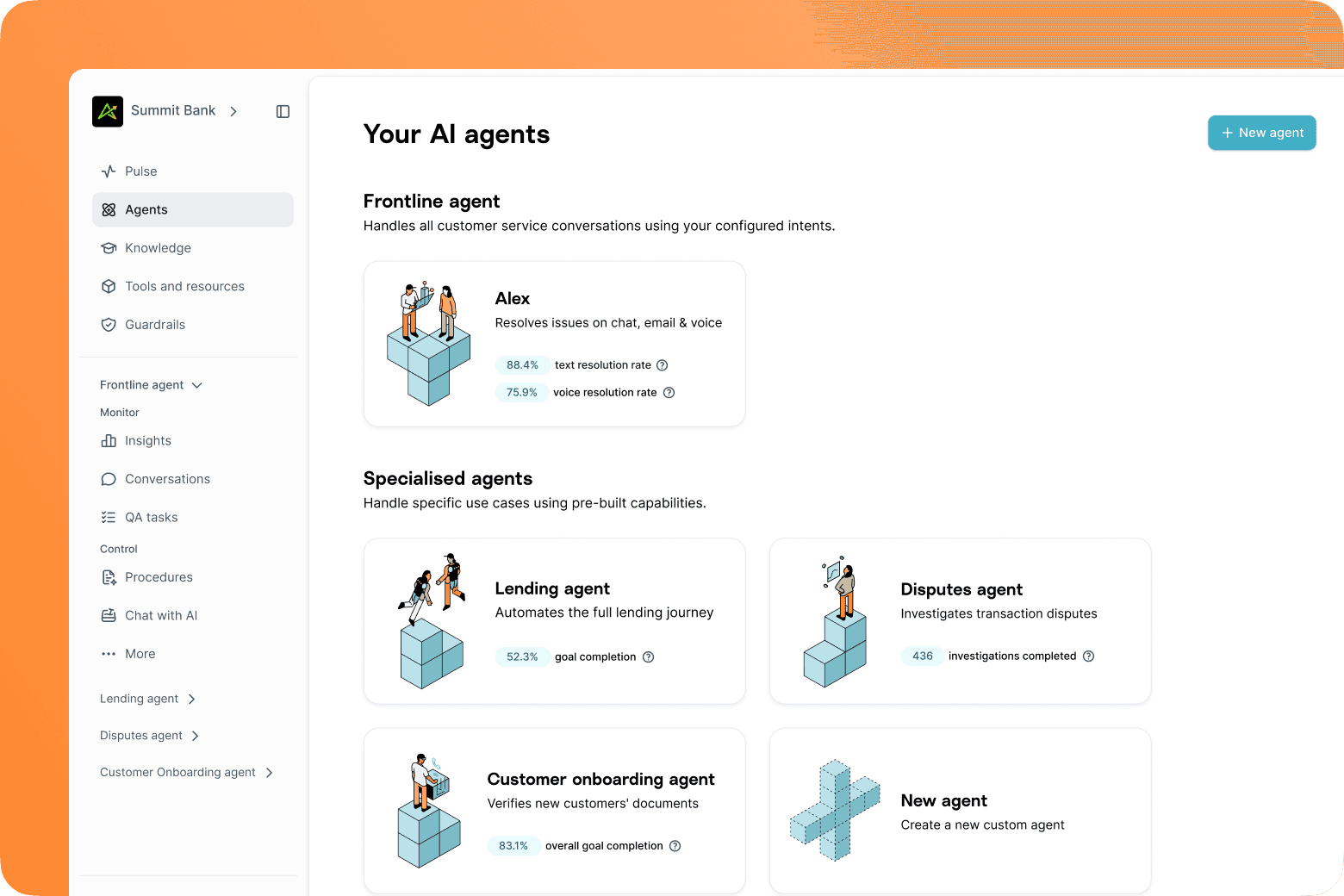
Image source: Gradient Labs official blog. The official product media explains the mechanism, not third-party performance proof.
Financial AI may make its first reliable money outside the chatbox.
Gradient Labs is worth studying because it does not treat customer support as a prettier conversation. It treats financial customer operations as a chain of work: identity checks, evidence collection, policy application, dispute handling, repayment planning, escalation, and audit records.
That distinction matters. Many AI support products still sell better answers. Gradient Labs sells a more operational promise: specialist agents for lending, disputes, KYC/KYB, collections, claims, and customer service that plug into the systems and rules financial institutions already use.
Three Signals First
The first signal is funding. Gradient Labs announced in June 2026 that its Series A had been extended to $26 million, led by Octopus Ventures and CommerzVentures.
The second signal is commercial momentum. The company says revenue grew 900 percent over the previous year and that its AI agents had reached 32 million end users. Those are company-published metrics and should not be read as independently audited results.
The third signal is pricing. Gradient Labs describes outcome-based pricing: no platform fee, with customers paying only for successfully resolved queries.
Together, those signals point to the real lesson. This is not a case about a chatbot becoming friendlier. It is a case about turning an expensive, regulated back-office workflow into something that can be bought, measured, and expanded.
Why the Back Office Matters More Than the Chat Window
Financial support looks like conversation on the surface. A customer reports a lost card, asks about a payment, disputes a transaction, misses a repayment, or submits documents for onboarding.
The expensive part begins after the message arrives. The company has to verify identity, check risk, inspect account history, collect evidence, apply rules, write records, decide whether a human must approve the action, and keep an audit trail.
That is not one answer. It is a cross-system, cross-policy workflow.
Gradient Labs positions itself as AI-native customer operations for financial services. Its public materials describe use cases such as dispute intake, claims, customer service, new customer onboarding, evidence gathering, and collections. The product surface is not one universal assistant. It is a set of finance-specific operating agents.
That is why the case is commercially interesting. The company picked a harder market than generic support, but it also picked a market with clearer budgets and sharper failure costs.
From General Agent to Job-Specific Agent
The most important product move is packaging.
Instead of asking a buyer to configure a generic AI agent from scratch, Gradient Labs presents agents around jobs. A lending agent can handle parts of the borrower lifecycle from missed payment to outbound collections calls and repayment plans. A disputes agent can handle intake, investigation, and chargeback workflows. A KYB agent can help check documents and route missing information.
This is productization by role. The customer is not buying “LLM plus tools.” The customer is buying a capability that looks closer to another operating team member, constrained by procedures, channels, policy checks, and escalation rules.
That makes the product easier to evaluate. A buyer can ask: did the dispute case move forward, did the evidence get collected, did the repayment plan get captured, did the customer get routed correctly, and is the record reviewable?
Those are better commercial questions than “did the model answer nicely?”
Compliance as a Default, Not a Footnote
Financial services buyers do not only care about automation rate. They care about control.
Gradient Labs leans into that constraint. Its materials emphasize finance-specific guardrails, policy checks, language controls, testing scenarios, and human oversight when needed. When an issue is flagged, the agent is supposed to investigate, collect evidence, apply rules, or hand over a complete case file to a human supervisor.
That is the difference between “adding a safety prompt” and building the industry’s constraints into the product shape.
For vertical AI companies, constraints can become a moat. Regulation, sensitive language, auditability, approval paths, data access rules, and model fallback behavior all make the product harder to copy with a generic assistant. They also help the buyer justify why this is a dedicated system rather than a feature inside a horizontal support platform.
Why Outcome Pricing Is the Real Commercial Signal
Gradient Labs’ pricing is the most instructive part of the case. Its pricing page says the company uses outcome-based pricing, charges no platform fee, and bills for successful query resolution.
That is a different contract from seats, messages, calls, or tokens. It says: if the agent actually resolves the work, the customer pays for the result.
This model is attractive, but it is also demanding. Outcome pricing only works when the product can define a result clearly. In customer operations, “success” cannot simply mean that the AI replied. It has to mean that the customer issue was resolved, the policy path was satisfied, the record is traceable, and risk was not pushed onto the customer, the institution, or the regulator.
The company’s public announcement also says that after the scope is defined, customers can receive a refund if the promised result is not delivered. That is a strong message. It lowers buyer skepticism, but it also forces the vendor to understand the workflow boundaries before promising automation.
The lesson for builders is practical: if your AI product cannot define the result, it will struggle to price on the result. If it can define the result and control the downside, it can earn stronger pricing power than a generic tool.
How to Read the Metrics
Gradient Labs has attractive numbers. The company says its agents can achieve 80 to 90 percent peak resolution, up to 98 percent CSAT, and 32 million customers reached. Its public customer result examples include Zego, Pockit, and Plum.
Those figures should be layered carefully. They are useful signals, but many are company-published and not independently audited.
The third-party funding and revenue signals are sturdier. Business Insider reported in 2025 that Gradient Labs raised a $13 million Series A led by Redpoint Ventures and reached $1 million ARR within four months of launch. In 2026, the company announced that the Series A had been extended to $26 million.
The combined picture is stronger than a homepage-only claim. Gradient Labs has product evidence, customer logos, recent financing, early revenue reporting, and a clear pricing thesis. The exact operating metrics still deserve caution, but the commercial direction is visible.
Why Financial Buyers Might Care
Gradient Labs can appeal to financial institutions because it addresses three anxieties.
First, control. Banks, fintechs, lenders, and insurers need automation that can be reviewed, constrained, and explained. Guardrails, policy checks, test scenarios, human approval, and case files speak directly to that concern.
Second, integration. The company says customers can see day-one value when using systems such as Intercom, Zendesk, or Freshdesk, often by resolving the simplest 20 to 50 percent of queries. Deeper automation of 80 to 90 percent of handling time requires defining procedures and connecting the relevant data points. That path is realistic: start with lighter integration, then expand into more valuable workflow depth.
Third, measurement. Resolution rate, CSAT, handling time, case completion, escalation rate, and repayment outcomes are metrics operations teams already understand. When an AI product attaches itself to existing operating metrics, it does not need to invent a new budget language.
Four Builder Lessons
The first lesson is to sell a job result, not an AI capability. A buyer does not pay for “agent tool use” in the abstract. A buyer pays for fewer stalled disputes, faster collections follow-up, better onboarding completion, cleaner records, and fewer support bottlenecks.
The second lesson is to treat industry constraints as product material. Regulation, SOPs, sensitive language, approvals, evidence files, and audit logs are annoying if you want a generic product. They are valuable if you want defensibility in a vertical market.
The third lesson is to start with the easiest 20 percent. Gradient Labs does not claim that every bank can be fully automated on day one. The more credible path is to prove value on simpler queries, then expand into deeper procedures after trust and integration improve.
The fourth lesson is to let pricing force product boundaries. Outcome pricing asks three hard questions: what counts as success, who verifies it, and who pays when the system fails? Many AI products remain vague because they define features but not outcomes.
The Bottom Line
Gradient Labs looks like a customer operations company, but the deeper case is vertical agents.
As general-purpose agents become cheaper, vertical AI companies need something beyond better conversation. They need workflow knowledge, regulated execution, measurable results, and enough operational confidence to share deployment risk with the customer.
The reusable insight is direct: do not rush to build another chat entry point. Look for places where the buyer already has a budget, the workflow is painful, the result can be verified, and mistakes are expensive enough that generic tools are not trusted.
AI may first make steady money in the places users do not see: the back-office steps that must be completed every day.