
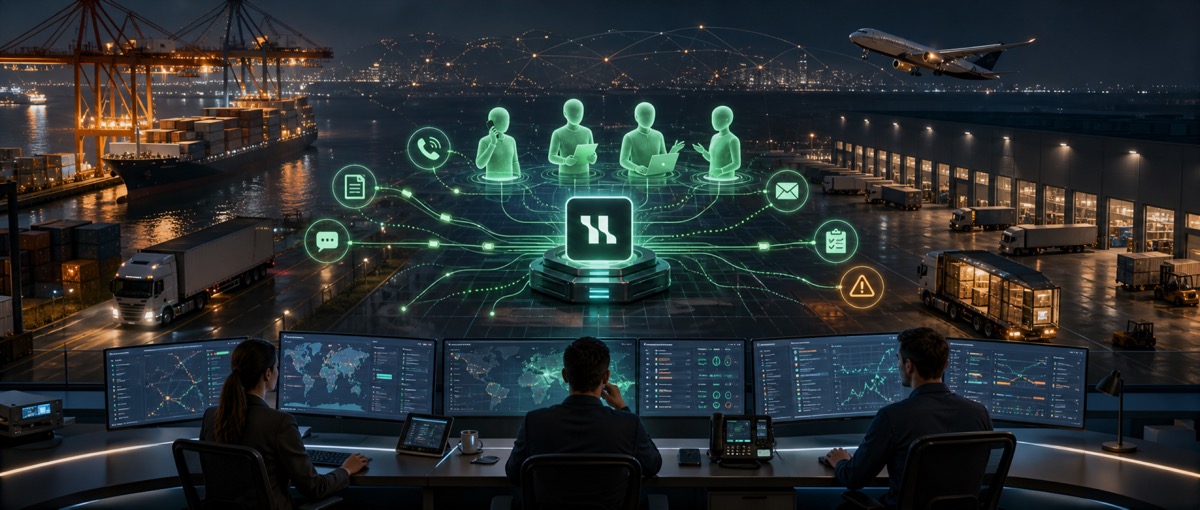
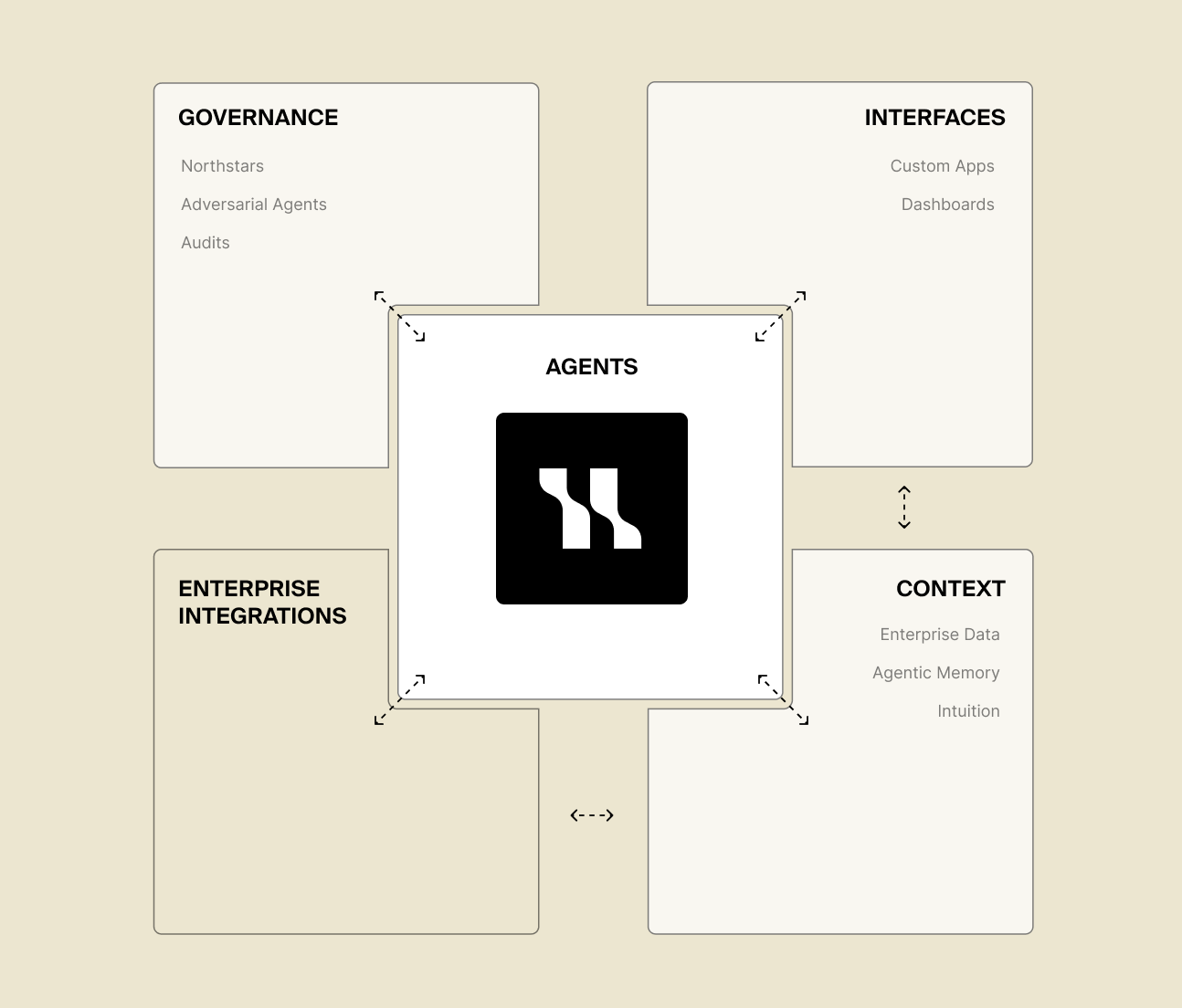
Image source: HappyRobot official platform illustration. Official product media is used to explain the mechanism, not as third-party commercial proof.
AI agents may first make real money in the operations layer.
HappyRobot is worth studying not because “AI for logistics” is a novel label. It is worth studying because it makes agent commercialization concrete. Many AI products still promise to generate better outputs. HappyRobot’s pitch is more operational: enterprises need someone to monitor systems, make calls, chase emails, update statuses, collect documents, handle exceptions, and write results back into business software.
Those jobs are not glamorous, but they have budgets.
Three Signals First
The first signal is financial momentum. Cinco Dias reported in April 2026 that HappyRobot had more than $10 million in annual recurring revenue and more than $62 million in total funding, including a $44 million Series B in 2025.
The second signal is customer deployment. HappyRobot’s own DHL case study says DHL has more than 10 live use cases across three divisions and multiple continents. Its Kuehne+Nagel case study reports more than 10,000 status checks and 6,000 emails processed. These are company-site metrics, not independently audited numbers, but they clarify the product’s operating context.
The third signal is positioning. HappyRobot does not present itself as merely a more human call bot. It calls the product an AI workforce for calls, emails, documents, scheduling, escalation, and system updates.
The commercial lesson is simple: the buyer is not paying for a chatbot. The buyer is paying for work that keeps operations moving.
What HappyRobot Actually Does
HappyRobot positions itself as an AI workers platform for complex operating environments. In logistics, it covers more than single-turn question answering. It touches a sequence of tasks:
- load booking and rate negotiation;
- carrier tracking calls and ETA confirmation;
- dock appointment scheduling;
- POD, BOL, and invoice follow-up;
- temperature, delay, missed-pickup, and other exception escalation;
- write-back into TMS, WMS, dispatch, or finance systems.
On its logistics providers page, the company frames the value in direct business language: close more deals and deliver on time. That matters. The product is not just reducing support volume. It is trying to improve operational throughput.
Voice is only one interface. The real product is the middle layer: an agent that understands the task, carries context, talks to external parties, interacts with enterprise systems, leaves governance evidence, and escalates when the workflow fails.
Why Logistics Is a Strong Entry Point
Logistics operations contain a familiar class of work: high frequency, low creativity, and expensive failure.
If one shipment is late, the problem is not merely a slow customer reply. It can affect dock scheduling, customer commitments, cold-chain risk, invoice settlement, claims, and downstream planning.
Historically, this work has been solved with people. Someone watches the inbox. Someone calls a carrier. Someone copies a status into another system. Someone chases a document. Someone escalates when the answer changes.
AI is not replacing one creative role here. It is replacing operational friction.
That is why HappyRobot is more commercially interesting than a generic support bot. A support bot reduces question volume. An AI worker increases task throughput.
What the Customer Cases Reveal
HappyRobot’s DHL case study says the companies began building a cross-division, cross-region, multilingual AI workforce in 2025. The page describes more than 10 live use cases and mentions agents processing hundreds of thousands of emails and millions of voice minutes annually.
Again, these are official customer-case claims, not audited operating results. They are useful because they reveal the workflow surface.
DHL’s use cases are not limited to phone calls. They include carrier tracking, customs duty collection, freight invoice follow-up, temperature alert escalation, new hire orientation, and warehouse coordination. That means the same platform can expand from logistics operations into finance operations, HR coordination, warehouse management, and exception response.
The Kuehne+Nagel case study looks like a pilot-to-expansion example. HappyRobot says AI workers were deployed in a Healthcare HyperCare control tower, launched within weeks, and handled cross-time-zone communication in English, French, German, Spanish, and Chinese. The disclosed metrics include 10,000+ status checks, 6,000+ emails processed, 78% connected calls handled end-to-end, and a 47% capacity increase for the team.
The important commercial point is not the exact number. It is the type of value being sold. Large customers are not buying “AI is smart.” They are buying the promise that every status gets checked, every exception gets handled, and every system stays synchronized.
What the Business Really Sells
HappyRobot does not publish standard self-serve pricing. Its conversion path is to book a demo. That suggests enterprise sales and custom deployment rather than pure self-serve SaaS.
In this market, that is not necessarily a weakness.
Logistics buyers are not purchasing a tool they can casually click around. They are buying a production execution layer. Four questions determine whether the product can move from demo to budget.
1. Can It Connect to Legacy Systems?
Logistics companies will not rebuild their TMS, WMS, dispatch, and finance systems just to adopt AI. The ability to plug into existing systems decides whether a product is useful in production.
HappyRobot’s operations page emphasizes integrations with TMS, WMS, dispatch, and maintenance systems. That is an important signal. It is selling the action layer around old systems, not a shiny AI front end.
2. Can It Handle Exceptions?
Real operations are not clean flows. A carrier does not answer. A driver gives a different ETA. A dock slot disappears. A temperature alert appears. An invoice amount does not match.
If AI only handles standard questions, it becomes another support entry point. If it identifies exceptions, escalates with context, and writes the outcome back into systems, it becomes a trusted operating component.
3. Can It Be Audited?
Enterprises want to know not only whether a task was completed, but who triggered it, what the agent used as context, where it failed, and whether the action can be reviewed later.
HappyRobot’s platform illustration places agents inside a surrounding layer of governance, enterprise integrations, context, and interfaces. That diagram matters because production agents must be governed, observed, and constrained.
4. Can One Workflow Expand Into Many?
If a customer first uses HappyRobot for tracking calls, then expands to appointment scheduling, invoice follow-up, POD and BOL collection, claims intake, and overdue payment follow-up, the platform value stops being “one bot.” It becomes a business execution layer that absorbs repeated operational work.
That expansion path fits enterprise sales better than a single-point tool.
Three Builder Lessons
1. Start With What the Organization Must Execute Every Day
Many AI startups begin with a capability: write, draw, chat, search, summarize.
HappyRobot points in the opposite direction. Start with actions an organization must perform daily, that people do not want to do, and that carry cost when done wrong.
Tracking calls, appointment confirmation, document collection, and exception escalation fit that pattern. They are not magical, but the budget is real.
2. Vertical AI Means Owning Exceptions, Not Using Industry Words
“AI for logistics” is easy to say. The hard part is knowing how carriers quote, how ETAs are confirmed, how temperature exceptions escalate, how invoices are disputed, and who must be notified after a missed pickup.
Vertical AI does not win because it speaks industry vocabulary. It wins because it handles industry exceptions.
If a product only answers industry questions, it is an assistant. If it reliably executes industry actions, it can become part of the business system.
3. Delivery Can Become a Moat
HappyRobot does not look like a lightweight PLG tool. It likely requires process discovery, integration, testing, rollout, governance, and continuous improvement.
That delivery burden is real. It can pressure margins and scale. But it can also become a moat. Every deployment can accumulate customer operating rules, escalation paths, system permissions, contact preferences, and historical context.
Once that layer is embedded, a competitor cannot replace it only by claiming to have a better model.
Risks to Watch
HappyRobot is not a risk-free template.
First, its customer-case performance metrics should be treated as company-site claims, not independent audits. They prove the scene exists; they do not prove audited ROI or revenue.
Second, if every customer requires deep customization, delivery time, gross margin, and repeatability will be tested. The challenge for vertical AI companies is not only signing the first large customer. It is making the tenth deployment feel less like a new consulting project.
Third, AI workers in operations carry higher error costs than ordinary AI tools. A bad answer may be a user-experience problem. A bad dispatch, escalation, collection message, or system update can become an operational incident.
That is why products like this are not really selling automation rate. They are selling controlled automation.
The Bottom Line
HappyRobot’s lesson is not that every founder should build logistics AI.
The reusable pattern is the commercialization order:
Find a high-frequency, low-creativity, cross-system operating action where mistakes are expensive. Package AI as an executable, auditable, and escalatable worker. Then expand from one action into a broader business execution layer.
AI agents may not need to replace white-collar workers first to become real businesses. They may only need to reliably complete the work companies already cannot stop doing.