

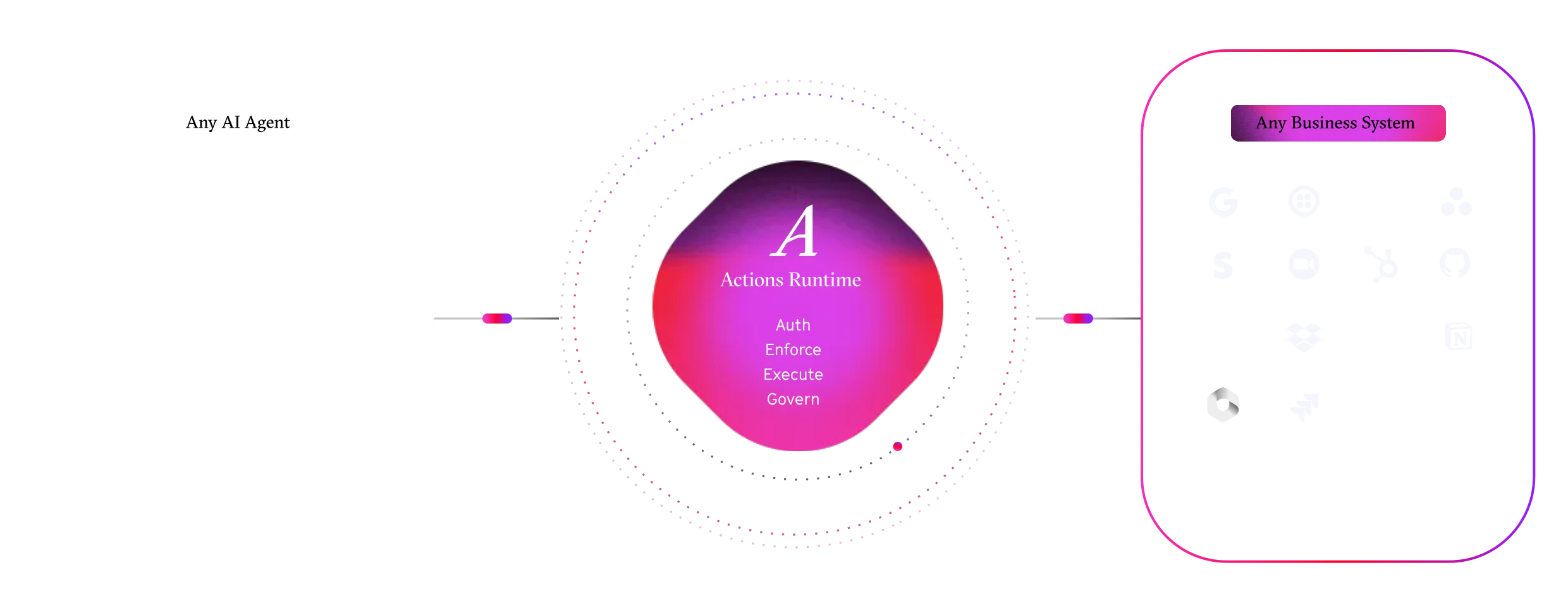
Image source: Arcade.dev official product illustration. Official product media is used to explain the mechanism, not as third-party commercial proof.
An agent that can act in production first needs permission to act.
That is the useful lesson in Arcade.dev. The company is not trying to sell another chat agent. It is selling the layer that lets agents safely call tools, use real user identity, enforce policy, execute actions, and leave an audit trail.
Over the past year, many AI products have repeated the same promise: agents will do work for you. But inside an enterprise, the bottleneck is often not whether the model can suggest the next step. The harder question is why the agent should be allowed to touch CRM records, email, tickets, databases, finance systems, or internal workflows at all.
Arcade.dev found a business in that gap.
According to The Wall Street Journal, Arcade.dev was founded in 2024 by Alex Salazar and Sam Partee. The team originally wanted to build an agent that could diagnose server or database problems. But that product quickly ran into a deeper issue: a useful agent needed broad system access, and real companies would not hand a fallible model a master key.
That failed first product exposed the more valuable problem. Production agents do not just need reasoning. They need an authorization, execution, policy, and audit layer that enterprises can trust.
Three Signals First
The first signal is financing. WSJ reported that Arcade.dev raised a $60 million Series A in June 2026 led by SYN Ventures, with participation from Morgan Stanley and Wipro.
The second signal is positioning. Arcade.dev describes itself as “The MCP Runtime for Production AI Agents”. It is not selling the end-user agent interface. It is selling the runtime that allows agents to safely call tools.
The third signal is pricing. Arcade.dev’s pricing page shows a free Hobby plan, a $25-per-month Growth plan, and Enterprise. Usage is measured through user challenges, tool executions, and hosted MCP servers.
Together, those signals show a specific commercialization thesis: as agents move from demos into production, the scarce resource is not only tokens. It is controlled action.
It Sells the Action Layer, Not the Agent
The phrase “MCP runtime” sounds technical, but the business meaning is straightforward. If an agent only answers questions, it can remain a software feature. If it acts on behalf of users, it becomes part of the company’s operating system.
That requires a controlled action layer.
Arcade.dev breaks that layer into several jobs.
1. Let Agents Act as Real Users
Companies do not want agents running around with shared tokens. They also do not want every internal team to rewrite OAuth flows, token refresh, scope management, and permission checks.
Arcade.dev’s product language emphasizes that agents act on behalf of real users. Permissions flow through existing identity and authorization systems. In other words, the agent does not get a universal key. It operates inside the intersection of what the user can do and what the agent is allowed to do.
That is less spectacular than an “autonomous employee” demo, but it is much closer to what enterprise buyers need before a system can go live.
2. Turn APIs Into Reliable Agent Tools
Many agent demos fail because of the messy space between natural-language intent and real API execution. Parameters, permissions, errors, retries, context, field mapping, and failure modes all sit between “the user wants this” and “the system safely did it.”
Arcade.dev makes a useful distinction: an API wrapper is not the same thing as an agent tool.
That sentence is important for builders. The opportunity is not simply to wrap an API endpoint. It is to map a user’s intent to a safe, observable, repeatable action in a business system. The product value lives in that translation layer.
3. Leave an Audit Record for Every Action
Enterprise security teams eventually ask plain questions:
What did this agent do? Which user did it represent? Which system did it touch? Why was it allowed? What happened when it failed? Who can investigate it later?
Arcade.dev puts audit logs, policy enforcement, RBAC, SSO/SAML, tenant isolation, and related controls into its enterprise package. Those are not decorative features. They are the bridge from impressive demo to procurement-ready infrastructure.
Many AI startups build a flashy capability first and add compliance later. Arcade.dev’s lesson is the reverse: compliance and authorization can be the product.
The Pricing Unit Is the Interesting Part
Arcade.dev’s pricing page reveals the shape of the business.
The Hobby plan includes 100 user challenges, 1,000 standard tool executions, 50 pro tool executions, and one 24/7 hosted MCP server. The Growth plan costs $25 per month, then charges extra usage after included limits: user challenges, standard tool executions, pro tool executions, and Arcade-hosted MCP server hours. Enterprise adds custom pricing for dedicated tenant isolation, audit logs, RBAC, SSO/SAML, custom SLAs, and dedicated account support.
This hints at a broader pattern. In the SaaS era, software was often priced by seats because humans were the operators. In the agent era, infrastructure may be priced by actions, authorizations, executions, hosted runtimes, and governance requirements.
For builders, the question becomes: what scarce resource does your product actually consume?
Is it model tokens? Human review? Workflow execution? External system calls? Compliance risk? Or the buyer’s need for controlled automation?
Arcade.dev’s answer is clear. It turns agent authorization and execution into metered commercial units.
Why This Is a Non-Obvious Entry Point
The hottest agent categories are general assistants, vertical workers, AI customer support, AI sales, and AI coding. Arcade.dev is less visible. It is closer to the infrastructure underneath those products.
Its non-obvious move is that it does not fight for the end-user interface. It fights for the layer that production agents cannot avoid.
That type of opportunity has three traits.
1. The Pain Is Boring, but the Buying Reason Is Hard
Permissions, audit logs, SSO, RBAC, token refresh, policy enforcement, and compliance evidence are not the easiest words to market.
But enterprises pay for them because without them, a smarter agent becomes a larger risk. Developers may love a great experience, but platform teams and security leaders buy control.
2. The Closer the Product Is to Risk, the More It Enters Budget
If an AI tool is merely more convenient, it competes with many optional tools.
If an AI infrastructure product removes the thing preventing production rollout, it enters a different budget conversation: security, compliance, platform engineering, and enterprise architecture.
Arcade.dev’s smart move is translating agent uncertainty into familiar enterprise procurement language: authorization, governance, auditability, deployment choices, and compliance.
3. Open Source Can Feed Enterprise Demand
Arcade.dev’s arcade-mcp repository is an MIT-licensed Python framework for building MCP servers and tools. Its README says it supports Arcade.dev’s MCP servers and prebuilt tools; those counts are company statements rather than independently audited metrics.
The open-source point still matters. For developer infrastructure, open source can be a distribution mechanism. Developers can try the framework, build tools, and run demos. Once they move into production, they run into hosting, audit, isolation, SLAs, and enterprise authorization. That is where the commercial cloud and enterprise plan have room to capture value.
What Builders Can Copy
Arcade.dev is not easy to clone. It requires identity, security, developer tooling, and enterprise sales depth.
But the underlying moves are broadly useful.
First, do not only ask who will build the agent. Ask what layer is missing before agents can do real work. It might be data preparation, evaluation, permissioning, workflow orchestration, human review, audit, or failure recovery.
Second, turn security constraints into product experience. If every tool call moves through authorization, policy, execution, and audit, security is no longer a PDF attached late in the sales cycle. It becomes the product mechanism.
Third, rethink the unit of pricing. AI products do not have to charge only per seat, token, or project. If the product completes actions, it can price by action, task, verification, call, audit event, risk tier, or runtime.
Arcade.dev’s user challenges and tool executions are not just pricing details. They express the product’s belief: customers are buying safe agent action, not another interface.
What to Watch
Arcade.dev is still early. WSJ reported a roughly 40-person company and a recent $60 million Series A. Its competition is not limited to other startups. Identity vendors, cloud platforms, agent frameworks, MCP ecosystem projects, and large companies’ internal platform teams all have reasons to own parts of this layer.
Customer logos, tool counts, and product claims on the company site should be treated as official statements, not independent proof. Whether developer interest becomes durable revenue will depend on customer cases, retention, and production usage.
Still, as a case study, Arcade.dev captures a useful direction. AI agent commercialization may not happen first in the products that look most human. It may happen in infrastructure that looks least like AI.
When everyone asks whether agents can do work, Arcade.dev asks the more enterprise-ready question:
If an agent really does the work, who makes sure it only does what it should?
That is the business.