

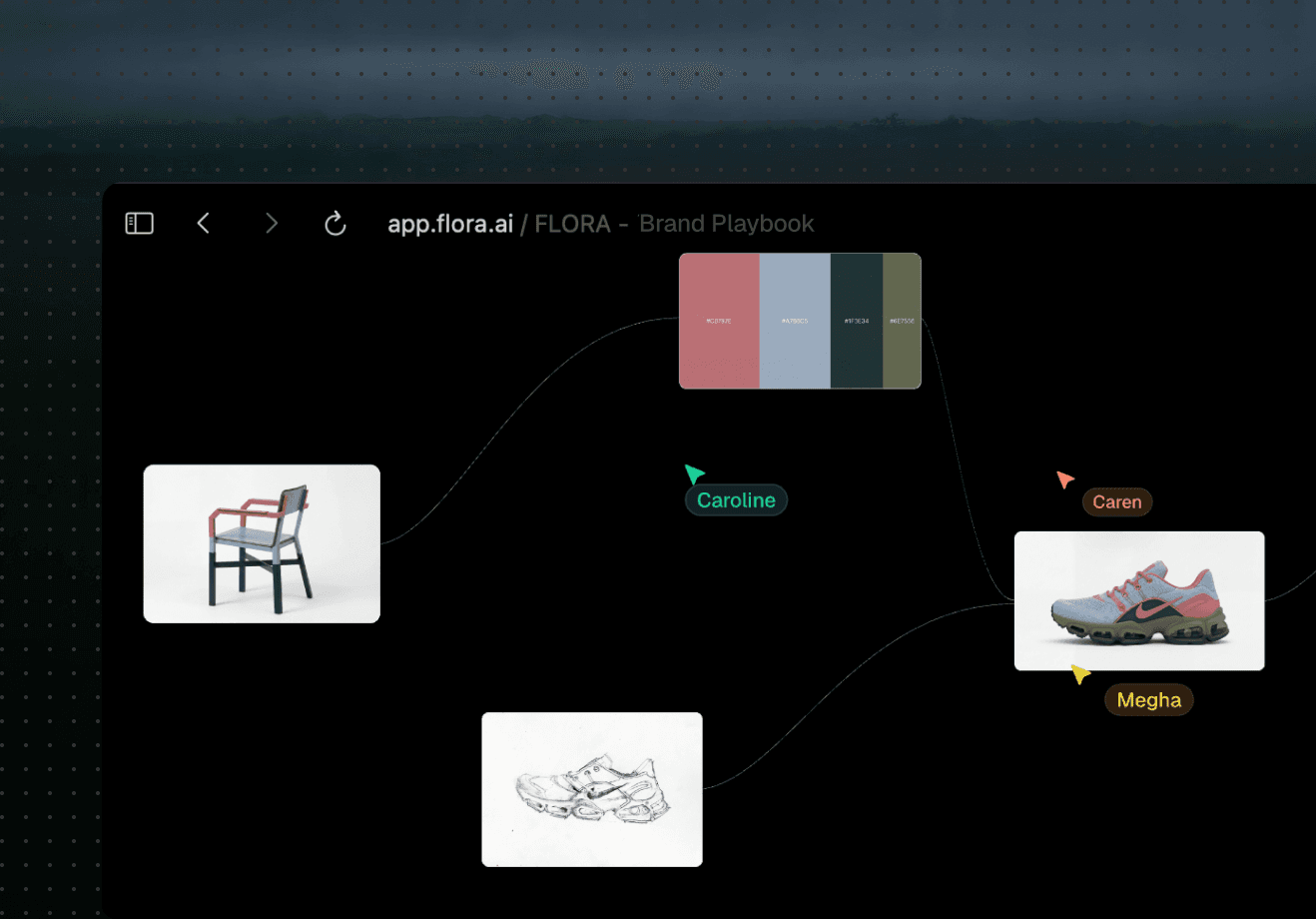
Image source: FLORA enterprise page. Official promotional media used to explain the product workflow, not third-party growth evidence.
Do not sell a new model. Sell order in creative production.
That is the useful lesson in FLORA. The AI creative-tool market is crowded with products promising better images, better videos, better music, and better copy. FLORA is more interesting because it frames a different pain: the more models creative teams use, the more chaotic their production system becomes.
A designer may generate images in one tool, test video in another, write campaign copy in a third, then drag everything into Figma, Adobe, a slide deck, or a project-management workflow. Every step can generate something. Every step also loses context: brand rules, version history, approved references, cost visibility, and team discussion.
FLORA enters that gap.
Three Signals First
The first signal is financing. Business Insider reported that FLORA raised a $42 million Series A, bringing total funding to $52 million.
The second signal is positioning. FLORA’s site describes the product as a generative AI canvas for creative teams. The important words are not just “generative AI.” They are “canvas” and “teams.”
The third signal is commercialization. FLORA’s pricing page shows Free, Starter, Pro, Max, and Enterprise tiers. At the time of the source article, Starter was listed at $18 per seat per month, Pro at $50 per seat per month, and Max at $200 per seat per month. Those are official website figures and may change, but they show the product being packaged around seats, usage, collaboration, and enterprise controls.
The business is not simply “generate one better asset.” The business is to make creative work governable when every team member can call many models.
It Is Not Just Another AI Image Tool
FLORA calls itself a “Generative AI Canvas for Creative Teams.” The key point is that the product is organized around a shared creative space, not around a single prompt box.
On its enterprise page, FLORA emphasizes that professional creative teams can explore ideas together on an infinite multiplayer canvas and access more than 170 image, video, and audio models. It also says teams can keep projects, references, brand standards, and approved assets in the same space so downstream PDP, advertising, social, retail, and video outputs remain consistent.
That is heavier than “type a prompt and get a picture.”
It answers a question creative teams face every week: when new models appear constantly, how does a team turn model capability into stable production capacity?
The Core Business Is Workflow Compression
If we look only at single generations, FLORA is exposed to model companies, Adobe, Figma, Canva, and many smaller AI tools. But if we look at workflow, the product logic becomes clearer.
1. Turn Model Choice Into a Canvas Action
Creative teams are not only asking whether a model exists. They are asking which model fits which step.
A single project may need scripts, product images, video previsualization, format variations, reference images, and platform-specific styles. When each step lives in a different tool, teams spend too much time moving files and re-explaining context.
FLORA places these models inside one canvas. The promise to the user is not just better generation. It is less transportation of assets and context.
2. Turn Brand Consistency Into a System Asset
In enterprise creative production, the expensive mistake is often not that one image is insufficiently beautiful. It is that the output does not fit the brand.
Brand colors, approved imagery, character references, campaign tone, and style rules become fragile when they are scattered across many tools. The faster AI generates, the faster the team can drift away from its own standards.
FLORA’s enterprise messaging emphasizes creative range and brand control in one place. That is official product language, not third-party audited performance data, but it reveals the product direction: creative AI cannot only maximize divergence. It also has to manage convergence.
3. Move Collaboration and Cost Control Upstream
FLORA’s pricing page does not only list canvas access and generation. It also packages layer editing, batch generation, real-time cursors, shared team assets, usage analytics, API access, MCP access, and team limits or pooled usage.
That means FLORA is not designed only as a personal toy. It is trying to turn creative generation into a team budget: who used how much, which project consumed which credits, which assets can be reused, and which members need permissions or limits.
For a B2B buyer, those questions are often closer to a purchase reason than whether one image is slightly more attractive.
Why It Has a Commercial Window
Business Insider reported that FLORA was founded in 2024 and raised a $42 million Series A in 2026, bringing total funding to $52 million. The report also mentioned customers including Levi’s, Pentagram, and Lionsgate, and said Lionsgate used FLORA for film concept generation and previsualization.
Those signals should be handled carefully. Media reporting is stronger than company-only marketing, but the public record still does not independently prove retention, revenue, ROI, or the ability to replace a full creative department.
The safer conclusion is that FLORA is addressing a problem that is becoming more expensive.
In the older creative-software world, the core asset was tool capability. In the AI creative world, the new disorder comes from model fragmentation. The more models teams use, the more they need a place to manage creative process, project assets, brand rules, collaboration, cost, and permissions.
That is FLORA’s window.
Four Lessons for Builders
1. Do Not Only Build a Model Entrance
Many AI products market themselves by saying they support the latest model. The problem is that many products can support the latest model. That advantage disappears quickly.
The better question is: what painful work happens before and after the model call?
FLORA’s answer is that creative teams still need to find references, align on brand, discuss work, edit layers, track versions, manage cost, and reuse approved assets. The startup opportunity is often not in the model itself, but in the messy work around the model that nobody wants to manage.
2. Price Near the Real Production Unit
Individual creators think about monthly subscription cost. Teams think about seats, usage pools, projects, permissions, and budgets.
FLORA’s public pricing currently shows seat-based tiers and an enterprise sales motion. Business Insider also described the company as exploring usage or credit packages. Those two views are not necessarily contradictory. They show that pricing for creative AI is still being shaped. It is not only per person per month, and it is not only per generation. The package has to follow how teams actually produce work.
For AI founders, pricing is not just cost-plus margin. It is the search for the unit that the customer can expense, expand, and explain internally.
3. A Vertical AI Moat Can Come From Accumulated Assets
If FLORA is only a model aggregation layer, it is vulnerable. Larger platforms can integrate the same models and use distribution to lower acquisition cost.
But if a team’s brand library, project canvases, historical generations, collaboration comments, approved assets, and usage rules all accumulate inside FLORA, switching cost no longer depends only on model access.
This is a recurring vertical AI lesson. The moat may not come from a stronger model. It may come from structured assets users leave inside the workflow.
4. The Stronger the Platforms, the More Specific the Gap
Adobe, Figma, and Canva will not ignore AI creative production. It is difficult for a startup to compete head-on by building a larger creative suite.
FLORA’s smarter move is to accept that the multi-model world is already messy and place itself at the intersection of that mess. It does not need to replace every creative tool on day one. It can first become the workbench where professional teams test models, manage assets, collaborate, and control cost.
When the platforms are strong, startup opportunities often live in specific breakpoints where new behavior has emerged faster than old tools can adapt.
The Risks
FLORA still faces real risks.
First, creative workflows can be absorbed by large platforms. If Adobe, Figma, and Canva keep adding model access and team controls, they can compress the market for independent tools.
Second, multi-model aggregation is not a durable moat by itself. If users treat FLORA only as a model collection, pricing pressure and distribution pressure will be intense.
Third, long-term enterprise willingness to pay will depend on whether team asset accumulation, brand consistency, collaboration efficiency, and cost governance are meaningfully better than the current workflow. Public material does not yet prove those metrics.
Those risks are exactly why the case is worth studying.
FLORA reminds us that the next stage of AI commercialization is not adding a chatbot to every industry, and it is not chasing every new model demo. The budget often appears where AI can already generate, but the organization cannot yet produce reliably.
Creative work is one example.
As model capability becomes cheaper, product value moves toward order. The companies that turn messy inputs, tools, assets, collaboration, and cost into reusable systems will have a better chance of turning the AI wave into durable budget.