
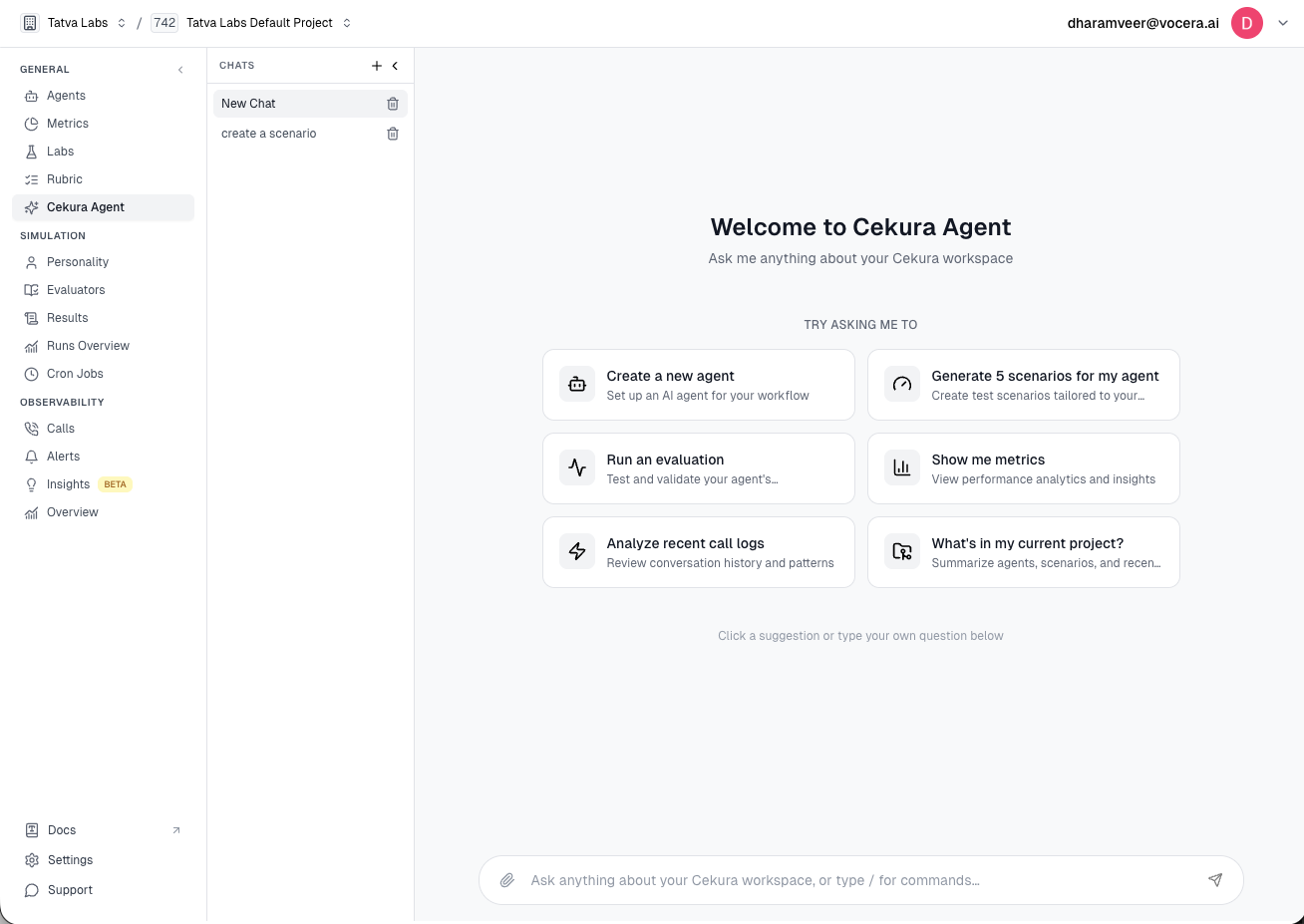
Image source: Cekura official product screenshot. Official product media is used to explain the mechanism, not as third-party commercial proof.
The first real money in voice AI may be made on the test bench.
That is the useful lesson in Cekura. Most people look at voice agents and ask who can make customer support, sales, reception, or scheduling calls sound more human. Cekura asks a more enterprise-shaped question: why would a company dare to hand a real phone call to an AI agent?
Every time a team changes a prompt, model, workflow, tool integration, or compliance script, someone has to prove the agent did not break identity verification, skip a disclosure, mishandle a refund step, lose context after an interruption, or fail silently in production.
Cekura is interesting because it does not rush into the crowded market of building the agent itself. It stands behind those agents and sells automated QA, simulation, regression testing, monitoring, and observability.
When other companies sell “AI employees,” Cekura sells the health check, stress test, and incident monitoring that make those employees shippable.
Three Signals First
The first signal is financing. Business Insider reported that Cekura raised a $2.4 million seed round with investors including Y Combinator.
The second signal is customer demand. The same report mentioned roughly 70 customers, while Cekura’s own site says it is used by more than 70 conversational AI companies. The company-site numbers should be treated as official claims, not audited third-party data.
The third signal is pricing. Business Insider reported that startup subscriptions begin at $1,000 per month, with custom enterprise plans.
That pricing clue matters. A generic “try a few calls” tool would struggle to justify that price. A QA and observability layer for agents going into healthcare, finance, automotive sales, customer support, loan servicing, or appointment scheduling has a clearer budget story. The buyer is not only purchasing a tool. The buyer is buying launch confidence.
It Is Not a Phone Bot. It Is a Launch Gate.
Cekura’s site positions the product as a testing, monitoring, and self-improvement platform for voice and chat AI agents. The workflow includes pre-production voice evaluations, test scenario generation, persona simulation, replaying historical failure calls, production-call monitoring, and alerts for latency, interruptions, sentiment, hallucinations, compliance checks, and other quality signals.
That sounds like an engineering tool, but the real value sits in business risk.
Voice agents differ from text agents. When text goes wrong, a user can copy, retry, screenshot, or escalate. On a call, failure becomes visible within seconds. The customer interrupts. Background noise appears. Accent, speed, emotion, and intent shift. A malicious user may probe for system prompts or policy loopholes. A tool call may fail. Latency may make the conversation feel broken before the model has technically made an error.
Cekura is not merely helping teams test more sample calls. It is compressing a manual workflow that used to require repeated phone calls, transcript review, recording analysis, prompt edits, and subjective QA into a productized routine.
The product screenshot is telling. The navigation is not organized around tickets, inboxes, or knowledge-base articles like a traditional support system. It points to Agents, Metrics, Labs, Rubric, Simulation, Results, Runs Overview, Observability, Calls, Alerts, and Insights.
That is the product category: not a conversation entry point, but a quality system for the agent lifecycle.
Why This Niche Matters
It captures a pattern that appears again and again in AI commercialization.
When a new category appears, the market chases the most visible application. When that application enters production, the budget often moves toward the infrastructure that makes it stable.
Cloud computing did not create value only through virtual machines. Monitoring, logging, security, CI/CD, error tracking, and governance all became large businesses because production systems needed them. AI agents will likely develop a similar division of labor.
The more voice agents are deployed, the more buyers will ask practical questions:
- Did the agent miss a critical step?
- Can it recover after the user interrupts?
- Did it leak PII or reveal system instructions?
- Is latency still within an acceptable range?
- Did the newest version break a scenario the previous version handled?
- Can the team prove that regulated flows were tested before launch?
These are not model-parameter questions. They are release, acceptance, and governance questions.
Cekura’s opportunity is to turn “I think the agent is good enough” into “we ran scenarios, metrics, regressions, and alerts, so this agent can move into production.”
The Strongest Commercial Point: Selling Certainty
According to Business Insider, Cekura was founded by three IIT Bombay alumni, was previously called Vocera, and later rebranded to Cekura. The same report mentioned the $2.4 million seed round, around 70 customers, startup plans starting at $1,000 per month, and custom enterprise pricing.
The pricing signal is more instructive than the funding signal.
If the customer is using AI for low-risk internal experiments, a QA layer may feel optional. If the customer is putting AI into real phone workflows, the buying logic changes. The cost of one bad call can be a lost customer, a compliance problem, a brand incident, or a manual cleanup process.
Cekura’s customer-case pages reinforce that positioning. In the Twin Health case, Cekura is described as being used for medical-agent identity verification, medical-history collection, process sequencing, PII safety, and pre-launch regression testing. In the Lindy case, the product is used to simulate interrupting users, validate expected outcomes, monitor latency and speaking pace, and test malicious calls.
Those case-study claims come from Cekura’s own site and should not be treated as independent audits. But they reveal the sales narrative. Cekura is not saying “we make the agent smarter.” It is saying “we make the customer more willing to deploy the agent.”
That is often closer to enterprise budget than a marginal accuracy improvement.
It Productizes Failure Modes
Many AI tools struggle commercially because they only say they are smarter, more automated, or more efficient. Those words are too large. Buyers have trouble mapping them to a purchase reason.
Cekura’s productization is more concrete. It breaks reliability into testable failure modes.
1. Interruptions
Real users do not wait politely for an agent to finish a sentence. They interrupt, change their mind, complain, ask a different question, or become angry. Cekura simulates different personas and behaviors to test whether the agent can stop, understand, recover context, and continue the workflow.
2. Workflow Regression
Every prompt change can fix one issue and damage another. Cekura turns appointment flows, refunds, identity checks, disclaimers, tool calls, and expected outcomes into regression tests that can run before launch.
3. Production Observability
Once a voice agent is live, reviewing a few random recordings is not enough. Cekura’s site emphasizes production-call monitoring, latency, sentiment, pitch, gibberish detection, alerts, and call analytics.
The shared point is that “voice-agent quality” becomes an object the team can discuss, review, repeat, and own. That is the commercial core.
Distribution Works Because the Market Is Already Educated
Cekura does not have to teach the world what a voice agent is. Vapi, Retell, ElevenLabs, LiveKit, Pipecat, Five9, and related ecosystems are already teaching companies that agents can answer calls, schedule meetings, qualify leads, and perform support work.
Cekura attaches itself to the next sentence: if you are already building a voice agent, you will eventually face testing and monitoring problems.
The company site shows integrations with platforms such as Vapi, Retell, Cisco, Five9, LiveKit, Pipecat, and ElevenLabs. Product Hunt categorizes Cekura/Vocera around AI infrastructure tools, AI metrics and evaluation, and AI voice agents, with launch-heat signals in 2024 and 2025.
That ecosystem distribution is well suited to an early infrastructure company. It does not need to convert every potential buyer into a voice-agent believer. It needs to find people already deploying agents and say: the failure you are most afraid of can be tested before a real customer experiences it.
Four Lessons for Builders
1. Hot Applications Often Create Cleaner Infrastructure Opportunities
When everyone is building AI support agents, AI sales agents, and AI receptionists, direct competition becomes crowded. But the more those products proliferate, the more valuable testing, monitoring, compliance, evaluation, replay data, and prompt regression become.
Not every startup has to own the final user interface. Sometimes it is easier to charge the teams building that interface.
2. Translate Fear Into Product Features
What does an enterprise fear about a voice agent?
Not that it is insufficiently impressive. The fear is that it will fail in front of real customers.
Cekura translates that fear into scenario libraries, personas, expected outcomes, red-team tests, latency monitoring, alerts, and production-call analysis. That is more persuasive than saying “we improve reliability.”
3. High-Risk Industries Buy Acceptance, Not Just Efficiency
In healthcare, finance, automotive, insurance, and customer support, AI products cannot sell only speed. Buyers also ask how failures are discovered, how release readiness is proven, how version updates are regressed, and how audits are handled.
Products that answer those questions look more like enterprise software.
4. Do Not Only Build Generation. Build Governance.
Much of the last two years of AI tooling has centered on generation: text, images, video, code, and voice responses. As generation becomes common, the next layer of value shifts toward governance.
Who evaluates the output? Who monitors production? Who prevents regressions? Who explains incidents?
Cekura’s case is a reminder that AI commercialization is not only about stronger models or smoother experiences. In some verticals, the reason to pay is simply this: it makes the customer willing to use the AI.
What Is Still Uncertain
Cekura is still early. Customer counts, case-study metrics, and product-effect claims need continued observation. Voice-agent platforms may also build more testing features natively, which could pressure a third-party QA layer.
The company has to prove that a specialized quality layer remains better than platform-native tests, internal QA scripts, and generic observability tools. It also depends on the broader maturity of voice agents in real production workflows.
Those uncertainties do not weaken the case study. They define the company-building question.
The Final Point
The lesson is not only “AI voice agents need testing.” The larger lesson is that many AI markets create budget just outside the main stage.
Do not only ask which task AI will perform.
Ask who makes that AI work deliverable, acceptable, repeatable, and observable.
When AI moves from demo to production, the most valuable position is not always the one taking the call. Sometimes it is the one testing the call before it happens.
Main sources: Cekura, Business Insider funding and customer report, Cekura Product Hunt page, Twin Health case study, Lindy case study, and Voice AI testing research. Official customer and effect claims are treated as company disclosures, not third-party audits.