

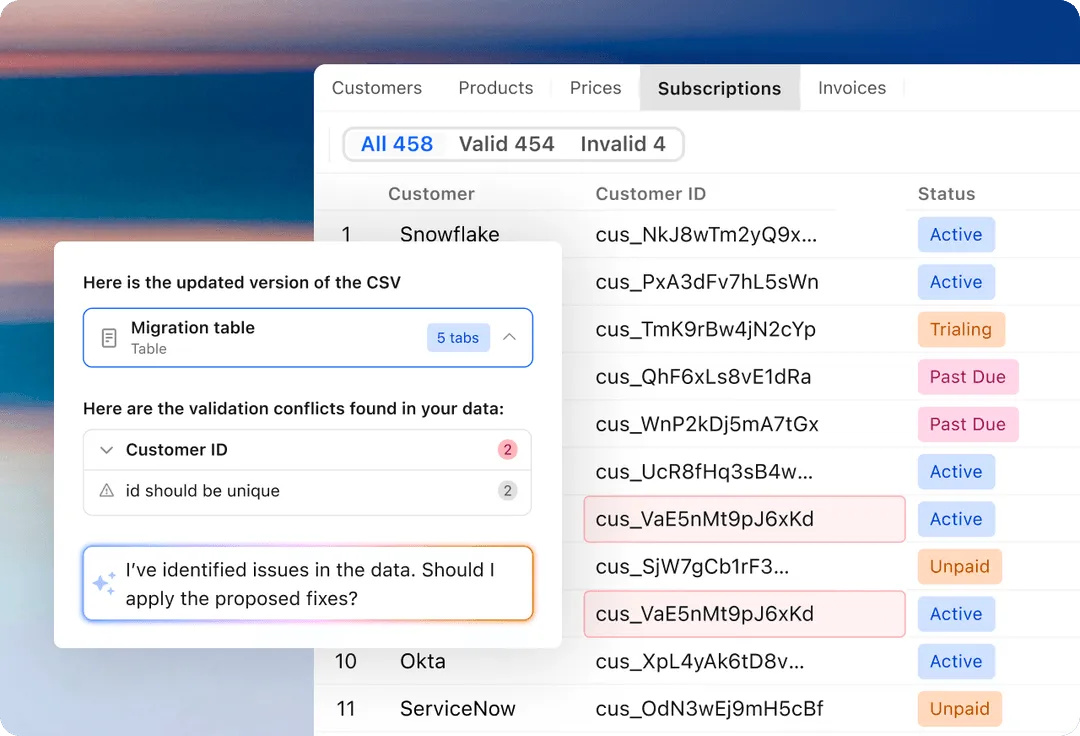
Image source: Rocketlane Agentic PSA product page. Official promotional material, useful for explaining the product mechanism but not audited third-party evidence.
Customers do not buy an “AI feeling.” They buy delivery certainty.
Rocketlane is a useful AI commercialization case because it places agents inside an old, expensive, and operationally accountable workflow: professional services delivery.
Many AI agent products describe themselves as digital workers. They write emails, research topics, update CRM fields, generate documents, or arrange meetings. Those tasks can be useful, but enterprise buyers keep asking a different question: can this agent enter an existing workflow, reduce rework, protect budget, catch risk early, and make the project deliver faster?
Rocketlane’s answer starts from PSA, or professional services automation. PSA is the operating layer used by SaaS implementation teams, IT services, customer-success teams, and professional-services groups to manage project plans, customer portals, resources, time, budgets, invoices, margins, and communication.
It sounds unglamorous. That is exactly why it may be a strong place for AI agents to commercialize.
Agents Belong in the Responsibility Chain
Rocketlane’s Agentic PSA and Nitro materials place agents in concrete delivery scenarios: resource matching, financial control, governance reminders, data migration, configuration validation, customer-signal detection, and project-document generation.
This is not a generic “summarize my meeting” assistant. It is a set of agents aimed at the repeated tasks that surround customer delivery.
Migration and configuration work reduces manual data handling and go-live rework. Resource matching recommends team members based on skills, availability, and project requirements. Financial control monitors hours, budget, margin, and revenue leakage. Customer-signal agents detect risk from communication and activity. Documentation agents keep SOWs, handoffs, implementation findings, and delivery materials current.
These tasks are not flashy, but they have inputs, process rules, approvals, error costs, and measurable outcomes. AI here is not performing intelligence for its own sake. It is entering a responsibility chain.
That is a major difference between a demo agent and a business product.
The Real Product Is Delivery Certainty
Rocketlane’s case highlights a counterintuitive shift in enterprise AI: the more powerful software becomes, the more important services can become.
Many people assumed AI would make enterprise software more self-serve. In practice, high-value AI projects often require more implementation work, not less. They need process mapping, data migration, permission setup, workflow redesign, user training, compliance checks, and ongoing adoption.
AI does not eliminate delivery. It raises the stakes of delivery.
Rocketlane sells to teams that move customers from signed contract to launch, and from launch to renewal. Their daily questions are operational: has the SOW changed, is the customer data ready, where is the project blocked, which hours have not been logged, which conversation signals escalation risk, and how will the team explain delays?
Traditional software records those facts. Rocketlane’s agentic narrative is that AI can identify, remind, generate, validate, and move more of that work forward.
That is the shift from project management to project execution.
Why This Can Be a Good Business
AI products struggle when they solve problems that users like but organizations do not budget for. Rocketlane avoids that trap because professional services already has a clear economic structure.
Services teams care about utilization, gross margin, project cycle time, delay rate, customer satisfaction, revenue recognition, renewals, and expansion opportunities. A tool that improves those metrics is not merely an AI subscription. It belongs to operations, services delivery, customer success, and margin management.
Rocketlane’s pricing page reinforces the point. It charges per team member, with annual plans ranging from Essential at $19 per user per month to Standard, Premium, and Enterprise tiers. Advanced resource, finance, Snowflake, RBAC, SAML, and enterprise controls move into higher packages.
The product does not complete one isolated AI task. It becomes the system where project plans, customer communication, time, budget, resources, delivery history, and best practices live. Once that system is running, agents have context.
For builders, this is the pattern: sell the system of work first, then use AI to make the system more valuable.
Public Signals and Their Limits
The Economic Times and Times of India reported that Rocketlane raised $60 million in March 2026, bringing total funding to $105 million. Times of India also reported company-provided figures that revenue doubled in the prior year and average contract value rose 4.5x versus 2023.
These are useful commercial signals, but they should be treated carefully. Reported growth claims are company or media-reported figures, not audited financial statements.
Still, the signals are strong enough to support the case. Rocketlane is not a brand-new AI wrapper. It is an existing PSA product using AI to reframe a mature operating category around agentic delivery.
That “old tree, new growth” pattern is common in serious B2B AI. A company understands the workflow for years, then a model-capability shift lets it repackage the product around automation, execution, and intelligence.
Three Moves Builders Can Copy
First, do not package agents as universal employees. Enterprise buyers often trust bounded agents more. Migration validation, configuration checks, resource matching, financial governance, risk detection, document generation, and handoff preparation are easier to buy than “AI that helps with work.”
Second, find existing budgets. Professional services teams already buy PSA, project management, resource planning, time tracking, customer portals, and finance tools. Rocketlane embeds AI into those budgets instead of asking the market to believe in a separate AI category.
Third, remember that productization is not generation. Many AI products stop at the layer of creating text, code, summaries, or images. Enterprise value appears after generation: who approves, who executes, who tracks, who owns the result, and how the organization knows whether it helped.
Rocketlane’s lesson is that agents commercialize when they connect to permissions, workflow, auditability, collaboration, billing, and customer commitments.
Risks Are Clear
Rocketlane has to compete with traditional PSA vendors, project-management platforms, CRM and customer-success tools, and large enterprise software companies that will all add AI. Salesforce, ServiceNow, Atlassian, Monday, Asana, Certinia, and Kantata-like competitors will not stand still.
The company has to prove that Agentic PSA is more than a layer of AI buttons on top of an old system. It must show that delivery execution, customer context, resource management, finance, and knowledge capture work better when designed around agents.
The second risk is responsibility. Agents that touch migration, configuration, validation, customer commitments, revenue recognition, and delivery data raise serious governance questions. What happens when the agent is wrong? Who approves the action? How are permissions managed? Where is the log? Can the team roll back?
Rocketlane’s public materials emphasize governance and enterprise controls, but this category ultimately has to be proven through long customer usage.
Conclusion
Rocketlane’s lesson is not “build an AI project-management tool.”
It suggests that AI agents may commercialize first in the old work sites where budgets already exist, processes are complex, errors are expensive, and outcomes can be checked.
For founders, that is harder than building a clever assistant. It requires workflow depth, customer context, permissions, auditability, and enough operational seriousness to enter the responsibility chain.
That is also why it is closer to real commercialization.
Sources
- Rocketlane website: https://rocketlane.com/
- Rocketlane Agentic PSA page: https://rocketlane.com/agentic-psa
- Rocketlane pricing page: https://rocketlane.com/pricing
- The Economic Times coverage: https://economictimes.indiatimes.com/tech/funding/saas-startup-rocketlane-raises-60-million-from-insight-partners-for-ai-push/articleshow/129800423.cms
- Times of India coverage: https://timesofindia.indiatimes.com/city/chennai/rocketlane-raises-60-mn-eyes-expansion-from-ai-adoption/articleshow/129810857.cms
- Rocketlane G2 reviews: https://www.g2.com/products/rocketlane-corp/reviews