

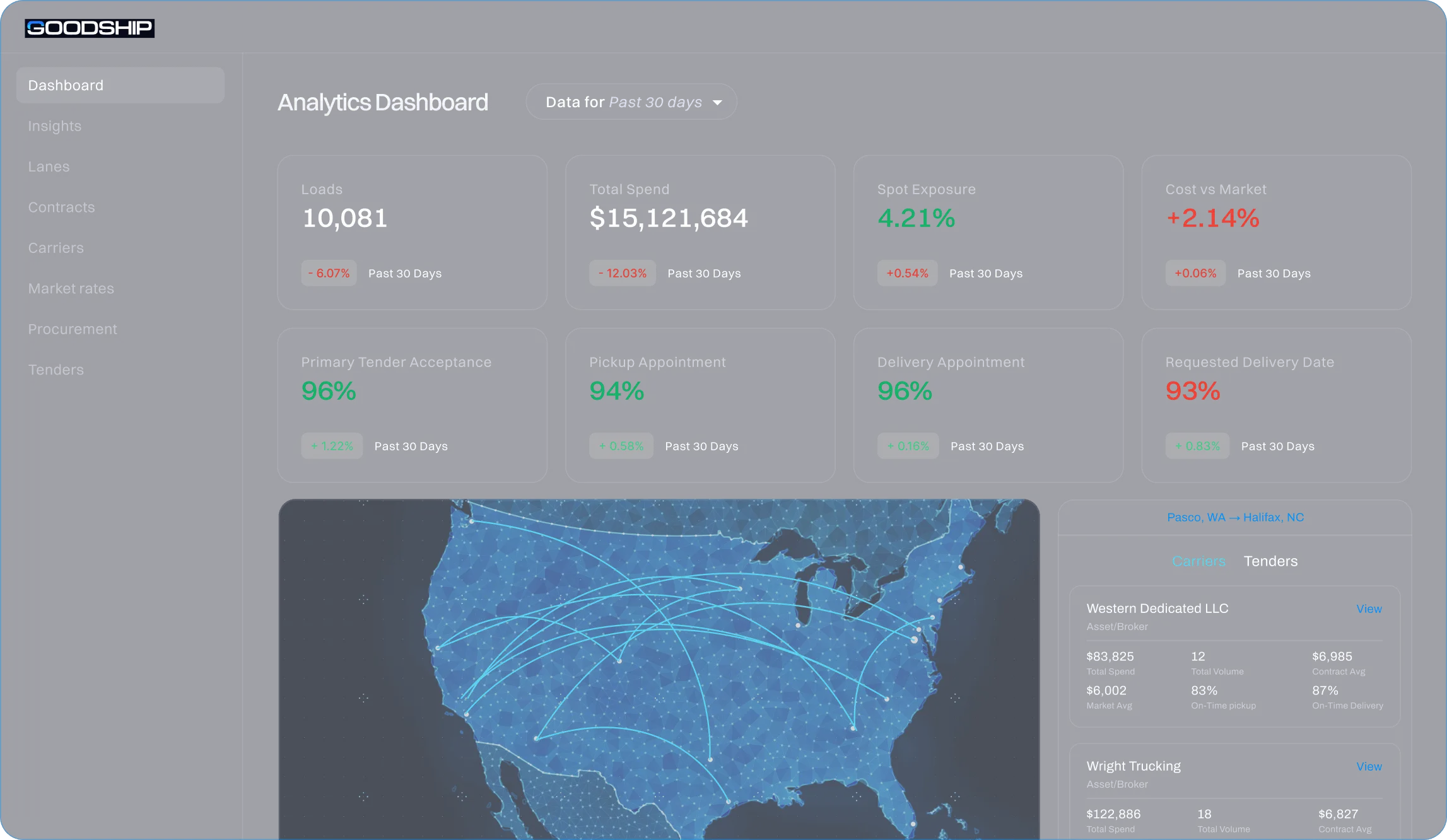
Image source: GoodShip product visual. Official promotional material, not third-party evidence.
AI may make money first in the budget hidden behind spreadsheets.
GoodShip is interesting because it does not start from a glamorous AI interface. It starts from freight procurement, carrier performance, transportation lanes, routing guides, contracts, market rates, and the daily operating questions that decide whether a logistics team is spending too much.
Many AI products look like tools. A user tries them once, sees something impressive, and may or may not come back. GoodShip points in the opposite direction. It enters a workflow that already has budget, recurring decisions, fragmented data, and expensive mistakes.
In freight, the costly question is not whether a model can chat. It is whether a team knows which lanes are overpriced, which carrier is missing service commitments, how to allocate an RFP award, where a routing guide is failing, and why a transportation budget is drifting.
If those answers live across a TMS, ERP, spreadsheets, carrier scorecards, contracts, email, and human memory, the valuable AI entry point is not a blank chat box. It is a workbench that makes the transportation network legible.
That is the productization lesson in GoodShip.
It Is Not Logistics ChatGPT
GoodShip describes itself as a freight orchestration and procurement platform. The product surface is organized around procurement, analytics, carrier management, collaboration, and Laney, its AI transportation analyst.
This matters because many vertical AI founders begin with the wrong question: “Can I build an industry-specific ChatGPT?” Enterprise buyers usually pay for something narrower and more operational. They pay when the AI is attached to data permissions, recurring objects, decision workflows, and measurable results.
GoodShip’s path is closer to a three-step product.
First, it collects transportation context. Its public materials describe connections across TMS and ERP data, budgets, market rates, carrier performance, contracts, and real-time tracking. Freight teams are not short on data. They are short on a system that can make data usable across procurement and operations.
Second, it turns procurement decisions into a product interface. On its transportation procurement page, GoodShip emphasizes historical lane data, carrier performance, market benchmarks, scenario planning, and award decisions. Its AI-powered scenario builder is described as helping teams manage cost, service thresholds, and incumbency while comparing award options side by side.
That is productization. The platform is not asking users to paste data and request analysis from scratch. It breaks the work into repeatable actions: detect abnormal lanes, compare carriers, model award scenarios, evaluate cost and service tradeoffs, and return the result to procurement.
Third, it makes the AI analyst specific to the freight network. Laney is not a general assistant. GoodShip says it is embedded in the platform and uses a customer’s own network data to answer questions about spend, service, carrier performance, procurement events, lane behavior, accessorials, and market comparisons.
A general model can explain what on-time-in-full means. GoodShip wants to answer why a specific customer’s performance on a specific lane is deteriorating and how that should affect procurement.
Why This Is a Strong AI Commercialization Case
GoodShip is worth studying because freight has several properties that AI founders should actively look for.
First, the pain has a price. A lane that sits above market rates is real money. A carrier whose service declines can affect customer experience and inventory planning. An RFP that is modeled poorly can break the routing guide during execution.
This is different from broad white-collar productivity. GoodShip is not selling “save some time.” It can talk about procurement cost, service levels, carrier performance, and transportation spend.
Second, the buyer already has budget. Transportation, procurement, and supply-chain teams already pay for software, market data, consultants, and operational headcount. Business Insider reported that GoodShip uses a subscription model based on freight spend. That pricing anchor is smart because it stays close to the economic variable the product affects.
AI founders should notice the pattern. When a product influences a clear customer budget or cost pool, pricing should be anchored near that pool. GoodShip affects transportation spend, so freight spend is a better anchor than a generic seat price or token allowance.
Third, the context can become a moat. If GoodShip were only a logistics Q&A bot, it would be vulnerable to a general model or a large TMS vendor adding an assistant. But if it keeps accumulating historical lanes, carrier performance, market benchmarks, contracts, RFP results, exception handling, and collaboration records, AI becomes the intelligence layer inside a system of record.
The moat is not that the model is smarter. The moat is that the product knows the customer’s transportation network.
How Strong Are the Public Signals?
The strongest public growth signals come from Business Insider and GoodShip’s own website.
Business Insider reported that GoodShip raised a $25 million Series B in August 2025, bringing total funding to $40.4 million. The report also said the company had dozens of customers, including Tropicana, KeHE, Kellanova, and KBX Logistics, and that GoodShip said revenue had grown 10x in the prior year.
GoodShip’s website shows outcome claims such as late loads down 20%, spend-to-market down 3-5%, and four-week implementation. These are company-disclosed or customer-marketing figures, not independently audited metrics. They are useful for understanding the value proposition, but they should not be inflated into neutral market facts.
Even with that caution, the case has enough commercial substance: third-party financing coverage, named customers, a clear pricing basis, a specific buyer, and a workflow where outcomes are financially legible.
Why It Beats More Obvious Agent Stories
The same scouting pass also considered broader enterprise agent and SRE products. Those markets can be attractive, but they often suffer from a crowded narrative. Everyone is building enterprise agents. Everyone is saying agents will automate work.
GoodShip is more useful because it is less obvious.
Freight procurement sounds dull, but dull can be commercially powerful. The workflow is repetitive. The budget is real. The data is fragmented. The mistakes are measurable. The buyer understands the cost.
That combination often matters more than category hype.
GoodShip is also not a single feature. It covers procurement, analytics, carrier management, collaboration, and AI analysis. AI is not a decorative layer on top of logistics software. It is meant to accelerate a freight operating system.
Three Lessons for Builders
First, look for industries with many spreadsheets and expensive answers. Spreadsheets signal that work is still being stitched together manually. Expensive answers signal willingness to pay. Insurance underwriting, clinical administration, construction documents, compliance reviews, financial close, procurement, logistics, equipment maintenance, and SRE incident response all have similar patterns.
Second, build the context before selling the agent. An agent without context becomes a polite support bot. GoodShip’s sequence is stronger: collect the freight network, structure the decision objects, then let Laney answer and act.
The difficult work is not the prompt. It is knowing where the data comes from, which fields define the business object, when the user asks the question, what action follows the answer, and who reviews the recommendation.
Third, sell business results, not AI cost. If the buyer sees the product as another software subscription, procurement slows down. If the buyer sees it as lower above-market spend, fewer delays, better carrier decisions, and faster RFP cycles, the product enters an operating budget.
Risks To Watch
GoodShip still faces serious competitive pressure. Large logistics platforms, TMS vendors, managed transportation providers, and freight marketplaces can add AI features around analytics and procurement. GoodShip has to prove that focused depth around freight procurement and transportation-network intelligence beats horizontal coverage.
The company’s outcome numbers also need careful treatment. Website claims about service improvements and cost reduction are attractive, but they remain official marketing or customer-case figures unless independently verified.
Finally, freight cycles affect buying behavior. In a weak freight market, companies want savings but may also watch software budgets carefully. GoodShip needs to make savings repeatable enough to survive budget scrutiny.
Those risks do not weaken the case. They make it a real business rather than a demo.
Conclusion
GoodShip’s main lesson is simple: do not rush to build an industry chatbot.
Find a workflow with existing budget, fragmented data, repeated decisions, and mistakes that can be priced. Turn that workflow into a system. Then AI becomes a natural capability inside the product.
GoodShip looks like freight software. More broadly, it represents a direction for vertical AI: enter traditional business decisions where the work is unglamorous, the data is messy, and the budget is already there.
That is where many AI products may finally become businesses.
Sources
- GoodShip website: https://www.goodship.io/
- GoodShip transportation procurement page: https://www.goodship.io/transportation-procurement
- GoodShip Laney AI Transportation Analyst page: https://www.goodship.io/laney
- Business Insider coverage of GoodShip’s Series B: https://www.businessinsider.com/ai-freight-startup-goodship-raises-25-million-pitch-deck-2025-8