
When most people talk about AI video, they talk about Midjourney, Runway, Sora, and tools that make it possible for one person to produce cinematic output.
Tavus chose a different route.
It did not try to become a general-purpose AI video generator. It pushed AI into one very specific enterprise workflow: personalized video outreach for B2B marketing and sales.
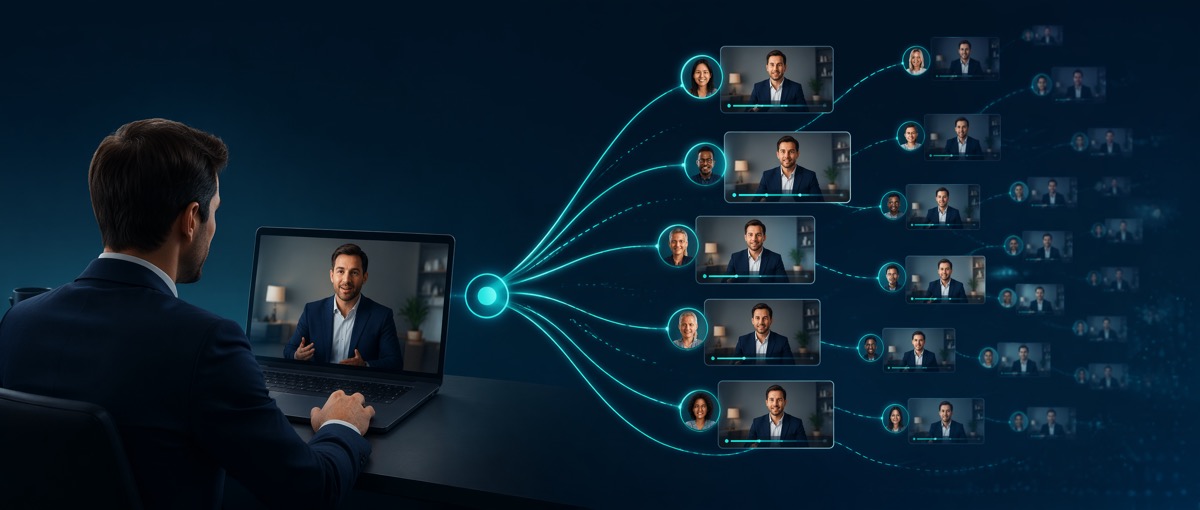
The product promise is simple. A sales representative records one video template. Tavus then generates thousands of personalized versions, with each recipient’s name, company information, lip sync, and voice delivery adapted as if the video had been made for that person. There is no manual editing, no one-by-one recording, and no expensive production cycle.
That productization strategy helped Tavus raise an $18 million Series A led by Sequoia Capital in 2023, after an earlier $6 million seed round, and become one of the visible AI video applications in the Salesforce ecosystem.
The interesting lesson is not only that Tavus has AI video technology. It is how the company turned a cool capability into an enterprise workflow that customers can justify paying for.
1. Narrow markets can be deeper markets
Tavus’ category choice is worth studying.
In 2023 and 2024, AI video was crowded. Runway iterated quickly, Pika went viral, Stability AI released video models, and HeyGen grew in digital avatars. Building another generic “type a prompt and generate a video” tool would have been difficult.
Tavus asked a better question: who needs video badly enough to pay for it?
The answer was B2B sales teams.
B2B sales has a strong need for personalized outreach. Generic outbound email performs poorly, while personalized video can improve attention and response. The problem is that manual personalized video cannot scale. Recording one video for one prospect is possible; recording 10,000 personalized videos is impossible.
Tavus enters exactly that gap: a job humans want to do but cannot do at scale.
This positioning is important. Tavus is not competing only inside the “AI video” category. It is competing inside B2B sales outreach, a category with known budgets and measurable return on investment. It is not selling something consumers find cool. It is selling something enterprises can connect to pipeline.
For AI founders, the question should not be “what can I do with AI?” It should be “who is already spending money on this job, and where is the workflow still inefficient?”
2. From AI capability to sellable product
Tavus’ strongest productization lesson is how it turns an AI capability into a complete workflow.
The core promise, “record once, generate 10,000 personalized videos,” is easy to understand. But enterprises do not buy a promise alone. Tavus wraps the promise in several product layers.
Reconstruct the workflow, do not merely improve it
Many AI video products help people make videos faster. They offer better generation, more controls, faster rendering, or easier editing. That is a productivity improvement for the existing video-production workflow.
Tavus takes a more radical path. It does not help salespeople record customer videos faster. It removes the need to record each customer video at all.
That is the difference between improving a workflow and reconstructing it. Improvement means doing the same task more quickly. Reconstruction means changing what the user has to do.
Close the loop from template to analytics
Tavus does not stop at generation. It packages the workflow in three layers.
The first layer is recording and templating. A user can record in the browser without professional equipment. The system identifies where personalization should happen and turns the recording into a reusable template.
The second layer is personalization and distribution. A team can import CRM data, generate personalized videos for each recipient, and send them through email or sales tools. Names, companies, product references, and lip sync are adapted automatically.
The third layer is tracking and analysis. After the videos are sent, the team can see who opened, how long they watched, where they dropped off, and whether they clicked the call to action.
This full loop turns Tavus from an AI video tool into a sales outreach platform. A sales leader does not only see time saved; they see potential conversion impact.
Embed inside existing tools
Tavus also integrates with tools such as Salesforce, HubSpot, Outreach, and Marketo. This is not a side feature. It is part of the product strategy.
Sales representatives do not want to export data, open another app, generate assets, and manually paste everything back. They want personalized video to appear inside the sales sequence they already use.
Integration lowers adoption cost, shortens time to value, and creates switching cost. Once the product is embedded inside CRM and outreach workflows, replacing it becomes harder.
For B2B AI products, integration is not a bonus. It is often the difference between a demo and a deployed workflow.
3. Who pays, and why
Tavus uses a hybrid of product-led growth and enterprise sales.
The free tier gives limited personalized video generation. The point is not to let a team use the product forever. It is to let a sales representative experience the full core workflow: record a template, import data, generate videos, send them, and inspect results.
That matters because the upgrade trigger is not frustration. It is proof. Once a salesperson sees that personalized video can improve outreach performance, the old manual process feels unattractive.
The paid path can move from individual use to team purchase and then enterprise deployment. A representative tries the product, sees a meaningful response, convinces the team, and the broader organization later needs security, SSO, dedicated controls, and procurement support.
The budget fit is also natural. B2B sales teams already spend meaningful money on Salesforce, Outreach, Salesloft, HubSpot, enrichment tools, and analytics. Tavus does not have to create a new budget category from scratch. It can attach itself to existing go-to-market budgets.
That is much easier than educating a market that has never spent money on the problem.
4. Distribution through B2B ecosystems
Tavus’ distribution strategy matches its product focus. It does not depend on consumer virality. It works through B2B ecosystems.
Marketplace presence in environments such as Salesforce AppExchange and HubSpot Marketplace brings high-intent visitors. People browsing those marketplaces are already using CRM or marketing tools and often have experience buying SaaS.
Content marketing also matters. Tavus can publish material about video outreach ROI, personalization best practices, and comparisons between generic email and personalized video. The goal is not only to advertise Tavus; it is to establish authority around the category.
The product itself can also create word of mouth. When a prospect receives a video that appears personally made for them, the reaction can be strong. That reaction is not mass consumer virality, but it is highly relevant within B2B buying circles.
5. Lessons for builders
First, choose a narrow entry point and embed deeply. Tavus did not try to beat every AI video generator. It focused on B2B sales personalization, where a smaller product can be the best product for one job.
Second, the moat for many AI products is not the model alone. It is the workflow: CRM integrations, sales-sequence placement, team collaboration, analytics, security, and compliance.
Third, “template plus AI variants” is a powerful product pattern. Record once and generate many versions can apply beyond video: landing pages, email campaigns, demos, pitch materials, and industry-specific collateral.
Fourth, in B2B AI, integration count can be a stronger PMF signal than raw signup count. If a product is inside the customer’s core system, retention can become structurally stronger.
Fifth, free strategy should create dependence on value, not dependence on free usage. Tavus’ trial path is designed to show a complete value journey before asking for payment.
Tavus still faces challenges. Generic AI video tools may add personalization. B2B marketing budgets can contract in weak markets. The personalized-video niche may have a ceiling unless the company expands into broader sales engagement. But the case already shows an important AI product lesson: do not build bigger AI for its own sake. Build deeper AI inside a valuable workflow.