
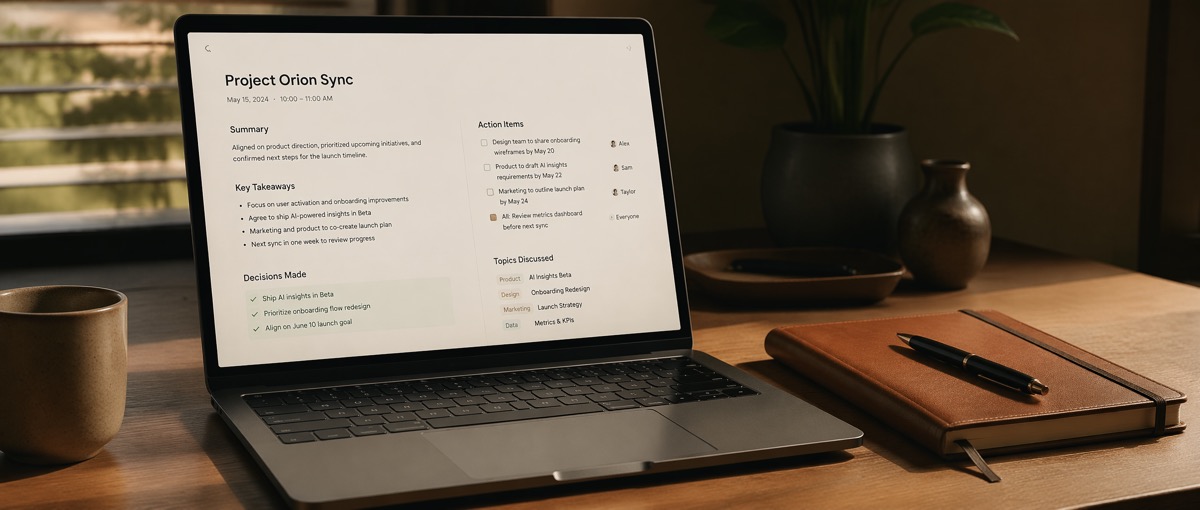
By 2024, the AI meeting-notes market already looked painfully crowded. Otter had early brand awareness. Fireflies had enterprise customers. Fathom attracted users with a free strategy. Zoom and Google Meet were adding AI summaries directly inside their platforms.
Then Granola launched as a Mac-only product from a small team. It did not send a bot into meetings. It did not support Windows. It did not work on mobile. On paper, that violates several SaaS growth playbooks.
Yet Granola survived and gained momentum. It raised a Series A in 2025, kept climbing in the Mac App Store productivity rankings, and generated a steady stream of social posts from users who said they could not go back after trying it.
The reason can be summarized in one sentence: while everyone else was building AI meeting recorders, Granola built an AI meeting notebook.
That distinction is the difference between product-market fit and product-market miss.
1. The ignored middle state
Consider a normal product review meeting. A participant has several choices.
They can focus on the meeting and take no notes, then reconstruct everything from memory later.
They can take notes manually while participating, which makes deep engagement harder.
They can invite a recorder such as Fireflies or Otter, then later search through a long transcript or recording for the important thirty seconds.
They can listen to the recording and manually rewrite useful notes after the meeting.
Each choice has an obvious flaw. The recorder option looks efficient, but it often transfers the organization burden back to the user. A transcript is a linear pile of noise. It is not a note.
Granola’s product is simple: it listens locally on the user’s Mac and produces the kind of structured notes the user would have written by hand.
It is not a smarter recorder. It is a notebook that understands speech.
The difference matters. A recorder’s logic is: I capture everything, and you filter it later. A notebook’s logic is: I understand what matters, write it down, and let you confirm or add context.
The first is AI bolted onto an old recording workflow. The second is AI-native product design around the job of remembering a meeting.
2. Why local listening is smarter than a meeting bot
Granola’s most counterintuitive product decision is that it does not join the meeting.
There is no Granola Bot in the Zoom participant list. It does not appear inside Google Meet. It quietly runs on the user’s Mac and listens through system audio or the microphone.
This is technically harder. Granola cannot rely on clean meeting-platform audio APIs. It has to handle noise, overlapping speech, and messy audio conditions. But the decision creates three major experience advantages.
First, there is no social awkwardness. If a customer sees an unfamiliar bot in a meeting, they may wonder who it is, what it records, and where the data goes. Even a brief explanation creates trust friction. Granola avoids that because it is invisible to other participants.
Second, privacy feels more controlled. Audio processing happens locally instead of starting from a visible cloud recording bot. That is not only a technical decision; it is a product statement about user data.
Third, the product is platform independent. It does not need a deep integration with one meeting provider. Zoom, Google Meet, a phone call, or another conferencing tool can all become note sources because the product listens at the system level.
Together, these advantages become a philosophy-level differentiation. Otter, Fireflies, and Fathom often compete on whose AI is smarter. Granola competes on who understands the user’s real meeting situation better.
3. Freemium designed to become a habit
Granola’s pricing is simple: Free, Pro, and Business. The subtle part is the free tier.
Many AI products make the free tier a damaged version of the product: weaker models, fewer features, and a limited preview. Granola takes a different path. Free users can experience a small number of complete meeting-note workflows.
That number is enough for a moderate user to try Granola across two or three weeks of real meetings. During that time, the product appears in important calls, produces structured notes, and teaches the user a new habit: open Granola before the meeting.
When the free quota ends, the user is no longer comparing Granola to a theoretical alternative. They are comparing it to a stack of notes Granola already created. Returning to manual notes feels slow. Switching to a bot recorder feels awkward and still requires cleanup. The paid plan becomes a way to preserve a proven workflow.
That is why the free tier is smart. It does not only let users taste a feature. It lets them experience a new work pattern long enough to miss it.
4. Growth without heavy paid acquisition
Granola’s early growth came largely from Product Hunt and word of mouth.
Product Hunt brought in the first group of users: knowledge workers who attend many meetings and are likely to try new productivity tools. Many of them are active on social platforms. When the first post-meeting note felt surprisingly good, they shared screenshots.
The growth chain was direct: strong product experience, voluntary sharing, more similar users, more feedback, and a better product.
The key is that Granola gives users something they want to show. A clean meeting note can make the user look organized and professional. Sharing it is not only promotion for Granola; it is also a signal about the user’s own workflow.
This resembles early Notion growth. Users shared Notion pages not only because they loved the tool, but because the pages made their own work look polished.
5. What builders can learn
First, in a crowded market, product philosophy can matter more than the feature list. If your product overlaps with competitors on most features, you need a different definition of the problem. Granola may not beat every competitor on raw transcription quality, but it changes the evaluation frame from “recording” to “note taking.”
Second, what you choose not to build can be as important as what you build. Granola did not build Windows, mobile, bots, or a cloud-first meeting recorder. Those omissions reinforce the product identity: a local AI notebook for Mac users.
Third, free strategy should create a point of no return. A free tier that gives two or three weeks of real usage can create habit. Once habit forms, payment feels like maintaining the new normal rather than buying an extra feature.
Fourth, AI-native products are not AI features added to old products. Otter is meeting transcription plus summaries. Granola is an AI notebook. That difference changes the product surface, privacy model, adoption path, and user expectation.
Granola’s story is a useful reminder that a red ocean can still contain room for a sharp product definition. It did not invent meetings, transcription, or note taking. It reframed the job with more respect for the user’s actual context.
Financial metrics and retention data for Granola are not publicly disclosed. Pricing and product information referenced in the original source come from the public product surface and should be treated as non-audited.