
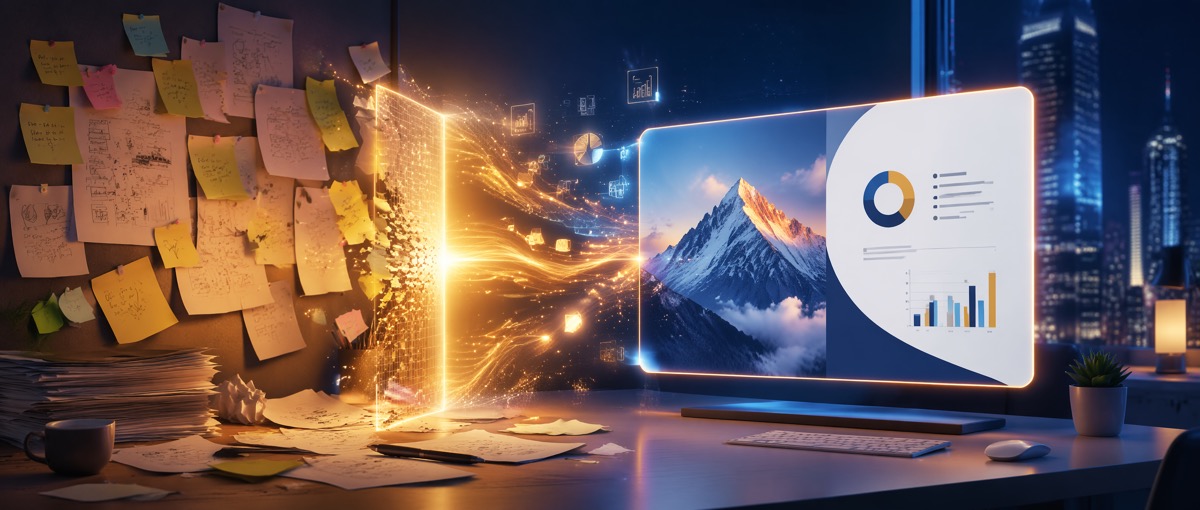
How long has it been since you made a presentation entirely by hand?
After ChatGPT exploded, dozens of tools started promising “one-click AI slide generation.” Gamma raised $110 million, Beautiful.ai became a Silicon Valley favorite, and Presentations.AI appeared everywhere in the AI presentation conversation.
But there is a quieter story in the same category. A Chinese company has already accumulated 30 million users in a market many people assume is dominated by Western products.
It is not Gamma, Beautiful.ai, or Presentations.AI. It is AiPPT.com, built by PixelBloom.
According to AICPB’s global AI ranking data for April 2026, AiPPT entered the global AI product growth-rate ranking at number 14, ahead of many better-known AI products. The company did not rely on loud launch events or a $100 million funding announcement. Instead, it used a practical combination of product, pricing, templates, and SEO to carve out a path in the crowded AI presentation market.
This article breaks down AiPPT across productization, commercialization, and growth.
1. It is not just “AI-generated slides”
Many people assume an AI presentation tool is simply ChatGPT plus templates. That misses AiPPT’s product logic.
AiPPT has three core creation modes:
Classic mode is the most direct “generate a presentation from one prompt” workflow. Users enter a topic, and the system organizes the outline, writes content, and matches it to a template. This is the version most people imagine when they hear “AI PPT.”
Flow mode is closer to a long document or web-style presentation. It fits information-heavy content that is meant to be read or browsed, not only delivered live.
Visual mode focuses on image hierarchy and visual design. Users can use AI to refine slides one by one instead of accepting a single generated deck.
Together, these modes cover different jobs. Some users need a fast proposal draft. Some need an information page that can be shared and read. Others need a more polished meeting or pitch deck.
The more important layer is the agent mode. AiPPT is not only filling templates with generated text. Its agent can perform deeper research and concurrent tasks. After a user enters a topic, the agent can search for information online, organize the argument, and generate visual content. The workflow is not “write an essay and turn it into slides.” It compresses research, organization, and expression into one product.
AiPPT also has a short time to value. On the free plan, a new user can generate two presentations per day. The first experience only requires one sentence, and a full deck appears about a minute later.
That matters because the product’s repeat-use opportunity is strong. Presentations are a naturally frequent workplace format: weekly reports, monthly reviews, quarterly summaries, annual retrospectives, project proposals, customer pitches, and class assignments. Every knowledge worker is a potential repeat user.
2. From 30 minutes to 1 minute
The traditional presentation workflow has many steps: choose a topic, collect materials, organize the outline, find a template, design the layout, tune colors, add images, add animations, and export. Even a basic deck can take 30 minutes to several hours.
AiPPT compresses that into four steps: input, generate, adjust, export.
The compression ratio is roughly 10:1. Work that previously took 30 minutes can often be completed in a few minutes.
What makes AiPPT feel like a product instead of a demo is the surrounding system.
Multi-mode input covers one-line prompts, documents such as PDF and Word, links, Markdown, and mind maps. This means AiPPT can accept the way users already prepare content instead of forcing them into a new input format.
A library of 200,000+ templates is not just decoration. It is a resource moat. With that many professionally designed templates, new users can usually find an acceptable visual direction for almost any scenario.
Digital-human video export turns a completed presentation into a narrated video. This maps to a real need: many users need course videos, product explainers, or sales material but do not want to appear on camera.
Multi-device coverage across web, desktop, and WeChat sharing lets users view and share decks from mobile contexts too.
The common logic is simple: AiPPT is not trying to replace the entire presentation habit. It upgrades the starting point. Users can still export PPTX files and edit in familiar tools, but the blank-page stage becomes much faster.
3. A four-layer PLG funnel
AiPPT uses a familiar SaaS freemium model, but the pricing ladder is carefully structured.
Free plan: two AI generations per day, 1,000 registration credits, 50 AI image generations per month, and 100 AI assistant uses per day. This is enough to evaluate the value, but not enough for heavy ongoing work.
Standard plan: 30 AI generations per day, access to the 200,000-template library and commercial template licensing, and document-to-presentation generation. This tier targets workers and students who make presentations regularly.
Professional plan: 15,000 credits per month, unlimited pages, 10 concurrent agent tasks, no watermark, five minutes of digital-human video, and advanced AI image models. This tier targets heavy creators.
Enterprise plan: custom pricing for organizational needs.
The funnel is clear: the free plan proves the value, the standard plan solves regular presentation work, the professional plan serves high-frequency and deep users, and the enterprise plan captures organization-level demand.
AiPPT also uses differentiated global pricing. In the Japanese market, visible annual pricing is roughly ¥9,331 for Plus, about $60, and ¥13,063 for Pro, about $85. That is lower than Gamma’s commonly referenced $96 to $240 annual range. The strategy is a form of “down-market pricing”: offer a product that is good enough at a lower price and capture the broad middle of the market.
4. Where 30 million users came from
AiPPT’s growth path is especially relevant for Chinese AI products going global.
Starting from the Chinese market gave AiPPT a strong SEO base. It attacked keywords such as “AI PPT,” “one-click PPT generation,” and “PPT AI assistant” on Baidu and other search surfaces. This is not a glamorous growth strategy, but it is durable.
Template-driven organic traffic turned the 200,000-template library into a content matrix. Each template page can become a separate SEO page that attracts long-tail searches from Google and Baidu. Searches such as “market analysis PPT template” or “thesis defense PPT template” can lead users into the product.
Education-market penetration gives AiPPT another seed-user base. It has dedicated pages for teachers, universities, high schools, lesson plans, and related scenarios. Students and teachers have strong usage frequency and social spread, which makes education a useful cold-start channel.
Global multilingual expansion follows a typical Chinese internet export path. AiPPT has a Chinese site at aippt.cn, an international site at aippt.com, and localized experiences such as a Japanese market with yen pricing. The pattern is to start in China, expand into Japan, Korea, and Southeast Asia, then move further into Western markets.
The flywheel is: free users create decks, frequent usage drives template discovery, the template ecosystem creates more searchable content, organic traffic brings in new users, and the new users restart the loop.
5. Three product decisions worth learning from
1. Templates are infrastructure, not decoration
Many AI presentation tools treat templates like wallpaper. AiPPT treats templates as a core asset: 200,000 designs across industries and scenarios. This changes the product strategy. When the template library is large enough, the AI generation does not need to be perfect on the first try. It only needs to reach a useful starting point, then let users refine from a good visual base.
2. Agent mode moves the product up a level
If “generate slides from one prompt” is version 1.0, agent mode is version 2.0. The agent can research, run concurrent tasks, search online, and produce structured presentation content. A user can ask for something like: “Analyze the AI video-generation market in Q2 2026 and create a pitch deck.” That is no longer simple template filling. It is an AI-native workflow.
3. Digital-human video is a smart expansion lane
While many competitors compete on prettier slide generation, AiPPT adds “presentation to digital-human video.” This expands the use case. Many users do not simply need a good-looking deck. They need a piece of content that can explain itself. Digital-human video shifts AiPPT from a presentation tool toward a broader content-creation tool.
6. Builder lessons
-
Do not build AI presentations as only a generator. Build AI plus a content system. AiPPT proves that an AI product’s defensibility is not only the model. It is the ecosystem around the model: templates, agents, input modes, export formats, and collaboration paths.
-
The middle market may be larger than the premium market. Gamma and Beautiful.ai focus heavily on design quality and premium positioning. AiPPT uses lower pricing, broader template coverage, and more input options to capture a wider middle market. The 30-million-user number suggests that market is large.
-
SEO is long-term infrastructure for AI products. AiPPT did not reach scale only through press coverage. It accumulated users through long-tail template pages and search demand. For many AI products, SEO is not optional.
-
A feature matrix can be more defensible than one headline feature. A single one-prompt slide generator can be copied quickly. A matrix of modes, agents, digital-human video, templates, and exports is harder to replicate.
-
Start from a familiar workflow, then expand the boundary. AiPPT starts from the old and familiar presentation workflow, then expands into digital humans, AI images, AI writing, and adjacent content creation. That expansion path lowers risk because users already understand the core job.
AiPPT’s story shows that, in the AI era, strong commercial opportunities often appear in old categories that AI reactivates. Presentations are a 30-year-old format, but AI makes the category interesting again. A Chinese AI product does not have to be the most technically radical company in the market. If it wins a vertical workflow deeply enough, it can still reach global scale.
Data sources referenced in the original article: AICPB global AI growth ranking for April 2026 and AiPPT official sites at aippt.com and aippt.cn.