
In the AI product market, most attention goes to products that seem to explode overnight. But one category is often underestimated: older products that existed before the AI wave and then redefined themselves through AI.
Fireflies.ai is one of the clearest examples.
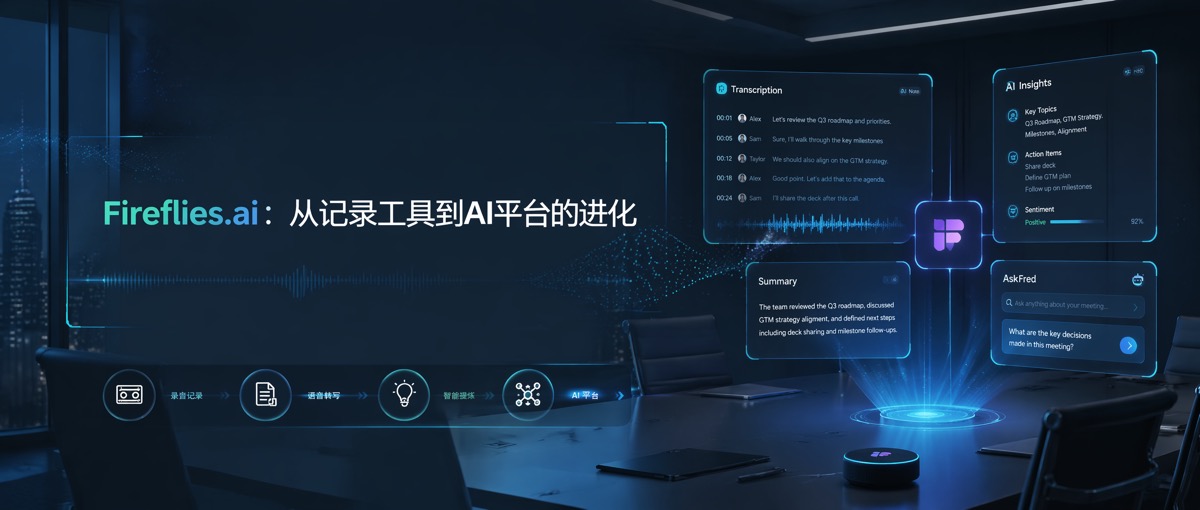
When it was founded in 2019, Fireflies looked like a normal meeting transcription bot. By 2026, it had evolved into an AI meeting platform combining Voice Agents, an AI Skills Store, and conversation intelligence. During 2025 and 2026, the product completed a key transition from “note-taking tool” to “meeting copilot.”
AICPB, the global AI product standards ranking platform, ranked Fireflies second in the AI meeting assistant category in April 2026, behind only Otter AI. Behind that position is a clear productization logic and a commercial flywheel.
01 What Problem Does It Solve?
Fireflies’ core value can be summarized in one sentence: meeting information should not disappear.
In traditional work, meeting participants run into four common problems:
- Incomplete memory: you listen and take notes at the same time, but important details still slip away.
- Poor retrieval: a data point from last week’s meeting exists somewhere, but no one can find it quickly.
- Weak follow-through: someone promises to follow up during the meeting, and then the action disappears.
- Hard synchronization: people who missed the meeting need extra time to catch up.
Fireflies attacks these problems one by one. It automatically joins meetings from calendars and platforms such as Zoom, Google Meet, and Microsoft Teams, transcribes the conversation in real time, generates AI summaries and action items, and syncs them into tools such as Slack, Notion, Salesforce, and HubSpot.
More importantly, it is no longer just a recording tool. The Voice Agents introduced during 2025 and 2026 can actively participate in meetings. Live Assist can provide real-time suggestions. The AI Skills Store offers more than 200 prebuilt vertical skills, from sales coaching and recruiting evaluation to user research and engineering retrospectives.
02 Three Layers of Product Evolution
Fireflies’ productization path is representative of a broader AI pattern.
Stage one: point solution, 2019-2022
The product did one thing: meeting transcription. Its core affordance was the transcript. The business value was limited, but it earned a position inside the meeting workflow.
Stage two: knowledge-layer product, 2022-2024
On top of transcription, Fireflies added AI summaries, action-item extraction, and keyword search. It moved from “recording” to “management.” Users were no longer only getting text. They were getting a searchable and shareable information asset.
Stage three: platform layer, 2025 onward
Fireflies added Voice Agents that participate in meetings, an AI Skills Store with more than 200 vertical skills, and Live Assist for real-time advice. It moved from observer to participant.
The lesson for AI product builders is direct: do not try to be a platform on day one. First, find a high-frequency workflow node. Then accumulate a data asset around that node. Finally, use that asset to build higher-value service layers.
Fireflies’ strategy keeps circling around one core asset: meeting information. It first used free transcription and summaries to acquire users, then used AI Skills and Voice Agents to increase value per user, and finally used compliance certifications such as SOC 2, HIPAA, and GDPR to open enterprise sales.
03 Commercialization: AI Credits Are a Smart Design
Fireflies uses a freemium SaaS model with per-seat monthly subscriptions. Its pricing structure is:
- Free: free forever, with unlimited transcription and AI summaries, 400 minutes of team storage, and 20 AI credits.
- Pro: $10 per seat per month when billed annually, with 8,000 minutes of storage per seat, video recording, Personal Assistant, AI Skills, and Voice Agents.
- Business: $19 per seat per month when billed annually, with unlimited storage, multilingual mode, conversation intelligence, and team analytics.
- Enterprise: $39 per seat per month when billed annually, with SSO and SCIM, audit logs, HIPAA compliance, and private storage.
The most interesting part is the AI Credits design.
Fireflies does not price advanced AI work by token, and it does not make everything unlimited. It uses credits as the unit for advanced usage. That design is smart for three reasons:
- Cost control: every AI call, such as generating summaries, extracting action items, or running AI Skills, has model inference cost. Credits cap that exposure.
- Upgrade pressure: free users consume 20 credits, feel the product value, and then have a clear reason to move to a paid tier.
- User psychology: credits feel like a measurable resource. They are easier for users to understand than tokens and less frustrating than opaque feature limits.
The value gradient across tiers is also clear. Free is the hook. Pro serves individual professionals. Business is for collaboration. Enterprise answers security and compliance requirements. Each tier adds features that map to a specific buyer’s decision point.
04 Distribution: Integrations as Channels
Fireflies’ distribution strategy has one defining feature: it does not rely mainly on traditional advertising. It turns integrations into channels.
The product is deeply integrated with Zoom, Google Meet, Microsoft Teams, Slack, Salesforce, HubSpot, Notion, and other mainstream work tools. Users discover Fireflies while working inside those ecosystems. The Chrome extension is one-click to install, calendars sync automatically, and meetings can be joined automatically.
The product-led growth mechanics are clear:
- Low-friction start: users do not need heavy configuration. After installation, the product starts working.
- Immediate value: after the first meeting, the user sees a transcript and AI summary.
- Team virality: one person shares a meeting recap with the team, and viewers become potential users.
SOC 2 Type II, HIPAA, and GDPR compliance also make enterprise sales easier. Compliance certification looks like a cost center, but for enterprise software it often becomes the real moat. Once a product passes procurement review, switching costs rise.
05 Action Guide for Builders
Fireflies.ai offers several concrete lessons.
First, do not start by trying to become a platform. Fireflies spent years doing the unglamorous job of meeting transcription. Only after accumulating enough meeting data and workflow trust did it add AI skills and Voice Agents. High-frequency node, data asset, value-added service: that path is reusable.
Second, design pricing around AI marginal cost. AI Credits are a good balance between user perception and cost control. Token pricing is too technical for most users, while fully unlimited AI can make cost unpredictable.
Third, integrations may be the best acquisition channel. Fireflies’ growth is tied to the work platforms where meetings already happen: Zoom Marketplace, Chrome extensions, Slack integrations, and CRM ecosystems. If an AI product can embed into an existing workflow, acquisition is often easier than pulling users into a new standalone destination.
Fourth, compliance is not just cost. It is a barrier. SOC 2 and HIPAA work can be painful, but after passing it, the product moves from “AI tool” into software that enterprises can buy.
Key data snapshot for Fireflies.ai:
- Founded: 2019, making it an “old tree with new growth” AI product.
- AICPB ranking: number two in the AI meeting assistant category in April 2026.
- Pricing: Free / $10 / $19 / $39 per seat per month when billed annually.
- Core selling points: Voice Agents, AI Skills Store with more than 200 skills, and Live Assist.
- Compliance: SOC 2 Type II, HIPAA, and GDPR.
Disclosure: The data in this article is drawn from Fireflies’ website, AICPB public rankings, and other verifiable public sources. The business model analysis includes reasonable inference and is not investment advice.