
In early 2024, when most AI coding tools were still focused on code completion, a VS Code extension called Claude Dev quietly appeared.
It did something that felt almost unreasonable at the time: it let AI not only write code, but also read files, run terminal commands, inspect browser context, and help complete changes under human supervision.
Eighteen months later, the product had become Cline. It had roughly 64,000 GitHub stars, a claimed 8 million developer users, and a product surface that had expanded from a single VS Code extension into a CLI, JetBrains plugin, SDK, multi-agent Kanban workspace, and mobile monitoring experience.
This is not just another success story about an AI coding assistant. It is a product strategy case about category definition, open source as distribution, and the path from a focused entry point to a broader developer platform.
What Problem Does Cline Solve?
Before Cline, AI coding tools usually fell into two groups.
The first group was code completion, represented by GitHub Copilot. You write a comment or a partial line, and the model suggests the next piece of code. The advantage is low friction. The weakness is that the developer still has to drive project-level refactoring, debugging, testing, and deployment.
The second group was chat-based assistance. You paste code into ChatGPT or another assistant, receive an explanation or suggested patch, manually apply the change, switch back to the editor, test it, hit an error, then paste that error back into the chat.
Cline identified the gap between those two modes. AI should not only make suggestions. It should be able to act. But because code changes are risky, the product also needs visible human supervision.
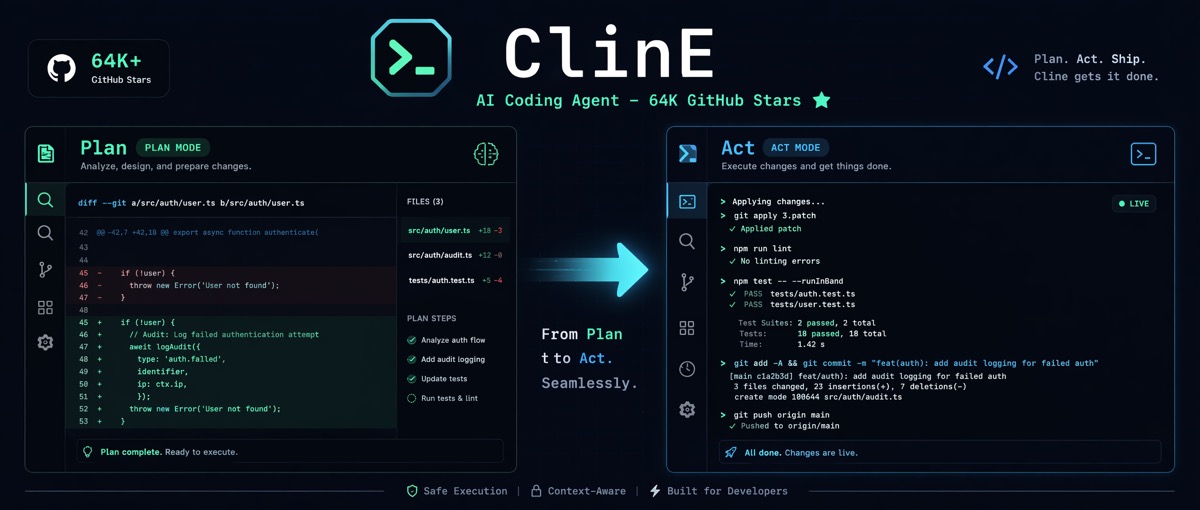
That is the core insight behind Cline’s Plan mode and Act mode. The AI first proposes a plan. The developer reviews and confirms it. Then the agent executes: reading files, editing code, running tests, and fixing errors step by step.
The idea sounds simple, but it changed the interaction model for AI coding tools. Later products such as Cursor and Windsurf also moved toward similar supervised-agent workflows.
Productization: From One Extension to a Platform
Cline’s product path is instructive because it did not start as a platform. It started from one specific point in the developer workflow and expanded only after that point proved valuable.
Starting Point: The VS Code Extension
Cline’s first product form was a VS Code extension. This was the right wedge because VS Code is already where many developers live. Installation is familiar, the usage surface is close to the code, and the product can show value without asking the user to adopt a separate environment.
The user installs an extension, configures an API key, and begins interacting with an AI coding agent directly inside the editor. That short path to first value matters. For developer tools, a product that needs a long setup process loses many users before they ever feel the core promise.
First Expansion: JetBrains
After covering the VS Code audience, Cline expanded to JetBrains IDEs such as IntelliJ IDEA, PyCharm, and WebStorm. This was not a random platform checklist. It covered another major group of professional developers whose daily work happens outside VS Code.
The lesson is that a platform expansion is strongest when it follows an existing workflow, not when it asks users to move to a new destination.
Second Expansion: CLI
Many developers want to use AI inside the terminal rather than inside an IDE panel. Cline CLI addresses that behavior. A developer can run a command such as:
cline "run tests and fix failures"The CLI also opens automation use cases. If an agent can operate from the terminal, it can be embedded in scripts, local workflows, and eventually CI/CD processes.
Third Expansion: SDK
In May 2026, Cline introduced an SDK. This changes the product’s role. Instead of being only an end-user tool, Cline can become an agent engine that other developers use to build their own AI development workflows.
That is the point where a tool begins to behave like infrastructure. The product no longer grows only through its own interface. It grows through the interfaces other people build around it.
Fourth Expansion: Multi-Agent Kanban
Cline’s most ambitious current step is multi-agent orchestration. Instead of running one AI agent, a user can run many. Each agent can have its own working directory, automatic commits, and dependency relationships. The user manages AI agents more like a small engineering team than a single assistant.
This is a meaningful product direction because it moves the mental model away from “AI helps me type” and toward “AI executes work units that I supervise.”
Fifth Expansion: Mobile Monitoring
In April 2026, Cline added mobile capabilities. A developer can check the status of agents running on a home or work machine from a phone. At first glance this may look like a stretch, but it points to a larger idea: future coding agents do not need to stay on the same screen as the user.
The expansion logic is clear: start from a high-frequency touchpoint, the editor; then cover more of the developer workflow; then become the underlying infrastructure for AI coding agents.
Commercialization: How Can Open Source Make Money?
Cline uses a familiar open-source commercial model: free community usage plus paid enterprise offerings.
The public pricing page frames two layers:
| Layer | What It Offers | Commercial Role |
|---|---|---|
| Open Source | VS Code extension, JetBrains plugin, CLI, SDK, and core agent capabilities, with users bringing their own API keys | Distribution, adoption, trust, and community feedback |
| Enterprise | SSO, SLA, dedicated support, centralized billing, and role-based access control | Monetization for teams and organizations |
There are also signs in the GitHub commit history of a possible ClinePass subscription service, suggesting that the company may be exploring a paid layer for individual power users.
The elegance of this model is the separation of jobs.
The open-source layer handles distribution. GitHub becomes a marketing engine. A developer tries Cline, finds it useful, stars the repository, shares it with a colleague, or opens an issue. The usage loop compounds without paid acquisition.
The enterprise layer handles monetization. Once a technical team begins using Cline at scale, it needs centralized management, security controls, compliance, support, billing, and reliability guarantees. Those are the features a company can charge for without damaging the free core.
The hard question is how high the ceiling is between free and paid. If most users can bring their own API key and access the core experience for free, the enterprise value proposition must be strong enough to support a business. Cline’s answer appears to be higher-order collaboration and management features, such as SDK usage and multi-agent orchestration, that teams cannot easily recreate by simply installing the open-source extension.
Distribution: GitHub as Free Water
Cline’s distribution is built almost entirely on the developer ecosystem.
GitHub open source is the largest acquisition channel. Every star, fork, issue, pull request, and release is a public signal. Developers discover the project, try it, star it, recommend it, and sometimes contribute back.
VS Code Marketplace is another natural discovery surface. A developer searching for “AI coding agent” or “Claude coding” can find Cline at the moment of intent.
Community operations reinforce retention and word of mouth. Cline has an active Discord community and a subreddit where users share workflows, report issues, and help each other. For a technical product, community support is not a side activity. It is part of the product experience.
Content marketing also matters. The Cline blog publishes technical essays such as “Architects or Tenants,” which discusses infrastructure lock-in risk. These pieces travel through Hacker News and developer communities because they speak to real technical concerns, not only product updates.
Three Moves Builders Can Copy
1. Use Plan and Act to Reduce the Fear of Autonomy
Many AI products face the same tension: if the AI is too weak, users see no value; if it is too autonomous, users become anxious.
Cline’s Plan and Act model is a clean answer. Before the agent changes the project, it shows a plan. The user can confirm, adjust, or reject it. That preserves the power of autonomy while keeping the user in control.
2. Expand from One Touchpoint into a Platform
Do not start by declaring that you are building a platform. Cline started with one focused surface, the VS Code extension. After proving value there, it expanded to JetBrains, CLI, SDK, Kanban, and mobile.
Each new surface mapped to a distinct user scenario. The expansion was not just feature accumulation. It was coverage of the developer workflow.
3. Treat Open Source as a Distribution Engine
If your users are developers, open source can be one of the most efficient distribution strategies. GitHub stars are public trust signals. Issues and pull requests are feedback. Community discussions become education and support.
The requirement is that the product must be good enough for developers to willingly attach their reputation to it by starring, recommending, or contributing.
What Is Hard to Copy
Cline also benefited from advantages that are difficult to reproduce.
First, it had early category timing. Cline was one of the first products to make the AI coding agent category feel concrete. While many competitors were still framed around completion, Cline let AI execute multi-file changes under supervision. That category memory is difficult for later entrants to erase.
Second, it rode the model capability wave. Cline’s rise aligned with improvements in models such as Claude 3.5 Sonnet. The product became more useful as the underlying models became better at reasoning, tool use, and code edits.
Third, it arrived during a golden period for open-source AI tools. In 2024 and 2025, developer enthusiasm for open AI workflows was unusually high. Cline fit that culture.
Signals to Watch
Cline now faces several important questions.
The first is differentiation. Cursor, Copilot, Windsurf, and others are quickly adopting supervised-agent patterns. If every product supports similar Plan and Act flows, Cline needs a new layer of difference.
The second is monetization sustainability. Open source can create massive adoption, but adoption is not revenue. If only a small percentage of the claimed 8 million users will pay, the enterprise and subscription layers must carry the business.
The third is category change. AI coding agents are evolving quickly. If models become capable enough to complete large development tasks independently, the current “coding agent” category may shift into a new operating model.
Even with those risks, Cline has already proved an important point: in a crowded market, redefining the category can create more room than competing feature by feature.
For AI builders, the larger lesson is simple. The winning move may not be to make a slightly better assistant. It may be to change what users believe the product category should do.
This case study is based on Cline’s official website, GitHub repository, pricing page, and product materials referenced in the local source research.