
An Underrated Pain Point
Almost every team has seen some version of this problem: it takes three weeks to teach a new hire how to use an internal system; every workflow update requires new screenshots, formatting, and instructions; SOPs are outdated almost as soon as they are finished.
Nobody wants to write documentation. But without documentation, teams become chaotic.
Traditional solutions such as Scribe and Guru still carry the same burden: someone has to set aside time to write the documentation. For teams that are already overloaded, that is one more job.
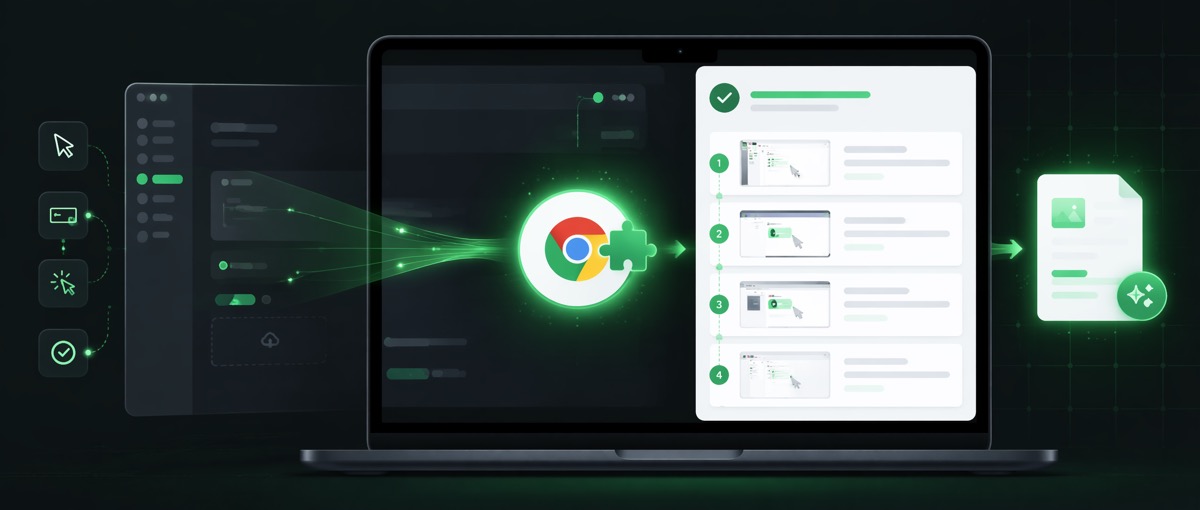
Tango’s product logic is different: you do your normal work, and it automatically generates a step-by-step guide.
Productization: Turning the Output into the Product
Tango’s productization strategy is worth studying. It does not help users “write documentation better.” It makes documentation a byproduct of the user’s actual job.
After installing the Chrome extension, the user operates software as usual: clicking buttons, filling forms, and navigating pages. Tango records each step in the background, automatically capturing screenshots, adding annotations, and generating explanatory text.
The result is a complete, shareable, step-by-step guide. The user only needs to make small edits, and in many cases can use it immediately.
The elegance of the model is that it does not require the user to change behavior. Users do not need to learn a new tool, change their workflow, or even think, “I am creating documentation.”
From an ROI perspective:
- Traditional workflow: 30 minutes of doing the task + 60 minutes of writing documentation = 90 minutes
- Tango workflow: 30 minutes of doing the task, with documentation generated automatically = 30 minutes
That is a 200% time saving, and the documentation is often more accurate because the AI does not forget steps.
Customer cases support this logic. Jasco Manufacturing reported a 90% reduction in documentation-related errors after using Tango. SEARHC used Tango to help roll out Workday for 1,400 employees.
Commercialization: Freemium First, Team Revenue Next
Tango follows a classic PLG, or product-led growth, commercialization path:
- Free tier: individual users can use the core feature for free, with the Chrome extension ready to install.
- Team plan: seat-based pricing adds collaboration, branding, and analytics.
- Enterprise plan: SSO, permission management, and custom deployment.
This layering is smart. The free tier has almost no adoption friction. A user installs the extension and quickly reaches the “wow moment”: the guide generates itself. Once a team starts accumulating documents, the motivation to upgrade emerges naturally.
Distribution: Chrome Extensions Are a Golden Entry Point for B2B PLG
Tango’s distribution depends heavily on the Chrome Web Store. The logic is straightforward:
- Its target users, including IT managers, operations staff, and training leads, already work in Chrome every day.
- The experience loop is short: install, use, see the result, often in under five minutes.
- Sharing creates natural spread: a user creates a guide, shares it with colleagues, and those colleagues install the extension too.
From IndieHackers community discussions, this “do the work and get the documentation automatically” experience has built-in virality. Every shared guide becomes a free promotion for Tango.
Actions Builders Can Copy
1. Turn the Byproduct into the Product
Do not only ask, “What tool does the user need?” Ask, “What is the user already doing, and can the output of that process become the product?”
Tango’s insight is that every software operation already produces the raw material for documentation: screenshots, steps, and sequencing. Tango collects and organizes it.
2. Reduce the Cost of Reaching the Wow Moment
Tango can deliver its core value within five minutes of installation. The most important product metric is not always DAU; it may be time from first seeing the product to the first wow moment. Shorter is better.
3. Chrome Extension + PLG = Low-Cost Distribution
For B2B tools, a Chrome extension is one of the lowest-cost and most precise distribution channels available. Users actively search, install, experience value immediately, and share with colleagues. That loop is naturally suited to SaaS.
4. Quantify Value with Customer Cases
Jasco Manufacturing’s “90% fewer errors” and SEARHC’s “1,400 employees trained” are strong value anchors. Specific numbers are far more persuasive than claims such as “improves efficiency.”
The First-Mover Advantages That Are Hard to Copy
Tango’s first-mover advantage is not purely technical. Generating step-by-step guides is not an extremely high technical barrier. The harder-to-copy advantages are:
- Data accumulation: large volumes of user operation data can train more accurate guide-generation models.
- Behavioral habit: once users expect “a guide appears after I finish the task,” switching becomes harder.
- Guide network: user-generated guides become a content moat. The more operational guides Tango owns, the more likely new users are to find templates they need.
Signals Worth Watching
Tango is currently positioned as a documentation generation tool, but its long-term ceiling depends on whether it can move upward into an enterprise knowledge management platform. If it can automatically update guides when software interfaces change, it could become a real challenge to traditional knowledge management tools such as Confluence, Notion, and SharePoint.
For AI builders, Tango’s productization logic is especially useful: finding a vertical scenario where “the result is the product” is often a better path to defensibility than building a generic AI tool.
AI Product Scout tracks the commercialization paths of global AI products. This article is a business case study and does not constitute investment advice.