
In June 2026, an e-commerce AI agent called StoreClaw won both Product of the Day and Product of the Week on Product Hunt.
In a market flooded with AI products, a vertical product does not reach that level without an unusual underlying logic.
Before breaking down StoreClaw, look at two customer data points:
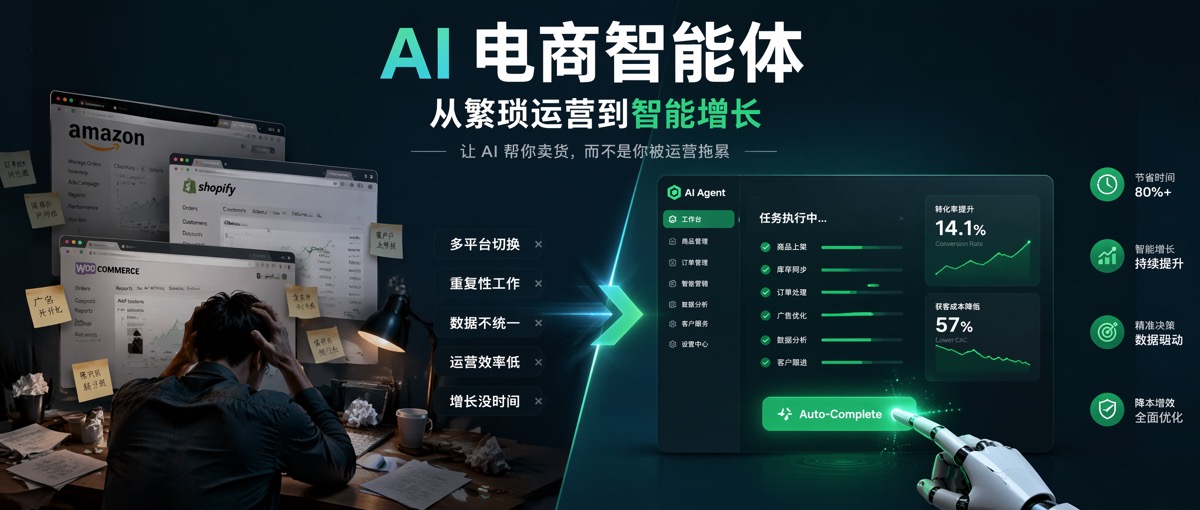
Twinkle Star, an Amazon lighting brand with $15 million in annual sales, used StoreClaw to shorten new SKU launch cycles from 5-7 days to 2 days, reduce content costs by 70%, and lift listing conversion from 9.3% to 14.1%.
INCENZO, a three-person Shopify natural fragrance brand, used StoreClaw to automate 85% of its operating workflows, increase organic search traffic by 142%, and reduce customer acquisition cost by 57%.
These are not abstract promises. They are reported customer cases.
StoreClaw’s success points to a paradigm shift: AI products are moving from “advisor” to “executor.” This is not only one product’s win. It is a signal that AI agent commercialization has moved from proof of concept into scalable deployment.
1. The Real Pain for Sellers Is Not Knowing What to Do. It Is Having No One to Do It.
Start with the real situation of an e-commerce seller.
A typical cross-border e-commerce operator must manage Amazon, Shopify, WooCommerce, and other platforms at the same time. Each platform has its own backend. Daily work includes product listing and optimization, keyword research, PPC ad management, competitor price monitoring, inventory audits, SEO/AEO/GEO content strategy, email marketing, and social media operations.
These tasks are scattered across five to eight tools and admin systems. Sellers repeatedly log in, export data, make decisions, and execute. A store with any meaningful scale usually needs a three-to-five-person team just to keep operations moving.
The market has plenty of “AI advice tools.” Ask one how to optimize a product title and it can give decent suggestions. But after the advice comes the real work: change the title, upload images, adjust ads, update listings. The seller still has to do it manually.
It is like having 100 coaches on the sideline telling you how to play, with no one willing to step onto the field.
StoreClaw’s product insight is exactly here: sellers do not lack advice. They lack someone who can finish the work.
2. The Product Philosophy of “Ready to Run”: No Empty Chat Box
Most AI products open with a familiar pattern:
An empty chat box plus “How can I help you?”
StoreClaw starts differently.
When you open StoreClaw, you do not see an empty input field. You see four loaded modules: store operations automation, SEO growth engine, social content factory, and intelligent website builder.
Each module comes with e-commerce-specific AI skills: store diagnostics, automatic listing optimization, PPC ad management, lifecycle email workflows, SEO/AEO/GEO strategy execution, and more. They are ready out of the box.
Connect your Shopify or Amazon store, and within minutes StoreClaw begins working automatically.
That matters because users do not need to learn prompting, configure complex automation flows, or even decide what they should ask AI to do. The product has already anticipated the workflow and placed the most important functions in front of the user.
The product philosophy is simple: a good AI agent should not first make the user think about how to use AI. It should directly complete the work.
StoreClaw co-founder Steven Zhou said the same thing more directly in the company’s blog:
Sellers do not need another dashboard or chatbot. They need an AI growth engine that can diagnose, decide, and execute across stores, with human approval at every step.
That sentence captures the core of AI agent productization: autonomous execution plus controlled approval.
StoreClaw’s agent is not a fully automated black box. It uses approval at every step. The AI makes decisions and executes based on store data, but key moments such as price changes, ad budget changes, and major content publishing require human approval. Efficiency improves without sellers losing control.
3. Commercializing AI Agents: Credits Plus a Freemium PLG Path
StoreClaw follows a classic PLG, or product-led growth, path:
- Free entry: new users receive 300 free credits and can try core functions without a credit card.
- Usage-based payment: basic functions are free, while advanced features and extra usage consume credits.
- Tiered expansion: as the store grows, users naturally upgrade into higher paid tiers.
The model works because:
- Trial friction is near zero. Sellers can receive value before making a purchase decision, removing the biggest conversion obstacle.
- Upgrade is value-driven. Once AI helps a seller make more money, paying more feels like a good trade, not just another cost.
- Data creates a natural lock-in. Store operating data, content strategy, and A/B test history accumulate inside the agent. Over time, switching costs arise from better performance, not from artificial technical lock-in.
Based on public information, StoreClaw’s product matrix now covers the full e-commerce operations loop. Future expansion could include supply chain management, inventory forecasting, multilingual localization, and brand compliance review. Each step deepens the same addressable market rather than jumping into an unrelated one.
4. Growth Engine: Product Hunt, Quantified Cases, and a Word-of-Mouth Flywheel
StoreClaw’s growth path is almost textbook PLG.
Step one: Product Hunt launch.
Winning #1 Product of the Day and #1 Product of the Week gave StoreClaw seed users and media attention immediately after launch.
Step two: use real cases to build trust.
Twinkle Star and INCENZO do the marketing work through their own numbers: 14.1% conversion, 57% lower CAC, 142% higher organic traffic. For e-commerce sellers, these metrics are more persuasive than any brand campaign.
Step three: community distribution plus SEO compounding.
Shopify and Amazon seller communities are natural distribution channels. When one seller says, “StoreClaw lifted my conversion rate by five points,” others will try it. At the same time, the company blog publishes long-tail content around SEO optimization and operations, creating a search-traffic moat.
The logic behind this entire system is that the growth engine of an AI product should be measurable outcomes, not flashy features.
5. Three Core Lessons for AI Product Builders
Lesson One: Skills Before Conversation
Most AI products begin with an empty input field. StoreClaw proves another path: preload domain skills first, then let users converse.
This is not only a UX decision. It is a philosophical divide. If you are building a vertical AI product, the first thing users see should be functions they can use immediately, not a tutorial on how to use you.
Lesson Two: Execution Is 100 Times More Valuable Than Advice
If your AI product only gives advice, such as how to write copy or optimize keywords, you face two problems:
- Users still have to execute manually, so perceived value drops sharply.
- Your product can be replaced by the next “better advisor.”
StoreClaw’s direction is to move from “telling you what to do” to “doing it for you.” In the AI agent era, completeness of execution is more valuable than depth of reasoning alone.
Lesson Three: Measurable Results Are the Best Growth Engine
StoreClaw does not rely mainly on ad spend or a large sales team. Its core fuel is ROI data that customers can verify with revenue and cost numbers.
When an AI product helps users lift conversion by five points, reduce cost by more than 50%, or automate 80% of a workflow, those numbers become the strongest possible growth loop.
From the first day of product design, build a feedback loop that measures outcomes. Do not only let AI do work for users. Let AI show users how much work it did and how much value it created.
6. What to Watch: Three Challenges Ahead
StoreClaw still faces real uncertainty:
- Pressure from platform-native AI: Amazon and Shopify are both actively launching native AI features. The differentiation space for independent AI agents may narrow as platform investment increases.
- LTV validation: The lifetime value and retention dynamics of a credit-based model are central to business health, but public data is limited.
- Expansion beyond cross-border e-commerce: StoreClaw’s current core users appear to be cross-border e-commerce sellers. Its ability to expand across categories will influence its TAM ceiling.
Closing Thought
In 2026, the AI industry’s keyword has shifted from “parameter race” to “value delivery.”
Investors and users no longer pay merely for powerful model capability. They care about one question: What problem does this AI product solve, how much cost does it save, and how much value does it create?
StoreClaw’s biggest lesson is not technical. It is product thinking:
Do not build a smarter AI. Build an AI that gets the work done.
In that sense, StoreClaw’s win is also a win for execution-oriented AI agents. It proves that in the second half of AI commercialization, productization beats model capability, execution loops beat advice quality, and measurable outcomes beat any kind of brand marketing.
Data note: customer case metrics are based on StoreClaw’s publicly disclosed case studies at storeclaw.ai/blog, and Product Hunt ranking information comes from official launch materials. Other referenced company data comes from public media reports.