
While everyone is chasing foundation models, conversational AI, and general agents, one company has quietly built an AI business with nine-figure annual revenue in a field that looks traditional: dentistry.
That company is Overjet.
Founded in 2018, Overjet has raised more than $160 million from investors including General Catalyst and Insight Partners. More importantly, it has received multiple FDA clearances and is reshaping a dental market worth hundreds of billions of dollars annually.
Why dentistry? Why Overjet? And what can founders learn from it?
Dental AI: An Underrated Gold Mine
When people discuss medical AI, they often think first of radiology: lung nodule detection, fracture recognition, retinal screening. Dentistry is often overlooked.
The market is enormous. The U.S. dental services market is roughly $170 billion per year, and China’s market is growing rapidly, with projections around RMB 300 billion in 2025. But dentistry is highly fragmented. The U.S. alone has more than 200,000 independent dental practices, most with fewer than five people.
Fragmentation means low digitization. Many dental clinics still rely on handwritten records, manual insurance checks, and phone-based patient follow-up. That is exactly where AI can enter.
More importantly, dental AI has an advantage that many other medical AI subfields lack: clear willingness to pay.
Dentists use AI to read X-rays faster, improve diagnostic accuracy, and increase case acceptance. Insurers use AI to review claims faster and reduce fraud or incorrect payouts. Both the supply side and demand side receive quantifiable financial benefits from AI, which is rare in healthcare AI.
Overjet’s Three-Step Productization Path
Overjet did not become well known overnight. It followed a clear three-step route.
Step One: A Focused Breakthrough With FDA-Cleared Imaging AI
Overjet began with the most essential use case: AI analysis of dental X-rays.
Dentists rely on X-rays for diagnosis, but traditional interpretation has serious issues. It is subjective, so different dentists may diagnose the same image differently. It is inefficient, because doctors review images manually one by one. It is also hard for patients to understand, because black-and-white X-rays do not easily communicate why treatment is necessary.
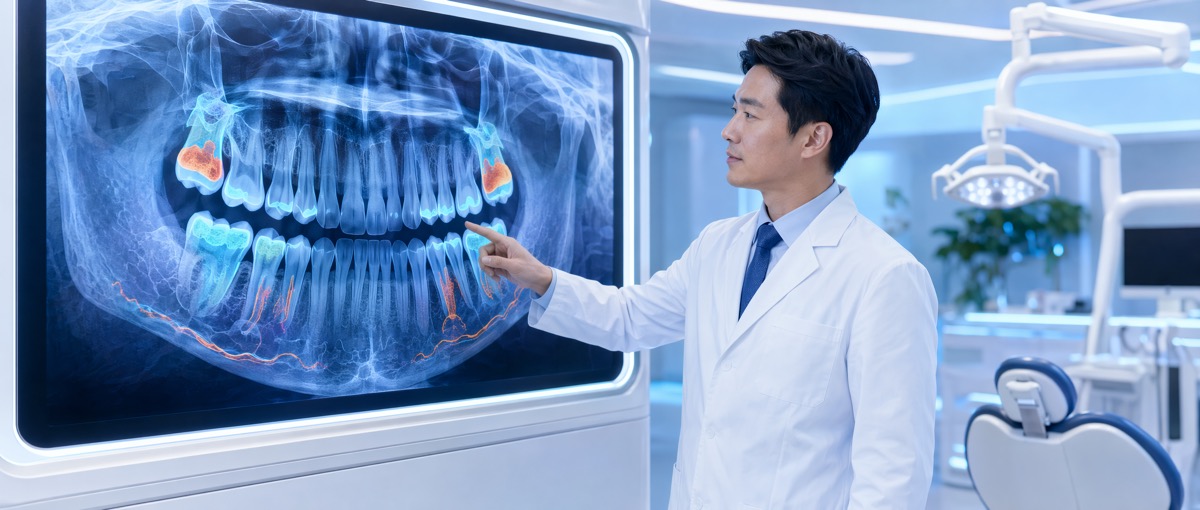
Overjet’s Vision AI product addresses these problems directly. AI marks cavities, periodontal disease, and other abnormal regions on X-rays with color and boundaries, making lesions clear. In 2022, it received the first FDA clearance for dental AI and later obtained additional clearances.
The key decision was to enter through the most standardized diagnostic step instead of trying to do everything.
Why not start with the full workflow? Because imaging analysis is easier to standardize, verify, and submit for regulatory approval. Win one nail first, then build the hardware store around it.
Step Two: A Two-Sided Platform Serving Providers and Payers
After FDA clearance, Overjet did not stop. It quickly found a more lucrative opportunity: dental insurance claims.
Dental insurance claims are inefficient. Clinics manually verify coverage, submit claim materials, and wait for review. Insurers also need large teams to assess whether diagnoses are reasonable and payouts are accurate.
Overjet’s logic was smart: if AI can understand X-rays, why not also let it understand insurance policies? It launched Dental Insurance Verification, automatically verifying patient coverage and providing code-level benefit details before appointments.
For clinics, this reduces insurance-related administrative work and can shorten claim cycles from weeks to days. For insurers, AI-driven claim review can sharply reduce review cost.
This is Overjet’s secret weapon: serve both providers and payers, with both sides willing to pay. One AI model produces two revenue streams.
Step Three: Platformization Through Voice AI and Imaging Software
If the first two steps were driving piles, the third is building the structure.
Overjet later launched IRIS AI-Native Imaging and Voice AI Suite. IRIS embeds AI directly into imaging software, replacing traditional standalone imaging systems. Voice AI lets dentists dictate diagnoses, while AI generates clinical notes and connects them to imaging data.
The core logic is to increase customer stickiness and contract value by expanding the product matrix. If a clinic already uses Overjet’s imaging AI and insurance verification, moving to IRIS imaging and Voice AI is a natural next step. Each added product increases migration cost.
At this stage, Overjet has moved from “an AI imaging tool” toward “a dental AI operating system.”
Moat: Why Is It Hard to Catch Up?
Overjet does have competitors, including VideaHealth and Pearl. But it has built several moats that are difficult to copy.
Regulatory Barrier
FDA clearance is a high barrier in dental AI. Clinical trials and approval typically take two to five years and millions of dollars. Overjet’s multiple FDA clearances mean that even if competitors start today, catching up can take years.
300+ Insurance Integrations
Integrating with more than 300 insurers is tedious work. Each payer has different interfaces, formats, and rules. This becomes a snowballing moat: the more insurers integrated, the more valuable the product is to new users, and the higher the barrier for new entrants.
Clinical Data Flywheel
Overjet processes large volumes of X-rays and claims data every day. More data improves models. Better models improve products. Better products attract more customers. More customers bring more data. This is a classic AI data flywheel.
Brand Mindshare
In dental AI, Overjet is moving toward becoming synonymous with AI dentistry. Doctor testimonials repeatedly say that others should adopt Overjet. Once this kind of industry word of mouth forms, it is hard to break.
Commercialization: Who Pays, and How?
Overjet does not publish pricing, which is typical for enterprise SaaS. But its likely business model is clear:
- Clinics and DSOs: monthly subscriptions per site, including Vision AI and insurance verification. Large DSOs managing dozens or hundreds of clinics may generate annual fees from hundreds of thousands to millions of dollars.
- Insurers: per-verification or subscription-based fees, valued by reduced claims review labor and lower incorrect payouts.
Compared with public pricing from another healthcare AI company, Corti, which charges API-level rates such as $0.0065 per minute of voice and $4-$16 per million tokens, Overjet’s contract value is much higher. Each contracted clinic can become a long-term, high-value relationship.
Growth Flywheel: How Overjet Builds Momentum
Overjet’s growth does not depend on virality. It depends on precise strikes inside a vertical industry.
First, it wins top DSO customers. The U.S. dental market is fragmented, but it is also moving toward DSO chain operations. Large DSOs manage hundreds of clinics. One contract produces scale. A few flagship customers can influence the whole industry.
Second, dentists become advocates. Website testimonials are not generic marketing copy; they are purchase reasons. A statement like “not one single patient has said no to my recommendations once I brought AI into the conversation” can sell better than ten pages of product description.
Third, payer adoption pushes providers. As more clinics use Overjet, insurers need Overjet to maintain processing efficiency. Conversely, if insurers prefer Overjet-formatted claims, clinics become more likely to adopt it.
This is a classic two-sided network effect.
Lessons for Founders in China
Overjet is not only a Silicon Valley story. China also has large vertical AI opportunities.
Lesson One: Do Not Fight in the Red Ocean of General Tools
If you build general AI writing, coding, or customer support, you face global competition. Vertical AI, especially in regulated industries such as healthcare, is a walled garden. The higher the wall, the deeper the moat.
Lesson Two: Find Money Pain, Not Just Efficiency Pain
Many AI products save a little time. Users like them, but do not pay. Overjet solves money pain: dentists increase revenue through higher case acceptance, and insurers reduce incorrect payouts. Quantifiable financial return is the strongest payment driver.
Lesson Three: Regulation Is Not the Enemy. It Is the Moat.
Founders often avoid regulation. Overjet shows that in healthcare AI, embracing regulation and obtaining medical-device approvals can create barriers competitors struggle to cross. China’s NMPA AI medical device approval path is open; Class II or Class III certification can become market access and trust validation.
Lesson Four: Fragmented Markets Create Chain-Operator Opportunities
China’s dental market is even more fragmented than the U.S. market, with small clinics across the country. But large dental chains and DSOs are emerging, including groups such as Bybo, Taikang Bybo, and Topchoice Medical. Working with DSOs can bring scale and use their standardization needs to promote AI adoption.
Lesson Five: Do Not Only Build a Tool. Build Infrastructure.
Overjet began with imaging AI, but its goal is much broader: to let dental workflows run on Overjet’s AI. This infrastructure mindset means your AI product should become the underlying system users cannot easily replace, not an app they can uninstall anytime.
Risks and Uncertainty
Overjet is not risk-free.
Competition is intensifying. VideaHealth also has FDA clearance, and Pearl received 510(k) clearance in 2024. Large dental equipment companies such as Dentsply Sirona and Envista are accelerating AI development. If those giants integrate AI directly into devices, Overjet may face pressure.
Another risk is large language models. Rapid progress in general AI may reduce technical barriers in medical AI. If a future general model can do what Overjet currently requires specialized training to achieve, the moat may weaken.
But for now, Overjet remains a clear leader in dental AI, and its productization, commercialization, and growth strategy deserve close study by AI founders.
Key Data
Overjet was founded in 2018, has raised more than $160 million, has obtained multiple FDA dental AI clearances, integrates with more than 300 insurers, and targets the U.S. and global dental markets worth hundreds of billions of dollars. Its business model is enterprise SaaS across clinic subscriptions and insurer verification. Its core barriers include FDA clearance, insurance integrations, clinical data flywheel, and brand mindshare.
Closing Thought
Overjet’s success is not accidental. It chose the right time, a market with high willingness to pay, and the right path from focused wedge to two-sided platform.
For anyone searching for AI startup opportunities, Overjet offers two reminders.
First, the largest opportunities are often not in the loudest places. While everyone chases foundation models, AI coding, and AI social, an overlooked dental AI market can hold a larger commercial opportunity.
Second, the hard and tedious work inside vertical industries is the real moat. Building general AI capability is like hitching a ride. Building vertical AI is like digging a tunnel. Hitching a ride is fast, but everyone can do it. Digging is slow, but once the tunnel opens, others must pass through your route.
Overjet chose to dig. Six years later, the tunnel is open.