
How Console Got Cursor and Scale AI to Pay
One-sentence summary: without replacing ServiceNow, Console adds an AI layer inside Slack and raises IT ticket auto-resolution from 15% to 57%. In 2025, Console raised $29.2 million and counted Cursor, Scale AI, and Webflow among its customers. The lesson for AI founders is that sometimes the best strategy is not to fight giants head-on, but to find the layer between systems and users.
Opening: Four People Supporting a 750-Person IT Organization
Cursor’s IT team has only four people, but it supports more than 750 employees.
This ratio is not unusual. In AI-driven technology companies, engineering teams expand much faster than back-office functions.
What is the traditional solution?
- Deploy ServiceNow
- Deploy Zendesk
- Deploy a full ITSM system
Implementation takes 6-12 months and requires a dedicated system administrator. The final experience is still that an employee sends a message in Slack, then waits for hours inside a ticketing system.
Cursor’s four-person IT team chose a completely different path: install an AI agent in Slack and watch 50% of IT tickets disappear automatically.
What Is the Product?
The AI agent is called Console, an AI-native ITSM platform founded in 2024.
Founder Andrei Serban was previously a product leader at Rippling. His earlier startup, Fuzzbuzz, was acquired by Rippling and completed integration in 2023. That means this is not his first enterprise SaaS company, and he knows the procurement logic of IT departments well.
Console’s core positioning:
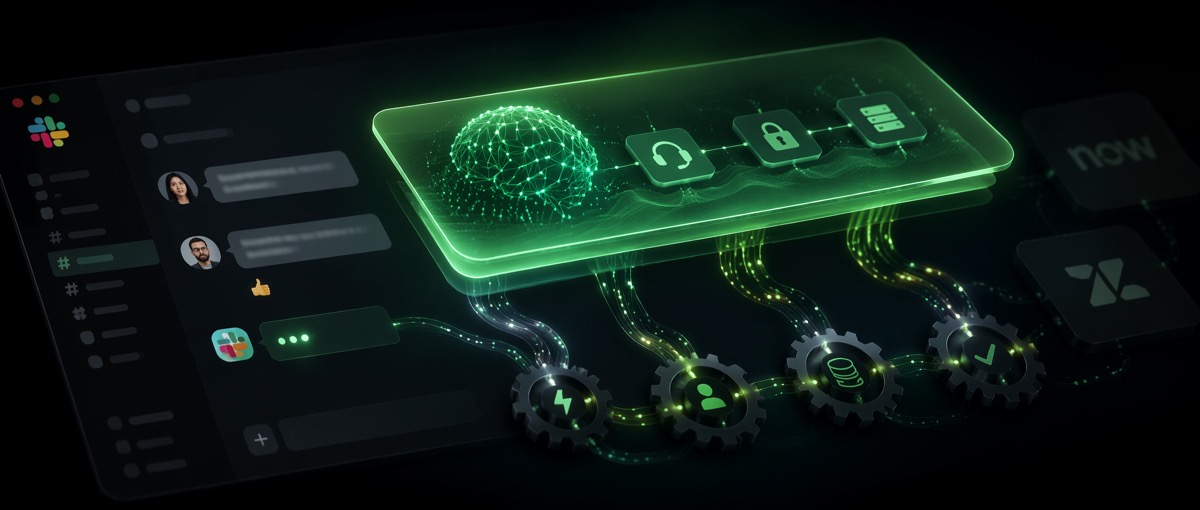
It does not replace ServiceNow or Zendesk at the system layer. It adds an AI layer at the collaboration layer, inside Slack and Teams.
Employees type “I forgot my password” or “I need Figma access” in chat. Console’s AI agent understands the request, checks user context, performs the action, and returns the result. Only complex issues the AI cannot handle are escalated to human IT.
The value of this logic is that switching cost is nearly zero.
There is no need to change the existing ticketing system, migrate data, or train every employee. Employees keep talking in Slack. The only difference is that the person replying is now AI rather than a human.
Financing Signal: A Rare Seed + Series A Rhythm
| Round | Amount | Lead Investor | Timing |
|---|---|---|---|
| Seed | $6.2M | Thrive Capital | June 2025 |
| Series A | $23M | DST Global + Thrive Capital | Shortly after |
Total: $29.2M
This financing rhythm is rare in the current capital environment. It suggests Console’s growth metrics were strong enough for investors to accelerate their bet.
The customer list is even more striking:
Scale AI, Databricks, Webflow, Cursor, Synthesia, Flock Safety, Bloomerang, Podium, Spring Health, Calendly
These are all high-growth technology companies. Not one is a traditional enterprise.
Why did these companies choose Console instead of traditional ITSM vendors?
The answer is hidden inside Thrive Capital’s portfolio. Thrive invested in OpenAI, Cursor, and Scale AI. These companies naturally have higher acceptance of AI-native products and are more willing to become paid testbeds for AI agents.
This is not coincidence. It is a deliberate investor-customer flywheel strategy by Console’s founder.
Moat: Context Graph Is the Real Barrier
You might ask: if adding an AI layer on Slack can solve IT issues, where is the technical moat? Why doesn’t Webflow just ask its engineering team to write a Slack bot?
Console’s moat lies in its core architecture called the Context Graph.
| Dimension | Traditional ITSM | Console (Context Graph) |
|---|---|---|
| Data model | Ticket-centered | Organization knowledge-centered |
| Interaction view | Isolated event | Full context |
| Learning capability | None; manually configured rules | AI automatically enriches the graph |
| Data flywheel | Not applicable | Stronger with usage |
Traditional ITSM tools treat each ticket as an isolated event. Employee A asks for access, a ticket is created, the ticket is processed, and then it is archived.
Console’s approach is completely different. It builds a knowledge graph that understands the entire organization, including each user’s device model, application permissions, ticket history, and reporting relationships. When an employee sends a request, the AI agent is not processing an isolated event. It is understanding and acting inside a complete organizational context.
That means every interaction enriches the Context Graph. The more it is used, the more complete the graph becomes, the higher the auto-resolution rate becomes, and the higher the switching cost becomes.
This is a classic AI-native data flywheel that traditional SaaS tools cannot easily replicate.
Customer Validation: “Bad to Good” Is More Convincing Than “Zero to One”
Scale AI’s IT team migrated from another tool to Console. So their story was not “from zero to something.” It was “from bad to good,” which makes the numbers more convincing.
Scale AI’s ticket auto-resolution rate
Before: 15%
After: 57%
Bloomerang’s CSAT change
Before: 84%
After: 94%
At the same time, Bloomerang added 100 employees without adding IT headcount.
The data above comes from customer cases published on Console’s official website and has not been independently audited by a third party. But the cases cite specific people and titles, which makes them more credible than generic marketing copy.
Product Breakdown: Four Modules Make Up the AI Service Desk
Module One: AI Service Desk
This is the core entry point. Employees talk directly with the AI agent in Slack. The AI automatically handles common requests such as password resets, permission requests, and device issues. Problems it cannot solve are transferred to human IT with full context included. In a traditional ticketing system, escalation usually means the user has to explain the problem again.
Module Two: Access Governance
Console automates access provisioning during onboarding and access removal during offboarding. It supports custom approval workflows and multi-factor authentication. This is one of the largest sources of manual work for IT teams.
Module Three: Proactive Playbooks
This is the most productized part of the system. IT teams can define playbooks in natural language. For example:
“When an engineer joins the company, create an Okta account, assign Figma permissions, send a welcome email, and grant access to the GitHub organization.”
Traditional ITSM systems require code or complex rule-engine configuration. Console’s playbooks can be described in natural language.
Module Four: Asset Management
Console automatically tracks and updates device status and integrates with MDM, or mobile device management, systems.
Above these four modules sit more than 600 prebuilt integrations and the Context Graph data layer. Console claims it can connect all existing application systems in 30 minutes.
Business Logic: Do Not Replace, Add On
To understand Console’s real business logic, you need to place it inside the evolution of enterprise SaaS.
For the past 20 years, the enterprise IT tools market has been dominated by ServiceNow, Zendesk, Jira Service Management, and similar giants. They are feature-rich but complex to implement. Even an experienced administrator may need weeks to configure a workflow properly.
Moveworks tried to use AI to transform this category and was acquired by ServiceNow in March 2025 for $2.85 billion. That number alone proves the value of the category.
Console chose a different route: do not replace, only add on.
Founder Andrei Serban said clearly in a TechCrunch interview:
“We don’t want to build a system that requires you to replace your help desk.”
This is extremely smart positioning:
Traditional route: sell to CIO -> need a $2 million budget -> 6-month implementation -> high risk
Console route: sell to IT manager -> try it in Slack for a few weeks -> low decision friction -> low risk
From a commercialization perspective, Console is currently fully sales-led. It has no public pricing page and routes users through a “Book a demo” flow. That is reasonable for an early enterprise SaaS company because a 500-person company and a 5,000-person company have very different pricing structures. But if Console wants to penetrate small and midsize businesses later, public pricing and a PLG motion will almost certainly become necessary.
Console’s long-term ambition goes beyond IT.
Its website already lists solution pages for HR, Finance, Legal, RevOps, and Security. All of these departments share a common pain point: large volumes of repetitive requests.
If Console can expand from the IT service desk into a company-wide employee service request management platform, its TAM could move from the tens-of-billions ITSM market to the hundreds-of-billions enterprise operations automation market.
Risk Variables: Three Unstable Fronts
ServiceNow’s Counterattack
ServiceNow’s $2.85 billion acquisition of Moveworks shows how seriously it takes AI ITSM. Console’s founder has implied that some customers turned to Console because they worried Moveworks’ product roadmap might change after the acquisition. But if ServiceNow rapidly integrates Moveworks and launches a strong competitor, Console’s early advantage could be eroded.
The Depth of the Context Graph Moat
Long enough usage can help Console accumulate deep organizational knowledge. But this data is not impossible to migrate. If ServiceNow or Zendesk launches a similar AI layer and supports importing Context Graph-like data from Console, Console’s moat will weaken.
Whether Expansion Beyond IT Can Materialize
Enterprise software history is full of companies that tried to expand from one scenario into a full platform and did not fully succeed. Slack, for example, extended from chat into document collaboration with Slack Canvas, but the result was not as strong as its core chat product. Whether Console can replicate its IT success in other departments still needs to be proven.
What Can AI Founders Learn From Console?
Lesson 1: Find the Layer Between Systems and Users
Do not fight giants head-on in their main battlefield. Find a layer between existing systems and users.
- Console chose the Slack and Teams collaboration layer.
- ServiceNow’s reach was not yet fully extended there.
- This is the digital space where employees spend the most time every day.
Lesson 2: Use Low Switching Cost to Open Enterprise Accounts
The biggest obstacle in enterprise sales is not price. It is the risk of switching to your system.
- Console’s “do not replace existing systems” strategy directly removes that obstacle.
- Andrei Serban’s background as a former Rippling product leader gave him a sharp understanding of enterprise procurement psychology.
Lesson 3: Build Moats With AI-Native Data Architecture
- The Context Graph turns every interaction into a data asset.
- Traditional SaaS cannot do this easily because its architecture is built around tickets.
- Designing around an organizational knowledge graph is what creates a real data flywheel.
Lesson 4: Turn Investors Into Customer Guides
- OpenAI, Cursor, and Scale AI from Thrive Capital’s portfolio are all Console customers.
- This is not coincidence.
- Choosing a VC that has invested in your target customer segment can create a natural distribution channel.
Lesson 5: Start With One Wedge, Then Expand Horizontally
- Console started with IT.
- Its website already prepares solution pages for HR, Finance, Legal, and Security.
- The path from wedge to platform is one of the classic expansion paths in enterprise software.
Lessons for Chinese AI Founders
The AI application ecosystems on Feishu and DingTalk are evolving quickly. If you are thinking about what kind of AI application to build on the collaboration layer of Feishu or DingTalk, Console is a textbook reference:
Find a high-frequency, high-pain scenario such as the IT service desk, use AI agents to compress the workflow dramatically, and accumulate organizational data as a moat during usage.
The Chinese market may not need another ServiceNow replacement. But it may very well need an AI assistant that solves IT issues inside Feishu.
Console proves one thing: sometimes the best strategy is not to reinvent the wheel, but to add a layer of intelligence on top of the wheel someone else already built.
That layer of intelligence is one of the biggest opportunities for AI founders in the enterprise market.
Vibe App Lab: understanding the business logic of AI products. Do fewer things that are destined to go nowhere.