
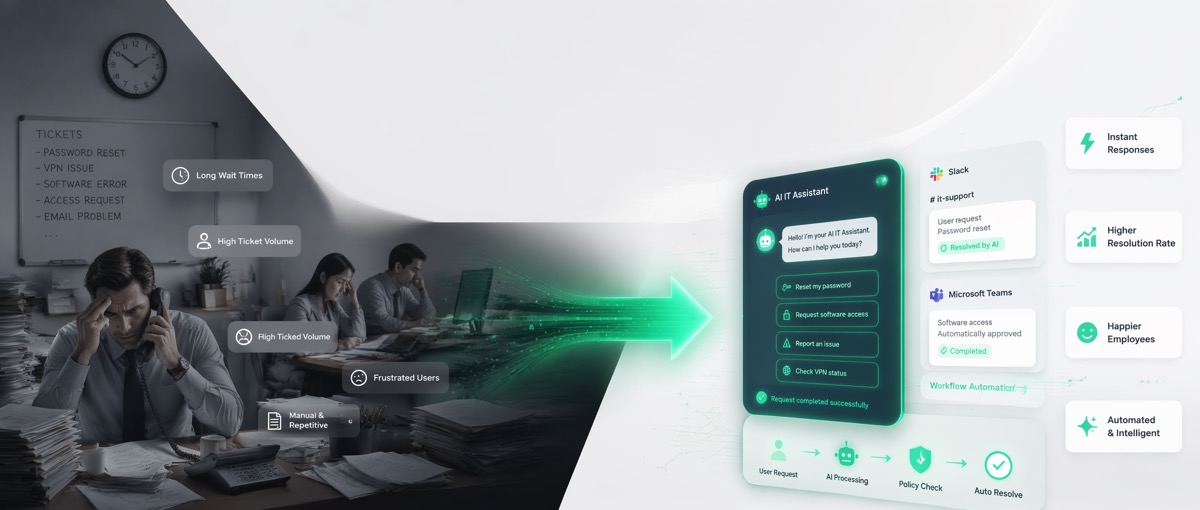
Every large company has an IT help desk. When your laptop breaks, your account is locked, or you need permission to use a piece of software, you file a ticket, wait two days, and then an exhausted IT specialist spends half an hour operating remotely.
This is one of the hidden costs every enterprise lives with. It wastes employee time, and IT departments are chronically dragged down by low-value tickets.
Over the past two years, AI agents for IT service management, or ITSM, have moved from a peripheral topic to one of the hottest enterprise software categories. In 2025, ServiceNow acquired Moveworks for $2.85 billion. In 2026, Serval raised a $75 million Series B at a $1 billion valuation. The entire category is being revalued quickly.
But inside this category, one company is older than most: Aisera.
Founded in 2018, Aisera has raised more than $164 million in total. In 2022, when the market was at its coldest, it raised a $90 million Series D led by Goldman Sachs and Thoma Bravo. Its founder previously served as an SVP at ServiceNow, and its customer list includes Zoom, Workday, McAfee, Grant Thornton, and other Fortune 1000 enterprises.
Today, we break down Aisera: how did an older player find a second curve in the AI wave? What can AI founders learn from its productization, commercialization, and growth model?
01 What Real Problem Does It Solve?
The first step to understanding Aisera is understanding how painful the enterprise IT help desk really is.
- Every large company in the world has an internal IT service desk that handles password resets, permission requests, software installation, and device repair year after year.
- The average handling cost of each IT ticket is $30-$50.
- The average resolution cycle is 2-5 days.
- Employee productivity declines while they wait, and IT teams are flooded with low-value tickets.
Aisera’s core value proposition is very direct: let employees solve IT issues through natural language in Slack, Teams, or a web portal, without filing tickets, waiting in queues, or requiring human IT intervention.
This is not a simple ChatGPT wrapper. Aisera’s product architecture includes:
- Agent Composer: a low-code AI agent builder that lets IT admins create their own agents through drag-and-drop workflows.
- Hyperflow: a cross-system workflow engine that lets agents automatically call ServiceNow, Workday, and more than 20 enterprise systems to execute actions.
- Domain-specific LLM: a domain-tuned language model optimized for IT and HR scenarios.
- Unsupervised NLU: unsupervised natural language understanding that can identify user intent without large volumes of labeled data.
In plain English: an employee says in Slack, “My laptop is too slow. Can I get a new one?” Aisera understands the request, checks the asset lifecycle, reviews budget rules, launches an approval flow, and notifies IT, without requiring a human to handle the whole process.
02 Why Did It Break Out?
Moat One: A Founder Who Knows the Field
Muddu Sudhakar is not an AI researcher. He is an enterprise software veteran:
- Former SVP at ServiceNow
- Former GM at Splunk
- Four-time founder whose companies were all acquired
That means he understands enterprise software sales cycles, including 6-18 month procurement processes. He understands CIO budget logic, which is driven by ROI. He understands the importance of system integrators and the ServiceNow ecosystem. This is the kind of tacit knowledge that a pure AI team may not learn even after three years.
Moat Two: The Art of Financing Rhythm
Aisera’s financing history is worth studying:
- 2018-2021: multiple rounds from investors including Khosla Ventures and True Ventures
- August 2022: $90 million Series D, led by Goldman Sachs and Thoma Bravo
What was the market like in 2022? Technology stocks were collapsing, and financing had entered winter. Yet Aisera completed a large round during that period.
The timing implied two judgments:
- Countercyclical financing is one of the best competitive weapons. When the market is cold, the competitors burning cash fastest are the first to fall.
- Bringing in Goldman Sachs and Thoma Bravo sends a signal to enterprise customers: “We are backed by top-tier institutions and will not disappear.”
Goldman Sachs said in the announcement that ITSM services had become commoditized and were being held back by manual intervention, and that the market was mature enough for disruption. The investment was not simply a bet on AI. It was a bet on the irreversible AI-ification of ITSM.
Moat Three: A Dual-Scenario Strategy
Most AI agent startups only focus on IT service. Aisera covers both ITSM and HR.
The strategy is clever for three reasons:
- The same AI agent platform can serve two very different departments.
- IT and HR are both high-frequency internal service scenarios inside enterprises.
- Covering HR can double account value, increase renewal rates, and make replacement harder for competitors.
Moat Four: Enterprise Integration Is the Real Moat
Aisera supports prebuilt integrations with more than 20 enterprise systems, including ServiceNow, Salesforce, Zendesk, Workday, Oracle, Atlassian, and BMC.
This is Aisera’s most easily overlooked barrier. It is not hard to make an AI agent call enterprise APIs. But passing SOC 2, clearing enterprise security review, and building production-grade integrations inside each customer’s environment usually takes 6-12 months.
When an enterprise has already spent $5 million on ServiceNow, it will not replace the entire ITSM system just to use an AI agent. Aisera positions itself as an AI layer on top of existing systems, not a replacement for them.
Moat Five: ROI Storytelling Drives Sales
Enterprise software purchasing decisions are not driven by “this feels useful.” They are driven by whether the numbers make sense.
Aisera’s customer cases all include precise ROI figures:
- NJ Transit: 60% increase in IT agent productivity
- OmniTRAX: 70% of tickets automatically resolved
- Big 5 Sporting Goods: 24,000 user hours saved per year
- Lifescan: $2.2 million in support costs saved
- BDO Canada: 72% productivity improvement
These numbers are the material a CIO can bring to the board. Aisera is not selling AI capability. It is selling ROI that can be told through numbers.
03 A Comparative View
Look at two other coordinates in the market.
Serval: The AI-Native ITSM Challenger
Serval is taking a completely different path from Aisera: not adding a layer, but rebuilding the system. It is an AI-native ITSM system designed from zero, without the legacy burden of traditional ITSM.
In 2026, Serval raised a $75 million Series B led by Sequoia at a $1 billion valuation. Its customers include AI-native companies such as Perplexity, Together.ai, and Mercor.
Its differentiation includes:
- A more modern user experience for developers and technical teams
- An AI-native architecture built from scratch, without 20 years of legacy code
- Faster deployment cycles
But Serval’s challenge is equally clear: when it enters Fortune 500 accounts, it will face the enterprise trust and security certification barriers that ServiceNow and Aisera have already built.
ServiceNow + Moveworks: The Giant’s Choice
ServiceNow spent $2.85 billion in 2025 to acquire Moveworks. It was the largest acquisition in this category.
The conclusion is obvious: ServiceNow built its own AI agent, ServiceNow Virtual Agent, but was not satisfied. It paid $2.85 billion to buy the best team and product it could find.
The signal from this acquisition is clear: AI in ITSM is not a nice-to-have feature upgrade. It is a platform-level structural change.
04 What Can Founders Learn?
1. Start From the Scenario, Not the Technology
Aisera did not build an AI platform first and then search for use cases. It locked onto ITSM and HR, two of the highest-frequency enterprise support scenarios, and built the product around those workflows.
One AI agent that does one job at 90 points is more valuable than a general platform that does everything at 60 points.
2. The Most Valuable Combination Is Industry Veteran + AI Narrative
Aisera’s founder’s ServiceNow background became its biggest trust signal. For enterprise AI products, the founding team needs people who understand the industry, not only AI researchers.
When customers buy AI products, they are buying “you understand my business,” not “your model accuracy is 99.5%.”
3. Enterprise Integration Investment Cannot Be Skipped
Integrating with ServiceNow, Workday, SAP, and other enterprise systems is both a technical cost and a competitive barrier. New entrants may need 6-12 months to catch up.
In enterprise software, stickiness and replacement difficulty do not come from AI capability. They come from integration depth.
4. ROI Storytelling Is the Universal Language of Enterprise Sales
Every Aisera case includes specific numbers. Not “improved efficiency,” but “60% productivity increase” and “$2.2 million in cost savings.”
If your product cannot let a CIO calculate ROI in three sentences, you have not yet understood enterprise sales.
5. Financing Must Survive the Cycle
Aisera raised a $90 million Series D during the 2022 funding winter, giving itself ammunition for later growth. Countercyclical financing does more than provide cash. It creates market confidence that the company will survive.
A startup’s biggest risk is not always that the product is bad. It is running out of money before the market turns.
Aisera’s story shows that the AI wave does not only belong to new companies starting from zero. It also belongs to older players that reposition themselves with the right strategy at the right time.
For AI founders, Aisera offers a useful template: how to use industry experience, financing strategy, product positioning, and ROI storytelling to find a place in a category watched closely by giants.
It may not be the fastest company in the market, but it is one of the companies still alive for the next day.