
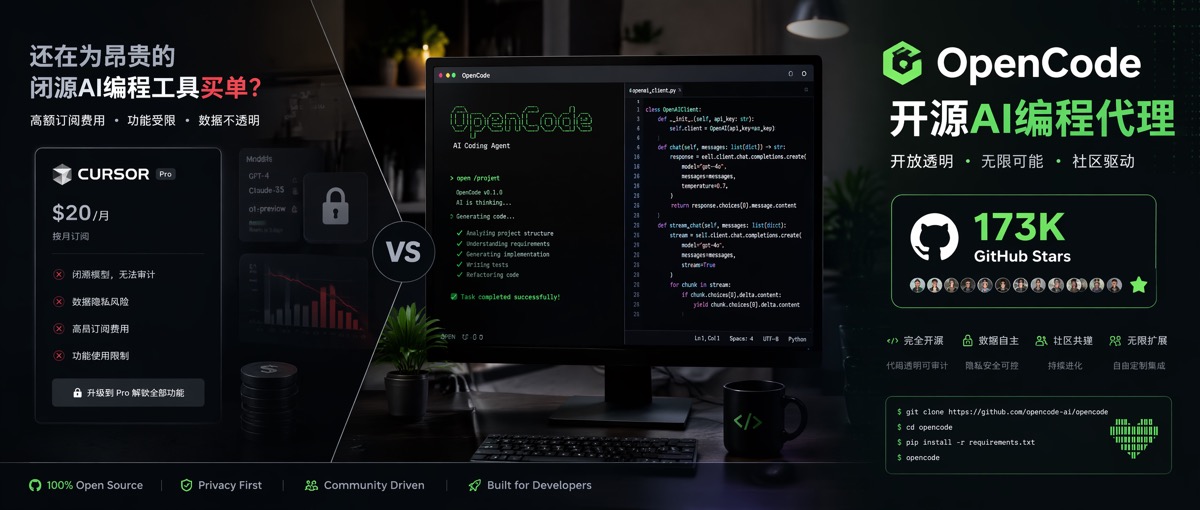
As Cursor begins charging more aggressively and GitHub Copilot remains tied to the Microsoft ecosystem, an open-source alternative is rising inside the developer community. OpenCode, an AI coding agent incubated by YC and backed by investors including Reid Hoffman and Max Levchin, has accumulated 173K GitHub Stars, 20.7K Forks, and 924 contributors over the past year.
This is not another “open-source GPT wrapper.” OpenCode’s differentiation is that it has built a full commercialization path: open-source acquisition -> paid inference -> enterprise expansion. For AI founders searching for PMF, its product strategy and monetization logic are worth studying.
Product Positioning: A Coding Agent, Not Just Code Completion
OpenCode defines itself as an “open-source AI coding agent,” not simply a code completion tool. That means it can do much more than autocomplete brackets. It understands project context, loads LSPs, supports multiple parallel sessions, and can even run terminal commands.
Installation uses one command:
curl -fsSL https://opencode.ai/install | bashAfter installation, developers can use OpenCode in the terminal, IDE, or desktop app. It includes two built-in agent roles: build, the default agent with full code modification permissions, and plan, a read-only agent for analysis and exploration that blocks file edits by default.
This two-agent design solves a real pain point. Developers want AI to help write code, but they also worry that AI will modify code recklessly. The plan agent helps them understand a codebase without changing it, lowering the psychological barrier to using AI.
Why Did It Break Out?
1. Open Source as a Growth Flywheel
OpenCode uses the MIT license, meaning developers can freely use, modify, and distribute it. In developer tools, open source itself is one of the strongest growth engines.
The 173K Stars were not bought with ads. Each star represents a developer who discovered, tried, and endorsed the product. Once a repository crosses 100K+ Stars, it enters GitHub’s trending and recommendation loops, creating organic traffic.
More importantly, open source brought 924 contributors. Contributors do not only submit code. They also spread OpenCode through their own social networks, blogs, and developer communities. Each contributor becomes a growth node.
2. Catching the Cursor Pricing Window
In early 2025, Cursor began tightening its free tier and increasing prices. Many independent developers and small teams started looking for alternatives. OpenCode filled that gap with an open-source, free, privacy-first position.
The privacy-first design is not just a slogan. Users can run it locally, and data does not need to leave their machine. For enterprise developers, that is becoming a real requirement.
3. Top-Tier Investor Signaling
OpenCode’s parent company, Anomaly, lists investors including LinkedIn co-founder Reid Hoffman, PayPal co-founder Max Levchin, YouTube co-founder Steve Chen, Y Combinator, and SV Angel.
In developer tools, that level of backing is a brand asset. When a developer sees YC and Reid Hoffman associated with a product, much of the credibility is already established.
Commercialization Roadmap: The Clever Design of Zen Inference
How does an open-source project make money? OpenCode’s answer is Zen, a curated AI model inference service optimized for coding agents.
Zen’s design logic is clear.
Pain-driven: developers can connect OpenCode to their own models, including Copilot and ChatGPT, but deciding which model to use, how to configure it, and which model performs best for coding all create decision cost. Zen provides models that the OpenCode team has tested and validated, removing that burden.
No-markup psychology: Zen says it does not add extra markup and charges by request volume, with a minimum top-up of $20. This makes developers feel, “I am only paying for model cost, not being taxed by a middleman.” In practice, Zen’s value is curation and zero configuration, not simply price.
Usage-based payment lowers the threshold: compared with annual enterprise subscriptions, request-based pricing lets individual developers try the service with $20 and continue if the experience is good.
This model is an important reference for open-source AI commercialization: the inference layer is one of the most natural monetization points for open-source AI products. Users need inference, do not want to configure models, and will pay for convenience. This is more sustainable than donations or a vague enterprise edition alone.
Moves Chinese Founders Can Copy
1. Use GitHub Open Source for Cold Start, Not Ads
OpenCode appears to have grown with very little paid promotion. Its growth came from GitHub’s open-source community. For AI developer tools, GitHub Stars can be a more effective early acquisition channel than Google Ads.
Concrete actions: open-source the core functionality, build a strong README and documentation, encourage community contributions, and participate actively in Discord, Twitter, and other developer communities.
2. Monetize Inference Before Charging for Features
In the Chinese market, willingness to pay for AI products is often concentrated around “compute consumption” rather than “software features.” Charging directly for AI features can meet resistance. OpenCode’s Zen model offers a path: keep the core software free and charge for inference usage.
It resembles the older “software free, services paid” model, but with finer granularity: the paid layer is specifically AI inference.
3. Run Bilingual Community Operations
OpenCode operates both English communities, such as Discord and Twitter, and Chinese communities, such as Feishu groups. For Chinese AI products targeting global markets, this should not be a sequential “English first, Chinese later” decision. Both communities should be built from the beginning.
Feishu groups have unique reach among Chinese developers and can be more effective than Discord in the Chinese market.
4. Use Fast Iteration to Build Trust
OpenCode released 820 versions in less than two years, averaging a release every few days. For developer tools, commit frequency and release cadence are visible quality signals. The 14,044 commits tell users the product is alive and actively maintained.
Advantages and Luck That Are Hard to Copy
1. YC Ecosystem Leverage
YC backing is not only money. It includes Demo Day exposure, the YC alumni network, and information sharing among founders. Ordinary startups cannot easily reproduce that.
2. Investor Names as Trust Assets
Reid Hoffman, Max Levchin, and Steve Chen have extremely high trust inside the developer community. Their presence on a website can be more persuasive than many marketing claims.
3. Timing Window
OpenCode’s growth coincided closely with Cursor’s pricing changes. If Cursor had not raised prices sharply in 2025, OpenCode’s growth might not have been as fast. Timing windows do not appear on demand.
Risks to Watch
- Zen’s margins may be thin. If Zen truly adds no markup, gross margin depends on OpenCode’s bargaining power with model providers. Early on, Zen may function more like an acquisition cost than a profit center.
- Open-source competitors are catching up. Cline, Aider, and other open-source coding agents are also growing quickly. Open source is both an advantage and a weakness because switching costs can be low.
- Model API policy risk. If OpenAI or Anthropic tightens API policies around agentic applications, Zen’s model supply could be affected.
- Enterprise willingness to pay remains unproven. Enterprises still need to be convinced that an open-source product is worth an enterprise fee.
Summary
OpenCode shows a clear path for AI product entrepreneurship: use open source to earn trust and traffic from the developer community, convert that traffic into revenue through inference services, and expand upward through enterprise offerings.
For Chinese founders looking for PMF, the lesson is not mainly the technical architecture. It is the open-source -> community -> inference -> enterprise growth logic. In the AI-native era, open source is not the enemy of commercialization. It can be the most precise acquisition engine.
Data note: This article uses data from the GitHub repository anomalyco/opencode, accessed on June 11, 2026, plus OpenCode’s official website, Anomaly’s website, and AICPB’s global AI ranking. GitHub Stars are public real-time data. Product descriptions are based on official documentation.