
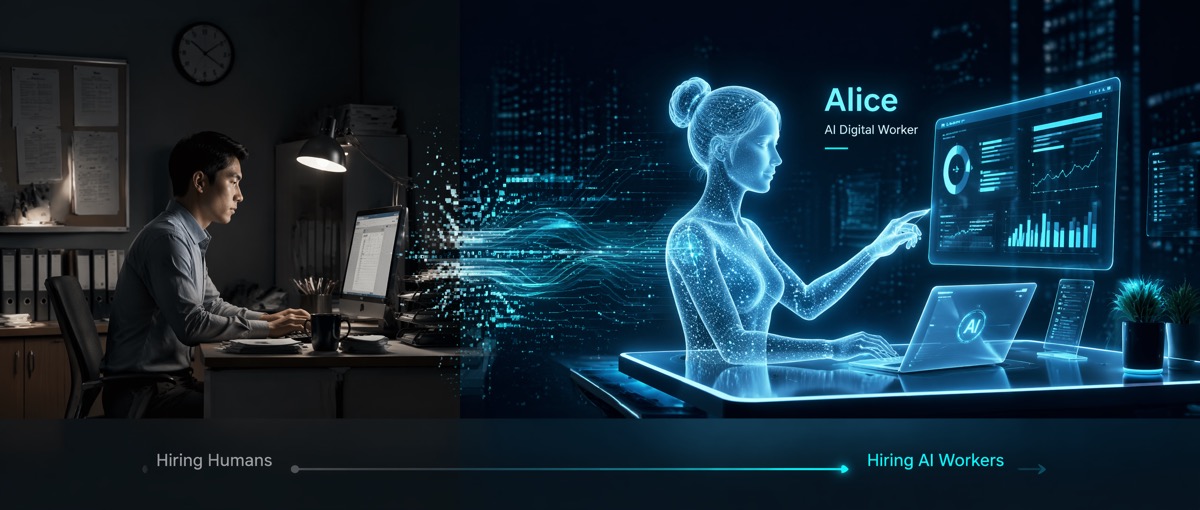
Do you remember when you first started feeling “AI product fatigue”?
In 2024, almost every article talked about “AI assistants,” “AI copilots,” and “AI co-drivers.” ChatGPT was an assistant. Claude was an assistant. Perplexity was an assistant. Even design, coding, and project-management products were all calling themselves assistants or copilots.
But in 2025 and 2026, a new category quietly emerged: AI digital workers.
Not helping you do work, but doing work for you. Not your copilot, but your employee. Not something you “use,” but someone you “hire.”
11x.ai, at 11x.ai, is a representative of this new paradigm. The UK company, founded around 2022, does not position itself as an “AI sales assistant.” It created two hireable AI employees:
- Alice, an AI sales development representative who finds leads, personalizes outreach, and books meetings.
- Julian, an AI phone agent who handles calls and customer communication.
While other AI companies were still debating whether they were copilot or autopilot, 11x.ai asked customers a more direct question: “Do you want to hire someone?”
At first glance, this may look like a marketing difference. But deeper down, it touches a fundamental product question: should AI products imitate tools, or should they imitate people?
1. From Tool to Worker: A Paradigm Shift in Positioning
Compare two sets of language:
| Traditional AI Product | 11x.ai |
|---|---|
| “Use ChatGPT” | “Hire Alice” |
| Start trial, learn features, use | Post a job, Alice starts working |
| Pricing by tokens or seats | Pricing by “worker,” implicitly benchmarked against human salary |
| Users learn how to operate the product | Users only tell Alice what to accomplish |
This is not wordplay. It changes the starting logic for product architecture, pricing, user expectations, and competitive moats.
Most AI products inherit the logic of SaaS tools: you buy software, learn its interface and features, then manually use it to complete work. Even with AI added, it is still “a tool with AI features.” You tell AI what to do, check the output, and manually handle exceptions.
11x.ai’s product logic is different: you hire an employee. She has a name, Alice. She understands your business, works proactively, keeps learning, and is online 24/7.
From the user’s perspective, these are two completely different mental models. The same monthly fee sits in very different psychological accounts when it is framed as “buying a tool” versus “hiring a person.”
Key insight: In the tool mindset, users constantly evaluate ROI, compare switching cost, and benchmark features. In the employee mindset, if output exceeds cost compared with a human SDR, the “hire” is rational.
This positioning is a redefinition of AI productization: not making AI easier to use, but making AI more like a person who can take ownership of work.
2. What Do Alice and Julian Actually Do?
Start with the product, not the theory.
Alice, the AI SDR, covers the full B2B sales-development workflow:
- Market monitoring: tracks every potential customer in the target market and detects buying signals.
- Precise outreach: uses deep research to personalize messages across channels such as email and LinkedIn.
- Lead activation: identifies high-intent behaviors such as website visits, job changes, or solution searches, then follows up immediately.
- Dead-lead revival: reactivates dormant leads in the CRM.
- Market expansion: supports 105 languages to help companies enter new markets.
The website’s language is more direct: “Alice is not a sales tool. She is your 24/7 revenue engine.”
Julian, the AI Phone Agent, adds voice outreach. He learns from every call, adapts to business needs, and maintains customer relationships around the clock.
Together, the two form a complete GTM, or go-to-market, digital-worker team.
From a product-architecture view, 11x.ai chose a strategy of going deep on one role. It first used Alice to prove product-market fit in the SDR role, then expanded to Julian. It did not begin with a grand “multi-agent platform.”
3. Commercialization: ROI Is the Best Sales Material
11x.ai does not publish a pricing page. That itself is a signal: this is a sales-led SaaS company.
But customer case studies on the website reveal interesting numbers:
- 1.5x pipeline increase
- More than $1M pipeline generated by one AI worker
- 35% of pipeline sourced by Alice
If we assume a mid-level SDR earns $50,000 to $80,000 annually, then after hiring, training, management, and overhead, the first-year cost can easily exceed $100,000. If an AI SDR is priced at several thousand dollars per month, it is a fraction of the human alternative.
More importantly, Alice does not take holidays, resign, need training, or require management. She can work at full speed on day one. This “hiring” economics is hard for a rational sales leader to ignore.
Key insight: For AI products, the pricing anchor should not be technical cost such as API calls or compute. It should be the human replacement cost. 11x.ai’s “fraction of the cost of a human SDR” logic anchors value to HR cost.
The commercialization path is also clear: from one worker in one team, to multiple workers, to company-wide expansion. This is similar to traditional SaaS expansion, but because the unit is labeled as a “person,” every expansion feels like “hiring another worker,” which is naturally understandable.
4. Moat: Where Is the Barrier for AI Workers?
11x.ai’s moat can be understood in three layers.
Layer one: integration depth. Alice integrates with the full GTM tech stack, including CRM, email, LinkedIn, and analytics. Once those integrations are deployed, switching cost becomes high because replacing Alice means replacing the workflow.
Layer two: learning accumulation. An AI worker gets smarter with use. Alice’s personalized messaging model, industry understanding, and customer-interaction history are all accumulated over time and data. Competitors cannot copy that overnight.
Layer three: brand cognition. 11x.ai is trying to own the mental category of “digital workers.” If “Hire Alice” becomes common industry language, later entrants automatically become competitors to Alice rather than the category definer.
But the risks are also real. Artisan, with Ava AI BDR, is doing something similar. Foundation-model companies such as OpenAI and Anthropic could also launch AI sales agents directly, pressuring 11x.ai from above.
5. Reusable Lessons for AI Founders
Lesson 1: The Hiring Logic Is Not Just Marketing
When you position an AI product as a hireable worker rather than a usable tool, your product architecture changes. A tool interface is a control panel. A worker interface is a chat window plus task goals. Tools require users to operate them. Workers require users to define outcomes.
Action to copy: Re-examine your product positioning. If it is a B2B product, consider whether the AI can be defined as a digital employee rather than a feature. Use “hire” instead of “subscribe.” Use “role” instead of “feature list.”
Lesson 2: Build One Super Worker Before Expanding Into an Agent Platform
11x.ai did not start with a broad “multi-agent collaboration platform” narrative. It built Alice, the SDR, proved the role, then added Julian, the phone agent.
Action to copy: Choose one specific role, one specific job, and one specific workflow. Make it excellent. Only after that role is established should you consider expansion.
Lesson 3: ROI Storytelling Can Beat PLG
11x.ai is sales-led, but it achieved something PLG often cannot: every customer can become a quantifiable ROI case. “Alice generated more than $1M in pipeline for us” is stronger than almost any acquisition copy.
Action to copy: Collect measurable ROI data from early customers. Do not only say “efficiency improved.” Say “saved X hours,” “increased revenue by Y%,” or “reduced cost by Z%.”
Lesson 4: Persona Is Product
Alice and Julian are not just names. They are role designs with personality, skills, and ways of working. This humanization turns AI from a cold function into a collaborator and helps users move from “using a tool” to “working with a colleague.”
Action to copy: If you are building an AI agent product, give the agent a name, a role, and a persona. This is not childish brand marketing. It helps users build the right mental model.
6. Keep Watching
11x.ai represents a new path for AI productization: not building more useful tools, but building workers that feel more like people.
This direction deserves attention from every AI founder. Is your AI product a tool, an assistant, or a worker users can hire directly?
The answer changes the logic of product, pricing, and growth.
Note: This analysis is based on public information from 11x.ai’s website as of June 2026. Pricing strategy, user data, and related metrics are reasonable inferences unless officially disclosed.