
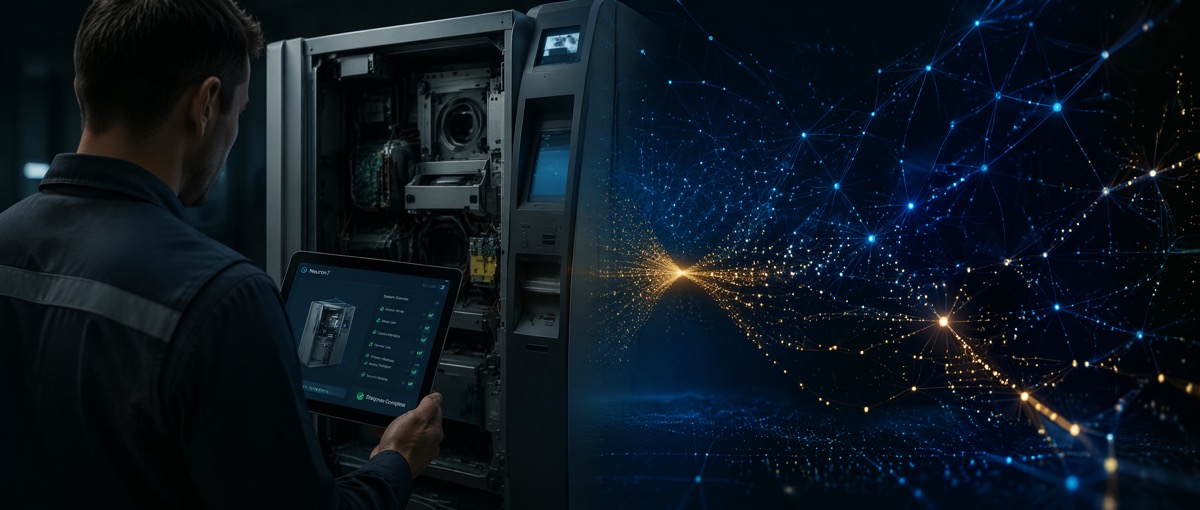
If I said there is an AI company whose goal is to help technicians repair ATMs without calling the veteran expert, your first reaction might be: how large can such a narrow market be?
That question is exactly why the company is worth studying.
It is called Neuron7, a name most readers outside enterprise service may not know. But its product logic and commercialization path may be among the most useful AI startup cases to study right now.
A “No Guessing” AI Agent
Neuron7’s core product is called Neuro. Its users are not consumers or programmers. They are field service engineers. When a CT scanner, telecom base station, or industrial machine breaks, a technician can enter a failure description into Neuro and receive a diagnosis, repair steps, and required parts.
This may sound like a vertical ChatGPT wrapper. It is not.
The essential difference is architecture. CEO Niken Patel told SiliconAngle: any system that fabricates information is unacceptable in critical service scenarios.
General AI agents, including ChatGPT and Claude, are probabilistic systems. They are good at guessing the most likely answer. That is acceptable when writing email or generating code. But when the question is “why is this MRI machine not working?” guessing is not acceptable.
Neuro uses a hybrid architecture of deterministic guidance plus autonomous reasoning, according to SiliconAngle’s November 6, 2025 coverage:
- when the enterprise knowledge base contains a known answer, Neuro uses deterministic algorithms to provide a precise result with no guessing
- when the issue is new and has no historical record, Neuro shifts into autonomous reasoning based on its understanding of the equipment
The switch is not a black box. The system indicates whether it “knows” the answer or is reasoning from available evidence. That transparency is a critical trust mechanism in enterprise settings.
Quantifiable Customer Validation
The hardest task for any B2B AI product is proving it is not just nice to have. Neuron7 has two public customer cases:
- Ciena, a networking technology company: Neuro-powered AI agents improved issue resolution speed by 46%
- Translogic, a motorcycle electronics transmission technology company: saved 960 warranty labor hours and achieved 96% diagnostic accuracy
These figures come from a PR Newswire release on November 6, 2025.
The “960 warranty labor hours” figure is especially important. In repair operations, warranty labor is a direct cost the company pays. Saving 960 hours is not vague productivity rhetoric. It is money on the income statement.
Commercialization: Classic B2B Sales-Led Growth
Neuron7 does not publish pricing. Its website pushes leads toward “Request a Demo.”
That implies a sales-led growth model:
industry content and events build awareness, such as the report AI Projects That Aren’t Failing; sales teams follow up with large customers in manufacturing, medical devices, and telecom equipment; deployments are customized and continuously optimized; customer success creates case studies that drive the next wave of sales.
For AI products with potential annual contract values in the hundreds of thousands or millions of dollars, SLG is the right choice. Not every AI product needs to be PLG.
Moat Analysis
1. Data flywheel. Every repair outcome feeds back into the system. The agent becomes more accurate with use. Competitors can build technology from scratch, but they cannot acquire years of repair-history feedback overnight.
2. Deep integration. Once Neuron7 connects to enterprise knowledge bases, product manuals, CRM, and ticketing systems, switching costs become high.
3. Compliance barriers. Enterprise security certifications make procurement more comfortable with existing certified vendors.
4. Domain knowledge. Foundation models such as Meta Llama 4 are fine-tuned on proprietary enterprise data. General models cannot replace that context.
5. Brand positioning. If Neuron7 becomes synonymous with “repair AI,” later entrants must spend heavily to win the same mental category.
Four Lessons Worth Taking
Lesson one: accuracy beats autonomy.
This is Neuron7’s most counterintuitive product decision. In the 2025 and 2026 AI wave, almost every agent startup emphasizes autonomy: how much can the agent do independently? Neuron7 says the differentiator is not doing more, but doing it correctly.
For enterprise AI, “does not do the wrong thing” can command a higher premium than “does many things.” If an AI agent is wrong once in 100 attempts, the cost of that one mistake may outweigh the value of the other 99 correct actions, especially for medical device companies or telecom operators.
Lesson two: do not build “general AI minus something.” Build “vertical workflow plus something.”
Many founders think: ChatGPT can do 100 things, so if I restrict it to three things, I have a product.
Neuron7 moves in the opposite direction. It does not subtract from general AI. It adds the architecture a specific scenario needs. The team reportedly tried RAG first and found it insufficient, then redesigned around deterministic plus probabilistic behavior.
The product lesson is clear: do not start with AI and search for a scenario. Start by understanding the failure modes the scenario cannot tolerate, then design AI to avoid them.
Lesson three: tribal knowledge capture is a powerful moat.
Neuron7 is essentially turning the tacit knowledge inside senior engineers’ heads into reusable system knowledge.
That is a strong but underappreciated value proposition. When experienced employees retire, their knowledge often disappears. Products that systematically capture and reuse this tribal knowledge create barriers that are difficult to copy.
Lesson four: B2B AI should go narrow before going broad.
From the launch of Neuro in November 2025 to May 2026, its public customer cases remain concentrated in equipment repair and field service. It has not rushed into enterprise support or IT operations, even though those categories look adjacent.
That restraint is an early-stage advantage. Every new customer adds data in the same scenario. Data quality improves. Product depth grows. Only after truly mastering repair should horizontal expansion begin.
Closing Thought
Neuron7 may not become the next OpenAI. Its total addressable market is not as broad as general-purpose assistants.
But it is doing something smarter: in a market large enough, global equipment repair is worth hundreds of billions of dollars, and narrow enough that few people apply AI deeply to it, Neuron7 is becoming hard-to-replace infrastructure.
For AI founders, the biggest lesson may be this:
When everyone is digging for gold, you can sell shovels. But when everyone is selling shovels, maybe you should fix ATMs.
Sources: Neuron7 website, SiliconAngle coverage from November 2025, and PR Newswire’s November 2025 release. Customer data comes from official releases and has not been independently audited.