
While everyone watches Sora’s cinematic video generation, a London company founded in 2017 has quietly signed more than 100 Fortune 100 companies and reached a $4 billion valuation.
Synthesia’s success is not a victory of AI models alone. It is a classic case about choosing the right scenario.
A Counterintuitive Opening
In October 2025, Adobe reportedly offered Synthesia a $3 billion acquisition check.
Synthesia refused.
In the AI industry, that decision looked almost counterintuitive. 2025 was one of the most crowded moments in AI video. OpenAI’s Sora was iterating, Google’s Veo was catching up, and Chinese tools such as Kling, Jimeng, and Hailuo were fighting aggressively. A rational founder might think: sell near the valuation peak and avoid the battle.
But founder Victor Riparbelli saw the market differently.
His judgment was simple: AI video generation had no final winner yet, and Synthesia had found a distinct path. It was not helping directors make movies. It was helping enterprises save money.
That difference was worth more than $3 billion.
They Chose a “Not Sexy Enough” Scenario
Open Synthesia’s product pages and you see a completely different species from Runway, Pika, or Kling.
Those products show “a prompt generates a Hollywood-like scene.” Synthesia shows “generate an enterprise training video in three minutes.”
The former pursues visual spectacle. The latter pursues workflow compression.
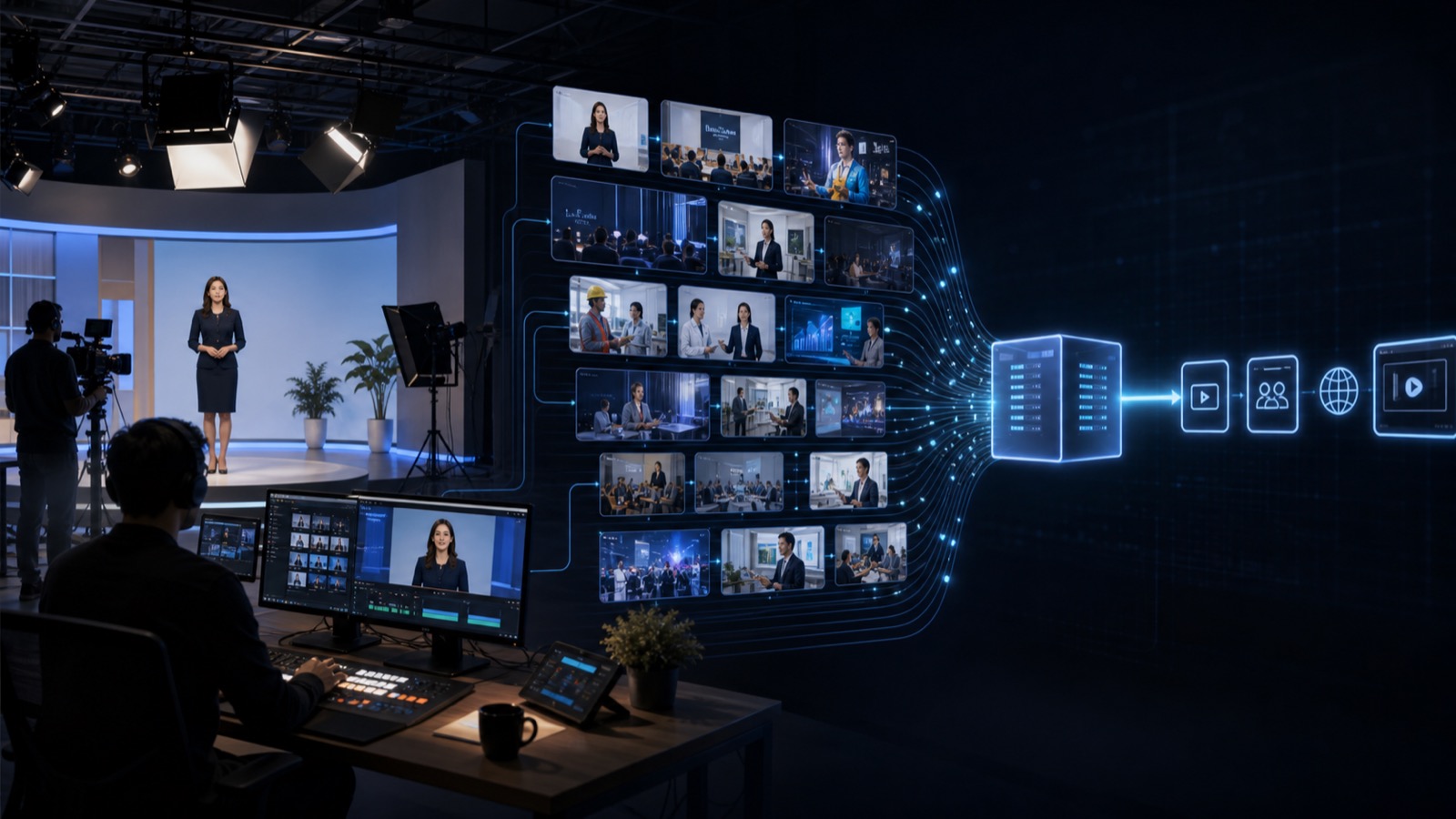
What does it take to make a traditional enterprise training video?
Write a script, hire actors, rent a studio, shoot, edit, translate into multiple languages, distribute. The cycle starts at four weeks and can cost from thousands to hundreds of thousands of dollars.
Synthesia compresses the chain into one step: enter text, choose an avatar, click generate.
More than 160 languages can be switched with one click. No actors, no studio, no editor.
This may look less cool, but it is the basis of commercialization. Enterprises pay to save money, and enterprise budgets are far larger than consumer budgets.
The Commercial Flywheel: Free Acquisition, Compliance Lock-In, Custom Renewal
Synthesia’s growth flywheel deserves close study.
First loop: free PLG as funnel.
Synthesia’s free version lets users generate a first video at zero cost. The strategy itself is not novel. The important point is that AI video has extremely high instant gratification. Seeing an avatar speak your script within minutes creates its own sharing impulse.
Second loop: compliance unlocks enterprise procurement.
Hidden among free users are enterprise decision makers. When their need shifts from “try it” to “deploy across the company,” SOC 2, GDPR, ISO 42001, SAML, and SSO become decisive.
Many AI startups view compliance as baggage in the early days. Synthesia built it into infrastructure early. As a result, while competitors were still saying “SOC 2 is coming next quarter,” Synthesia could sign UBS, Amazon, and IHG.
Third loop: custom avatars create lock-in.
Once an enterprise creates digital avatars for executives, embeds brand kits, and integrates with SCORM-compatible learning management systems, switching is no longer just changing software. It means recreating executive avatars and rebuilding training assets.
That lock-in gives Synthesia pricing power.
Five Copyable Moves
1. Choose the Scenario Before the Product
Synthesia did not try to prove that its model was better than Sora. It proved that in enterprise training, no one reduced cost better.
For AI founders, the trap is building around capability boundaries: “my model can generate video.” The better path is building around user pain: “enterprise training videos are too expensive; I reduce the cost by 90%.”
2. Turn Compliance Into a Barrier
Many AI startups wait until Series B to think seriously about SOC 2. Synthesia built compliance from early enterprise customers onward. As AI enters enterprise procurement, compliance is not a cost. It is the ticket. The earlier you have it, the earlier you can reach large customers.
3. Free Is Not Charity. It Is a Funnel
Synthesia’s free plan is not there to let users take value without paying. It lets enterprise users discover product value before speaking to sales. When a user moves from trial to internal rollout, the sales opportunity appears naturally.
4. Use Case Studies Instead of Feature Lists
Synthesia’s website does not lead with endless feature tables. It leads with customer stories: how UBS trains employees with AI analysts, how IHG standardizes global hotel training. Selling outcomes beats selling features.
5. Resist Short-Term Temptation and Build a Platform
From a single AI avatar tool to assistants, analytics, and SCORM integrations, Synthesia’s product expansion is systematic. Each acquisition offer is a fork: sell and cash out, or keep building. The founders chose the latter.
Four Advantages That Are Hard to Copy
1. Entering in 2017 and Surviving the AI Winter
Synthesia was founded in 2017, before “generative AI” became a mainstream phrase. It spent years refining technology, collecting data, and understanding enterprise needs. By the time ChatGPT ignited the AI wave in late 2022, Synthesia had already been running for five years.
That time window cannot be bought.
2. London’s Slower Rhythm
The London AI ecosystem’s advantage is lower competitive pressure. Without the same “grow fast or die” pressure from Silicon Valley, Synthesia could refine product and enterprise-service capabilities at its own pace.
3. $320 Million in Capital
From $50 million in 2021 to $90 million in 2023 and $180 million in 2025, Synthesia has raised more than $320 million. In capital-intensive AI video, that funding lets it invest in R&D, teams, and enterprise customer acquisition at the same time.
4. The Signal Amplifier of Rejecting $3 Billion
Refusing Adobe became a brand event. Media coverage signaled that the company had strong confidence in its independent growth path. That signal itself became marketing no competitor can easily reproduce.
Lessons for Chinese AI Founders
The most important lesson from Synthesia is not technical architecture. It is the courage to choose the right scenario.
In China’s AI video market, attention focuses heavily on generating visuals closer to Hollywood. Synthesia proves another point: enterprises pay large amounts to save money, and “saving money” and “looking beautiful” can be different product paths.
Similar underexplored enterprise scenarios may include:
- internal training videos
- multilingual product videos for cross-border commerce
- batch and personalized marketing content
- AI video replies for customer service
These scenarios do not require “a better video generation model” as much as they require a video product that understands enterprise workflows.
Synthesia spent eight years proving a simple truth: in the AI era, choosing the right scenario can matter more than owning the best model.
Data note: Sources include Wikipedia references to TechCrunch, Reuters, Forbes, The Times, Fortune, and Financial Times reporting. Synthesia’s specific ARR is not public. Market analysis reflects interpretation based on public information.