
In 2025, a simple post on X lit up the tech world.
“This feels like the most human-like assistant of any product I’ve tried. You really have to use it to understand.” That was the essence of the recommendation from product advisor Greg Isenberg.
The product was Lindy: an AI execution assistant with no standalone app, accessed through iMessage and SMS.
Soon Lenny Rachitsky, Andrew Wilkinson, Zain Kahn, and other tech influencers began recommending it. Lindy’s user base took off.
This is not a ChatGPT or Midjourney story. It is a case about a product quietly changing the definition of “assistant.”
The most useful lesson is that Lindy’s productization may matter more than its AI technology.
1. What Problem Does Lindy Solve?
Knowledge workers spend enormous time on administrative labor: roughly 2.5 hours a day on email, one hour scheduling meetings, and another half hour writing follow-ups.
That is not deep work. It is administrative work.
The traditional solution is hiring an assistant. But a human assistant starting at $3,000 per month is not affordable for every knowledge worker.
AI makes a different option possible.
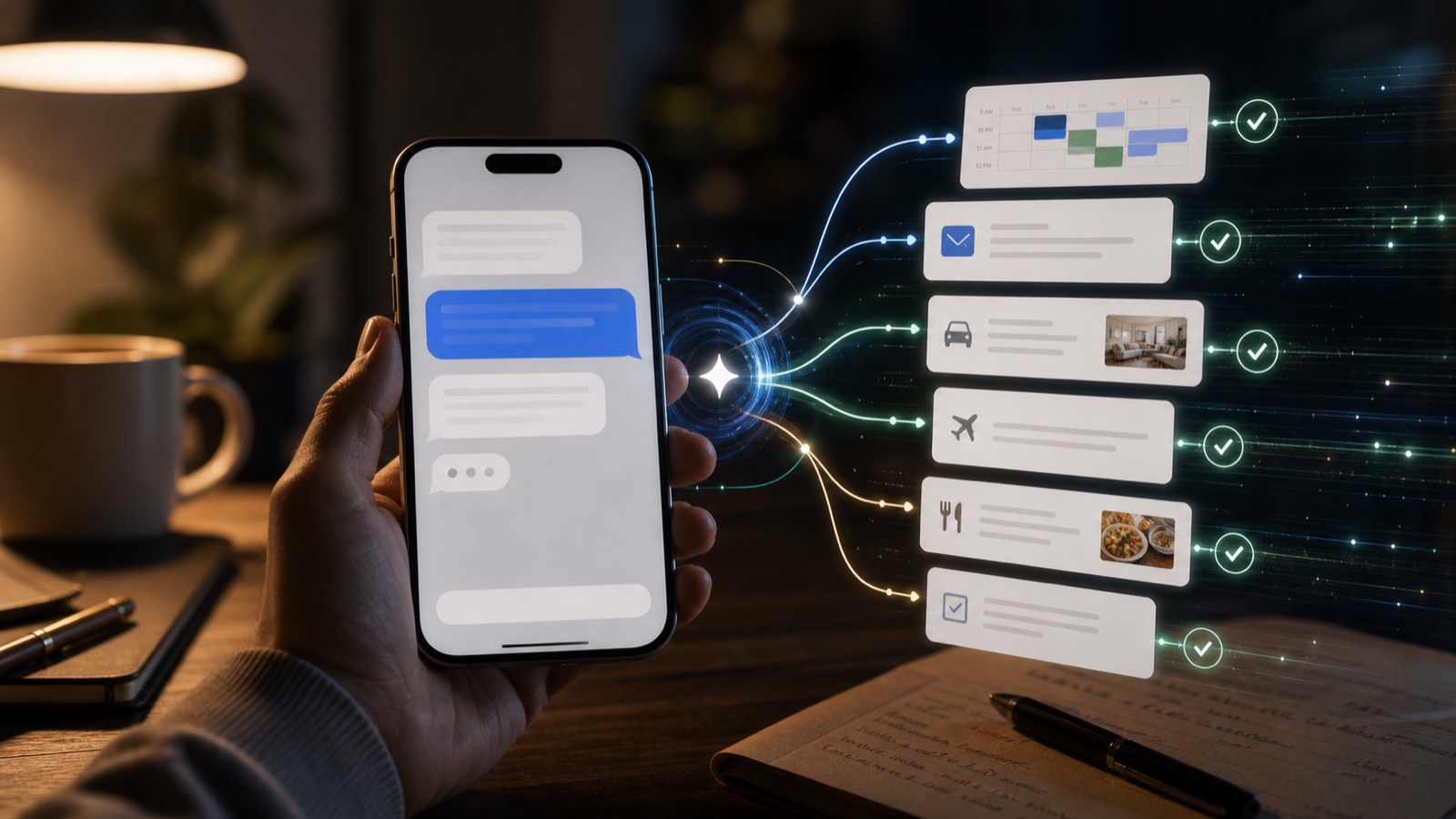
Lindy focuses on a specific job: through iMessage or SMS, it helps manage inboxes, schedule calendars, prepare meetings, and follow up on tasks.
It is not another AI chatbot. It behaves more like an assistant that works proactively.
You say, “check what urgent emails I have today.” It reads the inbox, analyzes priority, and drafts replies.
You say, “schedule a meeting with Mark on Wednesday afternoon.” It checks calendar availability, finds a time, and sends an invite.
The key distinction: Lindy is not only waiting passively for instructions. It learns your style and suggests actions.
2. What Makes the Productization Special?
The most important product decision is that Lindy did not build an app.
The default instinct for AI products is to create an app, PWA, or web app. Lindy chose iMessage, an interface users already open dozens of times a day.
That means:
- zero download friction, because every iPhone user already has iMessage
- zero learning cost, because if users know how to text, they know how to use Lindy
- high-frequency triggers, because assistant messages appear in the chat list rather than disappearing into another app
The second productization highlight is that it adapts like a person.
Most AI products ask users to teach them through rules, parameters, and prompts. Lindy reverses the burden. Once connected to email and calendar, it observes reply style, time preferences, and common phrasing. Within hours, it can start drafting replies that sound like the user.
The third highlight is deep integration rather than isolation.
Lindy is not only an email assistant. It connects Gmail, Outlook, Google Calendar, Slack, Notion, and other tools. That allows cross-app actions in one conversation, such as “email the project plan discussed in Slack to the team,” without forcing the user to switch tools.
3. How Does It Make Money?
Lindy’s pricing is smart because it anchors to labor cost, not software cost.
A human assistant starts around $3,000 per month. Lindy’s paid plans sit from tens to hundreds of dollars per month. The user’s psychological calculation becomes: less than one-tenth the price of a human assistant for a large share of the function.
The pricing ladder is clear:
- Human Assistant: free, basic trial functionality
- Plus, Pro, Max: paid plans with increasing functionality for individual power users
- Enterprise: sales-led tier with team management, SSO/SCIM, audit logs, and HIPAA compliance
From individual to team to enterprise, the expansion path is straightforward.
4. How Does Lindy Acquire Users?
Lindy’s growth formula is surprisingly simple:
Build a great product. Influential people discover it. They recommend it. Their audiences try it. Some of those users become the next distribution nodes.
The execution has three parts.
1. Choose the right seed users. Lindy did not begin with broad advertising. It let tech influencers become early heavy users. Recommendations from people such as Greg Isenberg and Lenny Rachitsky bring hundreds of thousands of high-intent users.
2. Give the product a shareable hook. “An AI that manages my email through iMessage” is inherently easy to describe. A user posting “Lindy saves me two hours a day” is more effective than paid copy.
3. Build SEO for long-tail demand. Lindy’s blog targets searches such as “Best AI Assistants 2026” and “AI Email Management Tools,” creating an organic search funnel.
5. What Chinese AI Founders Can Learn
Lesson One: Interaction Innovation Beats Feature Stacking
Too many AI products accumulate features: email, calendar, documents, analysis, and more. They become broad but forgettable.
Lindy does one thing, assistant work, but makes the interaction exceptional by using iMessage. It feels like talking to a real assistant.
One correct interaction design can create more differentiation than ten feature releases.
Lesson Two: Price Against Labor Cost
AI pricing should not only reference SaaS competitors. It should reference the human service it replaces.
A human assistant costs $3,000 per month. Lindy at $99 per month feels like a bargain.
If the reference point is another app at $29 per month, the user thinks in software terms. If the reference point is labor, the user thinks in value terms.
Lesson Three: Let the Product Speak
Lindy appears to spend little on traditional advertising. Its growth engine is influencer social proof.
The condition is that the product must actually be good. In the AI era, mediocre products are hard to hide. But a product that creates a genuine “wow” moment spreads faster than ever.
Lesson Four: Design for Proactivity, Not Passivity
Lindy’s design philosophy is that a good assistant should not require the user to specify every step.
It learns style, scans email, and suggests replies proactively. That sense of initiative is what separates an AI agent from a traditional chatbot.
Risks to Watch
Lindy’s moat is not fully established. If Google deeply integrates similar functionality into Gmail, Calendar, and Messages, Lindy faces pressure.
Data security is also a hidden adoption cost. Entrusting all email and calendar data to an AI agent is not something every company will accept.
Still, regardless of how far Lindy goes, its productization ideas are already worth studying: interaction innovation, labor-cost pricing, and proactive AI design.
Closing Thought
AI products can easily fall into technical competition: whose model is better, whose latency is lower, whose parameter count is larger.
Lindy reminds us that users do not care what model you use. They care what problem the product solves, how simple it is to use, and whether it is worth the price.
If you can answer those three questions clearly, your AI product is already halfway there.
This analysis is based on public information. Lindy’s user count and ARR are not public, and some points are reasoned estimates. Sources include Lindy’s product pages, pricing pages, blog, and public X posts.