
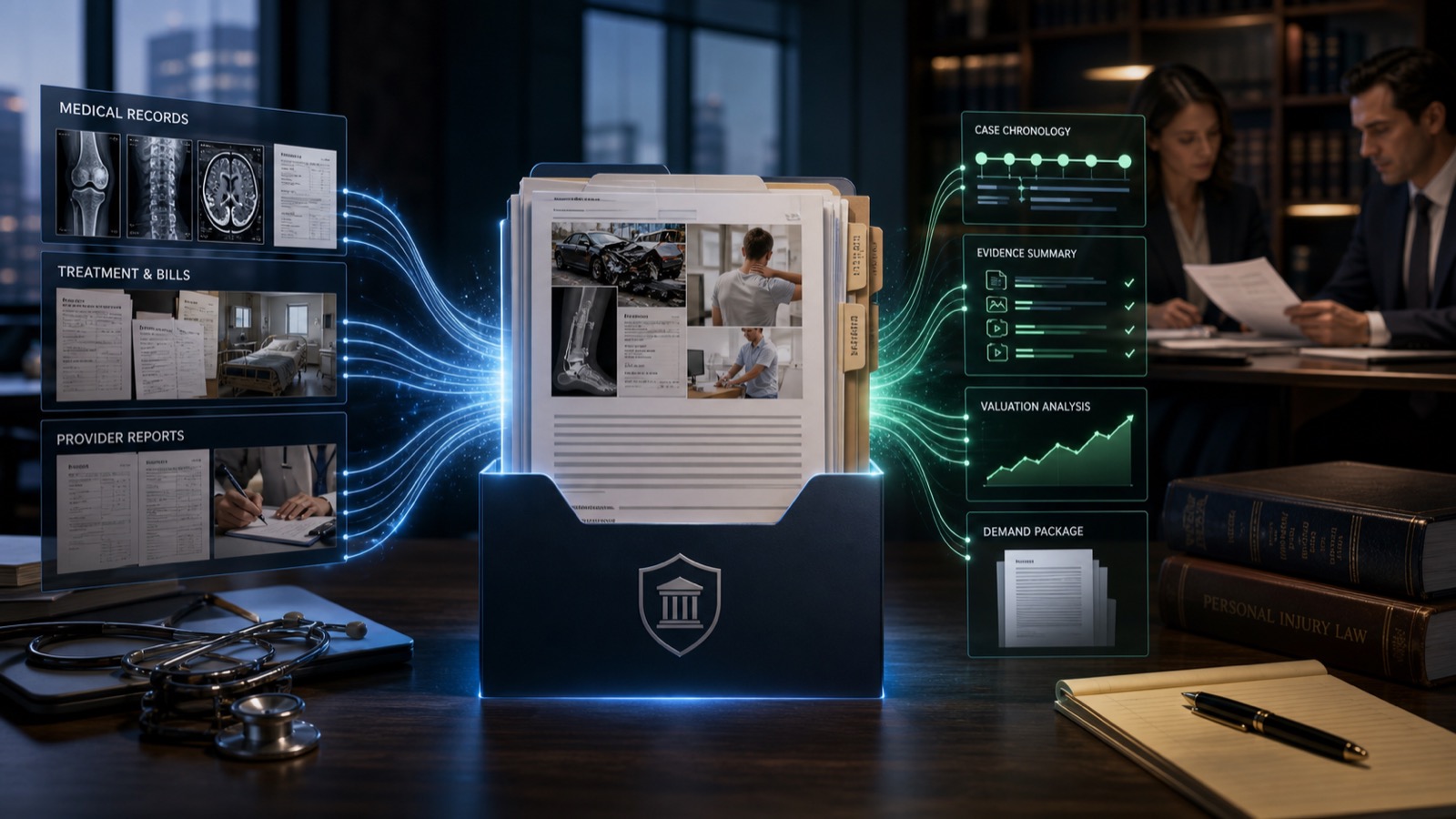
In AI legal tech, most founders are still debating how to use LLMs to write contracts or perform legal research. But the real dark horse has already become a unicorn in a non-consensus market.
In October 2024, EvenUp completed a $135 million Series C and crossed a $1 billion valuation. It does not help large law firms draft complex M&A agreements, and it does not compete in generic legal chat assistants. It focuses on one extremely vertical, almost unglamorous field: demand packages for medical claims in personal injury law.
Why can such a narrow wedge support a billion-dollar valuation? What does it teach today’s AI founders?
1. Pain Point: Lawyers Buried Under Medical Records
In the United States, personal injury litigation, including car accidents and workplace injuries, is a huge market. To obtain compensation from insurance companies, lawyers must submit one critical document: the demand package.
This is not a few pages. Behind it are thousands of pages of medical records, bills, rehabilitation documents, and testimony. In the past, a paralegal might spend 20 to 40 hours extracting useful details such as ICD diagnosis codes from piles of medical PDFs and turning them into a logically tight claims narrative.
Because the process is so painful, lawyers often face two choices: hire more people, or skip some claim items for the sake of speed. This is the bottleneck document EvenUp found.
2. Product Power: From Cost Reduction to Revenue Expansion
EvenUp’s core product, Piai, gets two things right and lifts AI’s value from “useful tool” to “money printer.”
First, it is a workflow compressor.
EvenUp integrates deeply with legal-industry ERP systems such as Litify and CASEpeer. Lawyers do not need to upload files manually. EvenUp pulls raw medical records from the system backend and produces a demand-package draft within 15 minutes that can be submitted to a court or insurance company.
Second, it is a claim-value amplifier.
This is EvenUp’s core barrier. Its AI model does not merely summarize text. It identifies details human assistants may miss, such as a minor complication code or the highest comparable jury verdict in a specific jurisdiction.
EvenUp says cases using its product are 69% more likely to reach the policy-limit settlement.
When a product directly helps customers earn 20%-30% more money, pricing becomes a much easier conversation.
3. Business Model: It Sells Certainty, Not AI
Many AI startups fail because of hallucinations and trust gaps. How does EvenUp address that?
It adds a human-in-the-loop layer.
All EvenUp outputs are reviewed by professional legal teams. This “AI rough processing plus expert refinement” model removes lawyers’ anxiety about AI accuracy. In a high-liability, high-contract-value industry, accuracy is the product’s greatest capability.
EvenUp now processes more than 10,000 cases per week. It is not only a software company. It looks increasingly like a claims factory with a massive private data asset.
4. Founder Lesson: Go After the Bottleneck Document
EvenUp’s path is a classic “old tree, new flowers” case. It was founded in 2019 and broke out after the 2024-2026 AI shift.
-
Find high-value vertical documents. Do not build generic summarization. Find documents where the business cannot close without that output.
-
Anchor pricing to ROI. If your product saves customers $100, you may charge $10. If it helps them earn $100 more, you may charge $30 or more.
-
Integrate deeply instead of replacing. Do not ask lawyers to replace their CRM. Become the “magic button” inside the CRM.
Conclusion: In the AI era, the biggest opportunities may not come from finding entirely new problems. They may come from using AI-native logic to reconstruct vertical workflows that were digitized but never automated.
Data notes and disclosure:
- Funding: $135 million Series C led by Bain Capital Ventures, sourced from TechCrunch reporting in October 2024.
- Claims data: 10,000 cases per week and 69% policy-limit settlement lift are EvenUp official disclosures and have not been independently audited.
- Product positioning: This is an “old tree, new flowers” case: the company is more than three years old, with breakout growth driven by technical reconstruction.