
Vibe App Lab | 2026-05-11
Over the past two years, we have seen countless AI tools launch. They share one trait: they ask users to learn new skills.
Learn prompt engineering. Learn how to talk to AI. Learn how to tune parameters for better output.
Recently, however, a small product in the AI visualization category chose the opposite path.
It is called Napkin AI. It was founded in 2023, has no massive financing round, and has no celebrity-founder halo. Yet the same line appears repeatedly in user feedback:
“This is the most surprising AI tool I have used, because I do not need to think about how to use it.”
1. A Counterintuitive Product Philosophy
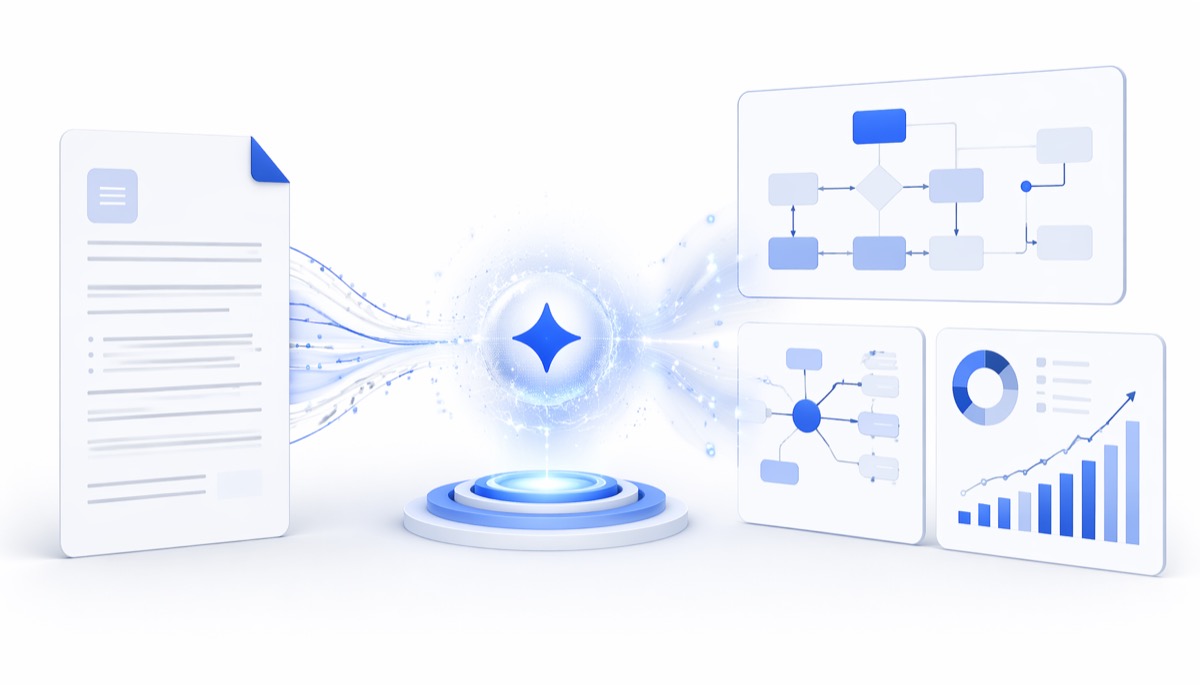
Napkin does something simple: it turns existing text into visual diagrams.
But it made a decision most AI products are afraid to make: remove the prompt.
Users do not need to write “please generate a flowchart.” They do not need to adjust temperature. They do not need to revise prompts again and again.
They paste existing text, click once, and the diagram appears.
This may not sound technically impressive. But that decision hits a neglected real pain:
Business users do not need “more powerful AI.” They need fewer steps.
Project managers need to report progress. Sales teams need to present proposals. Teachers need slides. They already have text. They lack a visual that makes the point obvious at a glance.
Napkin understood that.
2. The Courage to Subtract
What is the easiest mistake for AI products to make? Feature bloat.
They can draw, write, code, make videos, and do everything, which often means they are not excellent at anything.
Napkin chose the opposite route:
- It does not build general AI image generation. That is Midjourney’s battlefield.
- It does not build AI writing. That is Jasper’s battlefield.
- It does one thing: business text to visual diagrams.
And it pushes that one thing deeply:
- Generates diagrams in 60-plus languages.
- Exports to PPT, PNG, PDF, and SVG.
- Includes brand-color management.
- Supports real-time team collaboration.
This is not a lack of functionality. It is strategic focus.
3. The Business Intuition Behind Pricing
Napkin’s pricing model also shows restraint.
It uses credit-based pricing, aligned directly with AI inference cost:
- Free: 500 credits per week, roughly 500 words of generation.
- Plus: 10,000 credits per month.
- Pro: 30,000 credits per month plus optional top-ups.
This model has three advantages:
- Cost control: the company does not lose money through unlimited usage.
- User friendliness: people pay for usage instead of unused feature bundles.
- Natural upgrades: when credits run out, upgrading feels reasonable.
Compared with AI products that promise unlimited usage for a flat monthly fee, Napkin’s pricing is more honest and more sustainable.
4. Growth Flywheel: Let the Output Advertise the Product
Napkin has not relied on massive advertising. Its growth engine is built into the product:
User creates a diagram with Napkin -> exports it to PPT, LinkedIn, or a report -> colleagues or customers see it -> someone asks “how did you make this?” -> a new user registers.
Every chart created with Napkin is a moving billboard.
This product-led growth pattern is not new among AI tools, but Napkin executes it cleanly:
- Free-version exports carry a Napkin watermark.
- High-quality diagrams create curiosity.
- The watermark drives new users to the website.
The product output completes acquisition without paid media.
5. What Others Can Learn
1. Removing the usage barrier matters more than adding capability.
Napkin did not pursue the most powerful AI model. It pursued the fewest steps.
Insight: Users do not care how strong your model is. They care whether they get the desired result within three seconds.
2. Focus on a narrow category and avoid the giants’ battlefield.
Napkin does not compete in general AI image generation. It focuses on business visualization.
Insight: Winning a niche that big companies ignore can be smarter than fighting in a red ocean.
3. Pricing must align with cost structure.
Credit-based pricing makes Napkin’s business model sustainable.
Insight: AI pricing must connect to inference cost. Otherwise, scale can make losses worse.
4. Let the product speak for itself.
Napkin’s growth comes from the diagrams users publish.
Insight: The best marketing is when user output becomes your advertisement.
6. Risks and Uncertainty
We should be honest: Napkin still faces several unknowns.
- No public funding data: commercial scale remains uncertain and may still be early.
- Big-company threat: Canva or Microsoft Copilot could add similar features quickly.
- Technical moat: AI visualization generation may not have a very high technical barrier.
- Retention: will users keep using it, or is this a one-time “wow” experience?
These uncertainties are common to early AI products.
Conclusion
Napkin AI’s biggest lesson may be summarized in one sentence:
The best AI products do not make users say, “AI is so powerful.” They make users say, “I did not know it could be this simple.”
While many AI tools compete on model parameters and feature count, the product that makes users forget AI exists may be the one that truly wins.
Disclaimer: Product features and pricing are based on the napkin.ai website. User reviews are from website-displayed testimonials and have not been independently audited. Napkin AI has not publicly disclosed ARR, MAU, or funding data. Commercial scale remains to be verified. Competitive analysis is the author’s judgment and does not constitute investment advice.